

Foreign Protestants Expelled from Turkey: The ECLJ Denounces a Systemic and Discriminatory Policy Before the ECtHR
Foreign Protestants Expelled from Turkey: The ECLJ Denounces a Systemic and Discriminatory Policy
In written observations submitted to the European Court of Human Rights (ECtHR), the European Centre for Law and Justice (ECLJ) warns of a Turkish administrative practice specifically targeting foreign Protestant Christians engaged in peaceful religious activities in Turkey. The joined case Wilson v. Turkey, comprised of twenty applications, could become a landmark case for the protection of religious freedom in Europe.
Hundreds of missionaries, pastors, biblical scholars, and supporters of Turkish Protestant churches have been expelled from Turkey. Yet they had been residing there legally for twenty, thirty, sometimes even thirty-five years, and missionary activities are perfectly lawful under Turkish law. These measures are based on simple administrative security codes used to classify foreign Protestants as threats to public order or national security.
The practice of classifying Protestants as threats intensified considerably after the attempted coup of July 15, 2016. Using the state of emergency established by Erdoğan’s government, the Turkish authorities developed an especially broad security-based approach targeting not only Gülenist circles and political opponents, but also certain religious minorities and foreign Christian missionaries.
The case of American evangelical pastor Andrew Brunson marked a turning point. Despite living in Turkey for more than twenty years, Brunson was arrested in 2016 and accused of having ties to terrorist organizations and espionage. His imprisonment for nearly two years created a serious diplomatic crisis between Ankara and Washington until his release in 2018.
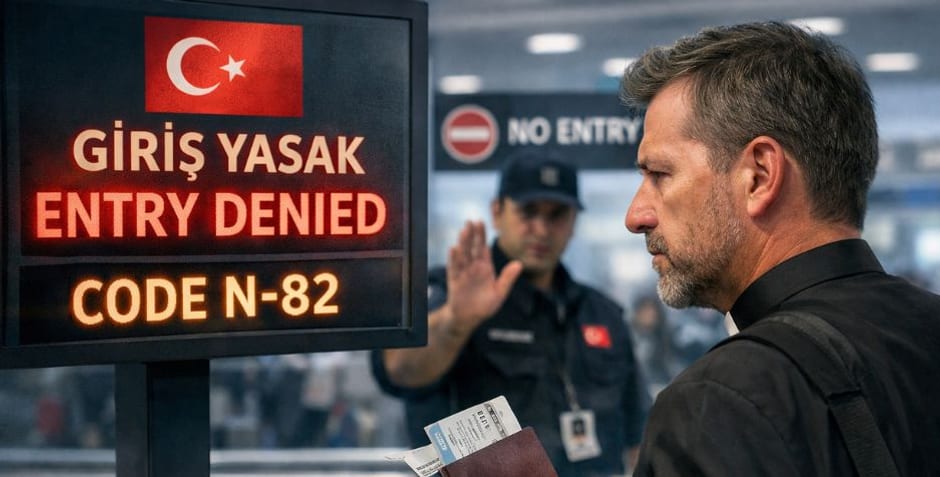
Since then, the Turkish authorities have favored more discreet methods than direct criminal prosecution, using the N-82, G-82, or G-87 codes. “Entry subject to prior authorization” is accompanied by cancelled residence permits, rejected visa renewals, and banned re-entry after temporary departures from the country. Hundreds of foreign Protestants thus find themselves arbitrarily de facto expelled, if not de jure, without judicial conviction or adversarial proceedings.
A Systemic Policy Denounced at the European Level
According to the Association of Protestant Churches of Turkey (TEK), at least 178 foreign Protestants were targeted between 2019 and 2025, affecting approximately 380 people in total when spouses and children are included. They had built families there, raised their children, and devoted their lives to supporting local Christian communities. Some discovered they had been banned from returning at the airport, after a mere family or professional trip abroad.
The European Centre for Law and Justice (ECLJ) raised the alarm with members of the European Parliament, who adopted a resolution on February 12, 2026 condemning these expulsions (see our article published in Le Journal du Dimanche). A few weeks later, the European Commission likewise called on Turkey to respect its obligations regarding religious freedom and effective judicial guarantees.
Following our intervention before the European Court of Human Rights in the Wiest v. Turkey case, we have now intervened in twenty new joined applications (Wilson and Others v. Turkey). Each case reveals the same underhanded administrative practices based on the N-82 and G-82 security codes. In our observations, we emphasize that these cases go far beyond the traditional framework of immigration litigation. They reveal the existence of systematic and discriminatory administrative practices specifically targeting foreign Protestants engaged in peaceful and lawful missionary or pastoral activities.
Religious Activities Treated as a Security Threat
Before the Court, the ECLJ recalls that the activities attributed to the applicants represent the very heart of religious freedoms protected by Article 9 of the European Convention on Human Rights: evangelization, Bible teaching, organizing Christian gatherings, ministerial support, or participation in religious conferences.
Moreover, none of the applicants has been convicted of terrorism, violence, or incitement to hatred. The Turkish authorities rely essentially on broad definitions of “national security” without providing concrete evidence accessible either to the individuals concerned or to their lawyers. The authorities’ decisions are based primarily on confidential reports from the Turkish intelligence services (MIT), which are kept secret during internal proceedings.
The ECLJ also highlights a central legal point: unlike other rights guaranteed by the Convention, Article 9, Paragraphe 2 does not mention “national security” among the legitimate grounds permitting restrictions on religious freedom. The Court had already emphasized this point in the Nolan case, holding that states cannot invoke abstract security considerations to restrict peaceful religious activities.
The ECLJ believes that these measures could amount to a “misuse of power” within the meaning of Article 18 of the Convention combined with Article 9. Under the guise of national security, the Turkish authorities are in reality seeking to limit foreign Protestant missionary activities in Turkey. These measures concern not only the individual fate of the applicants; they also affect the future of local Protestant communities suddenly deprived of support.
This “national security” policy forms part of a broader climate of hostility toward Christians in Turkey, documented in our report The Persecution of Christians in Turkey. In it, we denounce the persistence of institutional discrimination, hostile rhetoric, violence, and administrative pressure targeting Christian communities — Orthodox, Armenian, Catholic, and Protestant alike — as well as converts and foreign missionaries. In its present state, the recurring comparison of Protestant missionary activities to threats against national security reflects a systemic mistrust toward the Christian presence in the country.






 China: Pastor Cao Must Come HomeBy ECLJ
 Tunisia: Christians Facing Kais Saied’s Identity-Driven ShiftBy Constance Avenel
 Syria: Christians left Behind?By Thibault van den Bossche
 The EU Condemns the Systematic Persecution of Christians in PakistanBy Thibault van den Bossche