
Iraqi Christians: The Story of a Community Under Pressure
Iraqi Christians: The Story of a Community Under Pressure
Over two decades, the Christian population of Iraq has plummeted by 85%. Descendants of the Assyrians and Babylonians, heirs to one of the oldest civilizations in the world, face an unrelenting series of ordeals that makes the choice to remain on their ancestral land harder with each passing day.
The conflict between Israel and Iran has not spared Iraq, and the autonomous region of Iraqi Kurdistan, in the north of the country, is bearing the full brunt of the consequences. The Kurdistan Regional Government (KRG), caught in a vice due to its geographic position and the convergence of strategic interests, has become, against its will, a theatre of tensions. In this context, Christians once again find themselves on the front line. Ankawa, a Christian municipality in Erbil, the capital of Iraqi Kurdistan and the heart of Christian presence in the country, lies only a few hundred meters from the American military base at Erbil International Airport, a proximity that has made it collateral damage.
Drone attacks carried out by Shiite militias damaged several buildings belonging to the Chaldean Archdiocese of Erbil, including the Blessed Michael McGivney apartment complex and the convent of the Chaldean Daughters of Mary Immaculate. The Nineveh Plain was not spared either. This region, located to the east and north of Mosul, encompasses several historically Christian towns such as Qaraqosh, Bartella, Karamlesh, Telkief, and Alqosh, and remains one of the most complex territories in northern Iraq. Falling under the Nineveh Governorate, it sits at the boundary between the spheres of influence of Baghdad and the Kurdistan Regional Government. While some towns are administered by Kurdish authorities, others fall under the federal government or are marked by the presence of various armed groups. In this particularly sensitive context, the city of Bartella was also struck, this time by American airstrikes.
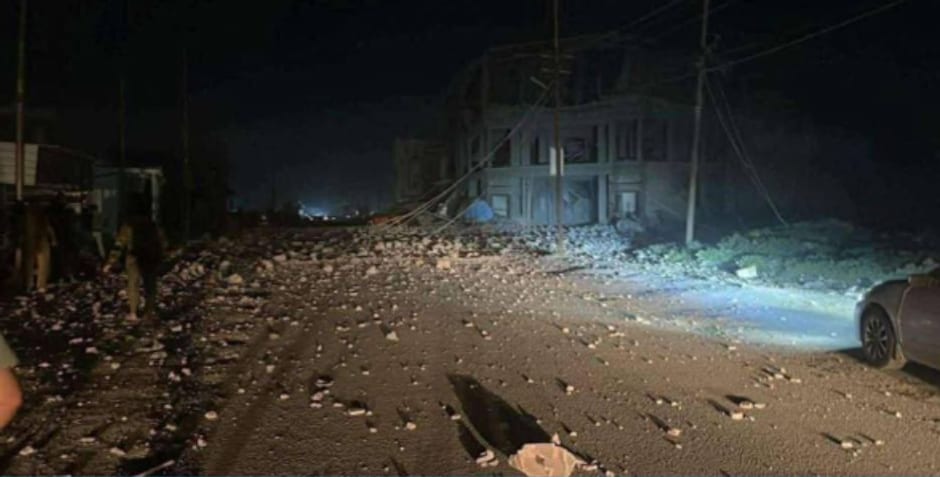
Ville de Bartella, située dans la province de Ninive, touchée par des drones américains en mars 2026
Unlike past ordeals, there is today no clear front line, no place to take refuge. Missiles are unpredictable and can strike anywhere. A diffuse and invisible threat, bearing down once again on a community that never seems to stop paying the price of war.
A Community on the Brink of Extinction
Iraqi Christians are not merely a religious minority; they constitute an indigenous people whose identity is sustained through the use of “Sureth,” a Neo-Aramaic language still spoken in liturgy and in daily life. “Iraqi Kurdistan,” and in particular Ankawa in Erbil, as well as the Nineveh Plain, are home to a mosaic of communities. These include the Chaldean Church of the Eastern Catholic rite, the largest in Iraq; the Assyrian Apostolic Church of the East, whose patriarchal seat is established in Erbil; the Ancient Church of the East (which split from the Assyrian Apostolic Church of the East in 1964); the Syriac Catholic and Orthodox Churches; and Armenian minorities who are descendants of the exoduses of the early twentieth century. Their disappearance would not be a mere demographic shift, but the end of a civilization rooted in history.
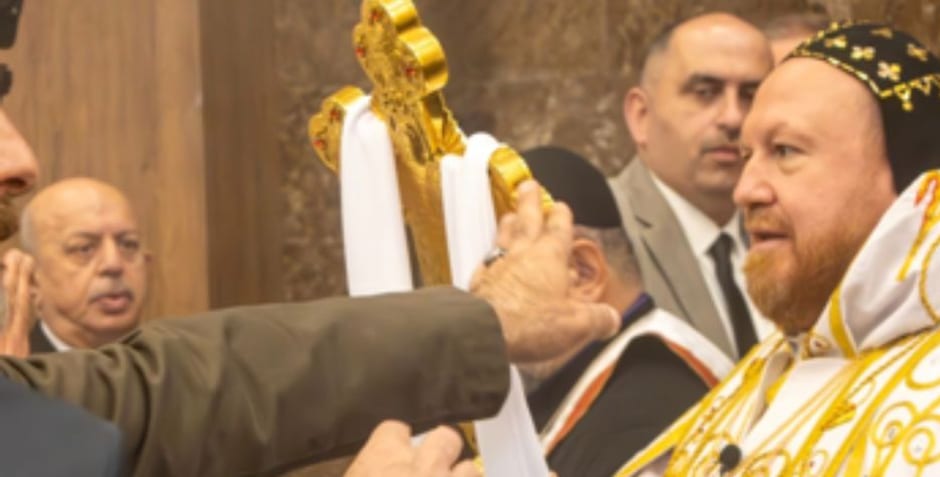
Messe de Pâques à la cathédrale syriaque orthodoxe Notre-Dame de la Lumière à Ankawa, célébrée par Monseigneur Nicodemus Daoud Sharaf
As the ECLJ noted in May 2025, the presence of these Christians in Iraq is threatened with extinction. Before the American invasion of 2003, they numbered approximately 1.5 million. Since then, they have been subjected to indiscriminate violence. First came, in the 2000s, a wave of targeted violence and kidnappings; then, in 2014, the conquest of the Nineveh Plain by the Islamic State, which triggered a massive exodus toward the West and neighboring countries. According to a press release from Aid to the Church in Need (ACN) dated July 2024, only 250,000 remain because of this ongoing decline, a drop of 85% in two decades.
Today, Christians live with a persistent sense of not truly being at home on a land that has been theirs for millennia. Forced to communicate in Kurdish and Arabic rather than in Sureth, they face a form of institutional marginalization. In January 2025, the Iraqi Federal Parliament adopted amendments allowing Shiite Muslims to have their family matters adjudged outside of unified civil law, under Jafari jurisprudence, an illiberal Islamic legal framework already applied in Iran. As the ECLJ has previously documented, these amendments have had a direct impact on minority rights regarding marriage, inheritance, and personal status. Faced with this accumulation of crises, discrimination, and invisibility, many no longer see a possible future on their land.
The Yazidis: A Recognized Genocide, a Community Still in Peril
Christians are not the only ones to have paid the price of jihadism in Iraq. The Yazidis, an ethno-religious minority whose syncretic beliefs were deemed heretical by the Islamic State, were subjected to atrocities of unimaginable barbarity. They were victims of massacres; women and children were sometimes reduced to sexual slavery, and many of their communities were destroyed. In August 2014, the Islamic State’s onslaught on the Sinjar Mountains in northwestern Iraq forced more than 100,000 of them to flee. The violence perpetrated by this jihadist group against the Yazidis does not amount merely to religious persecution, but to genocide. In May 2021, a special UN investigation team announced that it had gathered clear and convincing evidence to that effect, a conclusion since shared by some twenty international organizations and parliamentary bodies.
Yet international recognition has not been enough to secure a future. Only a few thousand Yazidis have returned to Sinjar. Others still live in displaced persons camps. Like Christians, they embody the fate of those minorities that no one truly protects, and whose survival on their ancestral land remains, day after day, an open question.
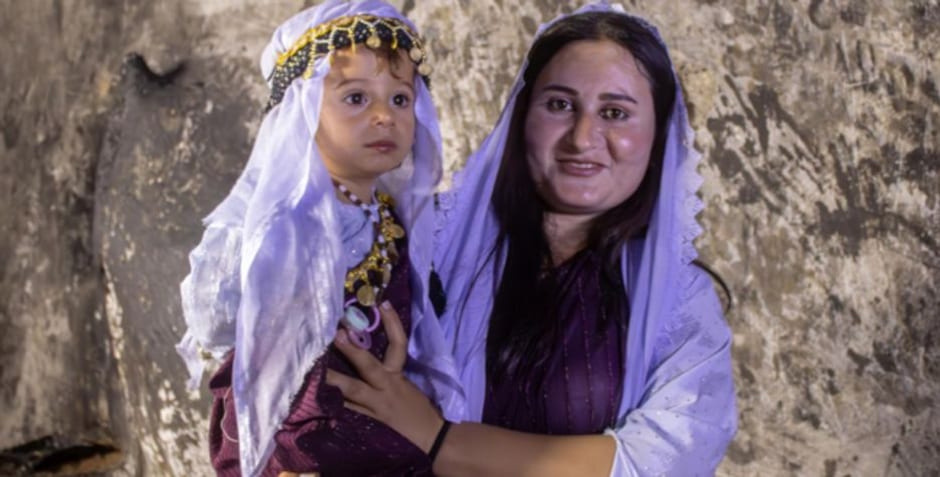
Fidèles yézidis à Lalesh, haut lieu de pèlerinage dans les montagnes du nord de l’Irak (crédit: SOS Chrétiens d’Orient)
An Autonomous Region, Fragile Institutions
Since 2005, the “Iraqi Kurdistan” has enjoyed autonomous status, enshrined in the Iraqi Constitution, which grants it nearly all the attributes of a state: a president, a government, a parliament, an army, security services, and border control. On paper, this region holds almost all sovereign powers. In practice, this entity in the making suffers from deep structural weaknesses that jeopardize what some call “the wild dream of Kurdish independence.”
The political system, officially pluralistic, is tightly controlled by the two historic parties, the Kurdistan Democratic Party (KDP) and the Patriotic Union of Kurdistan (PUK), which have shared power for decades. Corruption is endemic, eating away at the electoral process itself. According to multiple interviews conducted in the field, the secrecy of the ballot is not guaranteed. In practice, citizens are reportedly aware that their choice could be revealed after the vote. This exposes them to pressure and effectively forces them to vote for an “imposed” candidate. Under these conditions, the pluralism on display amounts more to a facade than to democratic reality.
At the federal level, five Christian members of parliament sit in the Iraqi Parliament in Baghdad, a representation that is essentially symbolic, with very limited real room for maneuver. Met at his constituency office in Erbil, despite sitting in the Iraqi Federal Parliament in Baghdad, Kaldo Oghanna, leader of the Christian Soyana bloc, paints a bleak picture of the Christian presence in Iraq. Faced with this reality, he stresses the need to encourage young people to develop economic and entrepreneurial activities, viewing the Iraqi public sector as out of reach for many. Indeed, certain positions can require up to $20,000 to obtain, with no guarantee of employment. The lawmaker also criticizes Article 26 of the national identity card law, which provides for the automatic registration of minor children as Muslims whenever one of their parents is Muslim. This applies to cases where a Muslim marries a Christian woman, or when a Christian parent converts to Islam after the birth of children. From that point on, the children can no longer be officially registered as Christians, even if the other parent remains one.
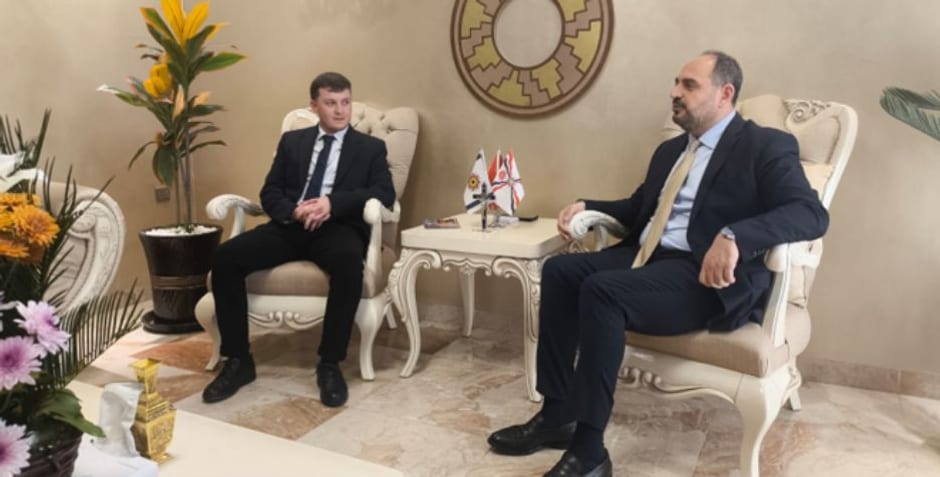
Rencontre avec M. Kaldo Oghanna dirigeant du bloc chrétien Soyana au Parlement de Bagdad (à gauche Antonin Dubois, chef de mission Irak pour SOS Chrétiens d’Orient, à droite Kaldo Oghanna, député irakien)
This political marginalization is not confined to Baghdad. It is also evident in the Iraqi Kurdistan Parliament, where minority representation was significantly reduced following the 2024 electoral reform. Whereas eleven seats had previously been reserved for minorities, the Iraqi Federal Supreme Court abolished this quota system, after which only five seats were reallocated to the various minority communities. Christians, Turkmens, and Armenians must now share this reduced representation within a Parliament dominated by the two main Kurdish parties. Under these conditions, elected officials from minority communities have limited room to advocate for their communities’ interests and to influence decisions that directly affect their future.
Stay or Leave: An Existential Dilemma
For Iraqi Christians, the question is no longer simply how to live on their ancestral lands, but whether remaining there is still possible when they are exposed to persistent insecurity, marginalization, and uncertainty. Yet to yield to departure is to contribute to the erasure of a millennia-old presence and, with it, a language, a culture, and an entire civilization. For Iraqi Christians are not only the heirs of a faith. They are the descendants of the Assyrians and Babylonians, among the last living speakers of Aramaic.
This dilemma is all the more acute given that the vast majority of Iraq’s Christian population now lives in the diaspora in France, Australia, the United States, Germany, and Sweden, among other countries. This network serves both as a safety net and as a pull factor. Over the years, the exodus has become a normalized reality. What is needed now is to normalize the return.
This is precisely the bet made by the association The Return, founded by Dilan Adamat, who grew up in France while part of his family remained in Iraq. His personal journey gave rise to a project rooted in a simple but profound conviction. In his words, “return is possible, and it is not synonymous with failure.” The association’s motto, “It is time to come back,” encapsulates the ambition on its own: to reverse the current, by reaching out to an educated diaspora, often well integrated in their host countries, but potentially ready to contribute to the rebuilding of their homeland. In practice, The Return operates “on a case-by-case basis,” through personalized support whose goal is, according to Dilan Adamat, to “concretely remove the obstacles to return.” For instance, it helps them find land, facilitates administrative procedures, or identify a local support network.
Other organizations, for their part, work to encourage Christians who have stayed to avoid leaving their lands. SOS Chrétiens d’Orient has carried out long-term projects at the heart of these communities for years, building schools, reconstructing clinics, distributing medications, and supporting farmers and small businesses. These efforts yield concrete results, with villages being reborn and schools and churches rebuilt, but they remain fragile in the face of the scale of the structural challenges.
All these initiatives demonstrate that the Christian presence in Iraq is not condemned by historical inevitability. It is threatened, yes, but it is holding on. The election on April 12, 2026, of the new Catholicos-Patriarch of the Chaldean Church, His Beatitude Paul III, formerly Archbishop of Sydney for the Chaldeans, represents a meaningful sign of hope in this regard. It testifies to the vitality of a community that, despite its dispersion, remains united around its institutions and its faith. This resistance calls for support that cannot rest solely on NGOs. The diplomatic and cooperation tools available to states and international institutions must be fully mobilized so that the choice to stay or to return becomes a genuine and unconstrained choice.
What the ECLJ Is Calling on European and International Institutions to Do
Faced with this situation, the ECLJ advocates for Christian communities before international bodies and European institutions. The question of Iraqi Christians must be systematically integrated into the political dialogue between the European Union and Iraqi and Kurdish authorities. The ECLJ also calls for financial support for local NGOs, which today are guarantors of the communities’ survival, and for the funding of concrete projects for return and rootedness. Ultimately, Iraqi Christians should not have to choose between their faith and their safety.
 Secularism, Catholic Schools, Protection of Life: Leo XIV Has Spoken OutBy Constance Avenel
 Baptism and the “right to be forgotten”By Alicja Słowik
 France: The Church's Suffering & HopeBy Grégor Puppinck
 China: Pastor Cao Must Come HomeBy CeCe Heil