
Anti-Religious Hatred: France Fails to Rise to the Challenge
Anti-Religious Hatred: France Fails
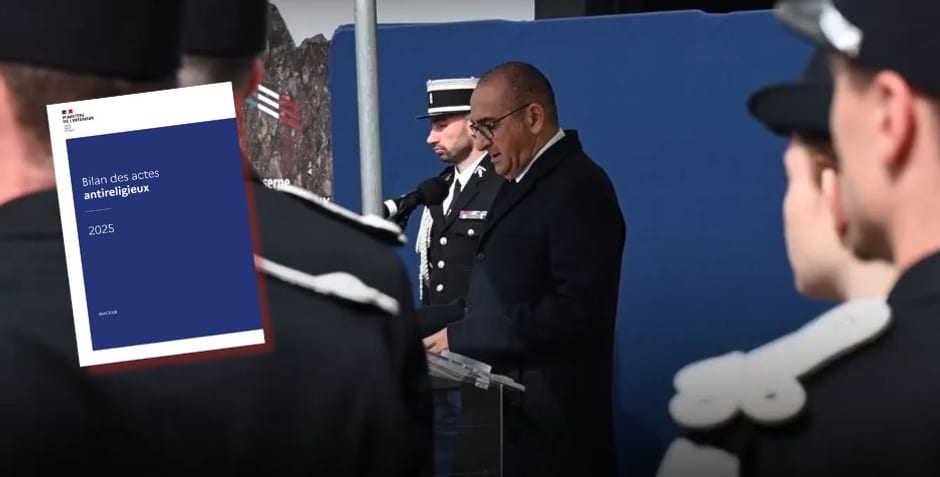
“These acts are not isolated incidents. They reflect a troubling reality: anti-religious hatred is on the rise and affects all faith communities across our country.” With these words, Laurent Nunez introduced the first national assessment of anti-religious acts (2010–2025), published by the French Ministry of the Interior on May 29. The initiative deserves recognition, but it also warrants careful scrutiny.
Op-ed first published in French in Le JDD on June 13, 2026.
Fluctuating Anti-Semitism and Deep-Rooted Hostility Towards Christianity
The report records a sharp increase in anti-religious acts, with 2,489 incidents reported in 2025 across all faith communities. Anti-Semitic acts account for the largest share in the wake of the 7 October 2023 attacks: 1,320 incidents, representing more than half of the total. Anti-Christian acts rank second, with 843 cases—34 per cent of all recorded incidents—and rose by 9 per cent in 2025. This steady increase primarily affects Catholics. Anti-Muslim acts remain comparatively limited, with 326 cases, despite an 88 per cent rise which ADDAM (the Association for the Defence Against Discrimination and Anti-Muslim Acts) largely attributes to improved reporting mechanisms.
Beyond the overall increase in anti-religious acts, it is their nature that should give particular cause for concern. Attacks against property remain the most common form of offence, but violence against individuals is intensifying across all faith groups. Threatening words and actions directed at Jews have tripled since 2022, while violence targeting Christians doubled within a single year. On 10 September in Lyon, Ashur Sarnaya, a 45-year-old Iraqi Christian, was murdered with a machete. His death deeply affected the Christian community, both because of the victim’s particular vulnerability—he was confined to a wheelchair—and because of the extreme brutality of the attack.
The chronology of these trends is particularly revealing. Anti-Semitism follows a largely geopolitical dynamic. The attacks of 7 October triggered a 1,209 per cent increase in anti-Semitic incidents between September and October 2023, even before Israel’s military response began. Hostility towards Christians, however, follows a different pattern: it is structural, persistent and largely detached from international events. Its growth is slower, but also more deeply entrenched. The statistics reflect only the visible part of a broader phenomenon, which has long remained outside the focus of public debate. Why should a country that has been Christian for centuries—the Church’s “eldest daughter”—feel the need to defend its Christians?
A Methodology Marked by Significant Blind Spots
The second part of the report outlines the measures adopted by public authorities: €47.8 million invested since 2015 to improve the security of nearly one thousand places of worship, regular dialogue with religious communities through the Central Bureau of Religious Affairs, and the “My Security” reporting platform. These efforts are real, but they remain insufficient.
The most striking omission is the absence of any dedicated institutional framework to combat anti-Christian hatred. France’s Interministerial Delegation for Combating Racism, Anti-Semitism and Anti-LGBT Hatred (DILCRAH) benefits from a clear structure, dedicated resources and a national action plan. No equivalent mechanism exists for Christians. The report also sidesteps the issue of underreporting, even while implicitly acknowledging it by noting that the data do not provide a comprehensive statistical picture. Several specialised observatories estimate that the actual number of anti-Christian acts may be two to three times higher than official figures, placing France among the European countries most affected by this phenomenon.
The Politics of Reports: When Governments Stop Acting
By limiting itself to statistics and preventive measures, the report addresses symptoms rather than causes. The state’s response remains overwhelmingly focused on security, without any serious reflection on the cultural and educational factors that contribute to the normalisation of hostility towards Christianity. The approach recalls the authorities’ handling of the riots that followed Paris Saint-Germain’s victories: a large-scale security deployment, a handful of arrests, reassuring ministerial statements, and then the same scenario repeated the next time.
More broadly, the report illustrates a recurring flaw in contemporary French politics: the predominance of rhetoric, the proliferation of reports and the multiplication of consultative bodies. The Grand National Debate, the Citizens’ Convention and the National Council for Refoundation are all examples of this tendency. As early as 2017, the philosopher Bérénice Levet warned against the emergence of a form of government that sought to become “master of discourse” rather than master of decision-making.
Although intended as a republican response to a genuine problem, this report ultimately leaves a sense of incompleteness and a feeling of a missed opportunity.



 Secularism, Catholic Schools, Protection of Life: Leo XIV Has Spoken OutBy Constance Avenel
 Baptism and the “right to be forgotten”By Alicja Słowik
 France: The Church's Suffering & HopeBy Grégor Puppinck
 China: Pastor Cao Must Come HomeBy CeCe Heil