
Protecting Children from Pornography: Dialogue Continues with the New UN Special Rapporteur
Protecting Children from Porn***: Dialogue Goes On with New UN Rapporteur
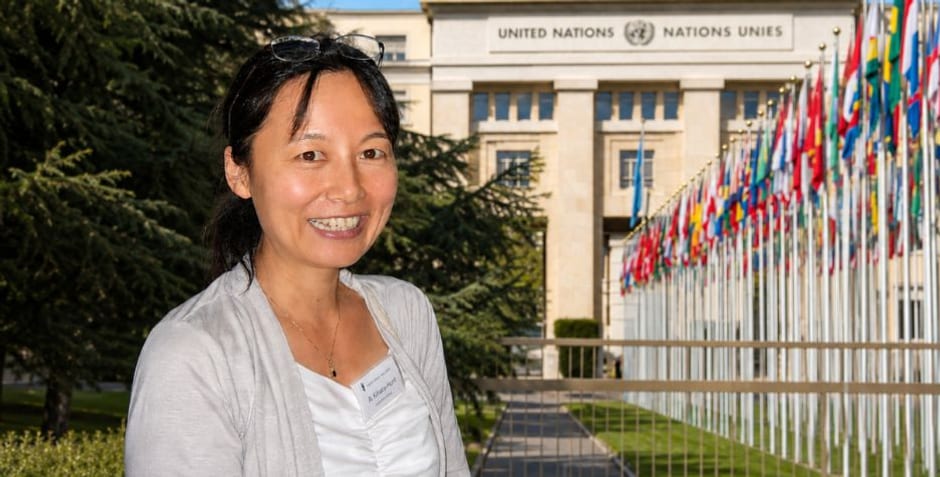
The European Center for Law and Justice (ECLJ) has just submitted a written contribution to the new United Nations Special Rapporteur on the sale, sexual exploitation, and sexual abuse of children for her thematic report on “The Special Rapporteur’s Vision.” Scheduled to be presented at the 81st session of the United Nations General Assembly in October 2026, this will be the first report by Ai Kihara-Hunt (Japan), who took office on May 1, 2026, succeeding Mama Fatima Singhateh (Gambia). In it, she will outline her priorities for carrying out her mandate.
In its contribution, the ECLJ first congratulated the new Special Rapporteur, assuring her of its support and its hope to establish a dialogue as constructive as the one it had with her predecessor. Indeed, the former Special Rapporteur had explicitly drawn on the ECLJ’s observations in several of her thematic reports. In January 2024, she had thus recalled that “Child sexual abuse material appears not only on the darknet but also on legal websites” and stated : “The digital industry should intensify its proactive detection efforts in order to counter the online dimensions of the sale, sexual exploitation and sexual abuse of children in the entertainment industry . . . the Special Rapporteur endorses the proposal for the enforcement of global standards that impose accountability requirements on service providers. The application of online age verification measures, where the use of an online service, including its content, involves risks for minors, should be widely promoted within the online media industry”.[1] Similarly, in August 2024, she cited the submission filed by the ECLJ to assert that “Repeated exposure to extreme forms of hypersexualization and pornographic material can have a significant impact on a child’s development, leading to trivialization of the phenomenon and distorting what is considered normal sexual interactions”.[2] In January 2026, she addressed the rise in child sexual abuse committed by other children, citing the ECLJ among the “Many contributors to the report [that] pointed to children’s exposure to pornography as the biggest risk factor”.[3]
While Ms. Kihara-Hunt stated her intention to build on the work of her predecessors—particularly in line with Ms. Singhateh’s latest report—the ECLJ once again emphasized in its submission two areas of analysis that it considers priorities in protecting children from sexual abuse: the link between exposure to pornography and child sexual abuse, and the imperative need to hold digital platform operators accountable. It demonstrated that children’s exposure to pornography is both a contributing factor to sexual abuse among minors and a form of sexual abuse in itself. It also highlighted the profit-driven nature of this exposure, which is part of the pornography industry’s business model. In the best interests of the child, it advocated for greater accountability on the part of the pornography industry, as well as the systematic implementation of effective age verification measures for accessing online platforms of this nature.
The ECLJ ultimately made several recommendations for the mandate, including the drafting of a thematic report on the role of the pornography industry in the surge of sexual exploitation and abuse of minors, particularly those committed by other minors. It would also be appropriate to promote international harmonization of criminal law definitions of sexual abuse to explicitly include the intentional exposure of a child to pornographic content, as well as, in the long term, the exposure of children to online pornography. Finally, the Special Rapporteur could urge States to abandon self-regulatory policies in favor of adopting binding legal frameworks that, in particular, require the implementation of effective online age-verification mechanisms that respect fundamental freedoms.
_________________
[1] A/HRC/55/55, Study on the sexual abuse and exploitation of children in the entertainment industry, §17 and 63.
[2] A/79/122, Existing and emerging sexually exploitative practices against children in the digital environment, §86.
[3] A/HRC/61/45, Protecting children from sale, sexual exploitation and sexual abuse: progress, new frontiers and the path forward, §48.






 Violent Pornography: PACE Calls for a BanBy Priscille Kulczyk
 Online Sexual Exploitation: UN Highlights ResponsibilitiesBy ECLJ
 CEDAW Recommendation on Gender Stereotypes: ECLJ RespondsBy Alicja Słowik