
Tunisia: Christians Facing Kais Saied’s Identity-Driven Shift
Tunisia: Christians Facing Kais Saied’s Identity-Driven Shift
Since the Covid-19 pandemic, Tunisia has fallen from grace: from being a pioneering and exemplary liberal democracy in the Arab world, it has become a dictatorship that persecutes Christians, amongst others. How did this turnaround come about?
As early as the 19th century, Tunisia stood out within the Arab-Muslim world for its strong desire for freedom. It was one of the first states to abolish slavery in 1846, to adopt a bill of rights with the Fundamental Pact of 1857, and to adopt a constitution in 1861. In 2011, it was Tunisia that sparked the Arab Spring by overthrowing Ben Ali’s dictatorship, subsequently serving as a democratic outlier in the Arab world for 10 years. In 2014, it adopted a constitution that many described as ‘revolutionary’, which notably enshrines freedom of conscience – a first in the Maghreb – and explicitly prohibits campaigns accusing people of apostasy.
For a time, this trajectory fuelled hopes of a lasting democratic transition. However, it came to an end with the rise to power of Kaïs Saïed in 2019, followed by his institutional power grab on 25 July 2021. In the name of fighting corruption and restoring the state, the president is gradually dismantling the main checks and balances that emerged from the revolution. Arrests of his opponents, the bringing of the judiciary to heel and the weakening of Parliament: all the elements of an authoritarian drift are in place. This democratic disillusionment is also reflected in the sphere of religious freedoms, the scope of which is becoming increasingly theoretical for Christians.
Saied’s Shift: The Law Professor Who Buried the Constitution
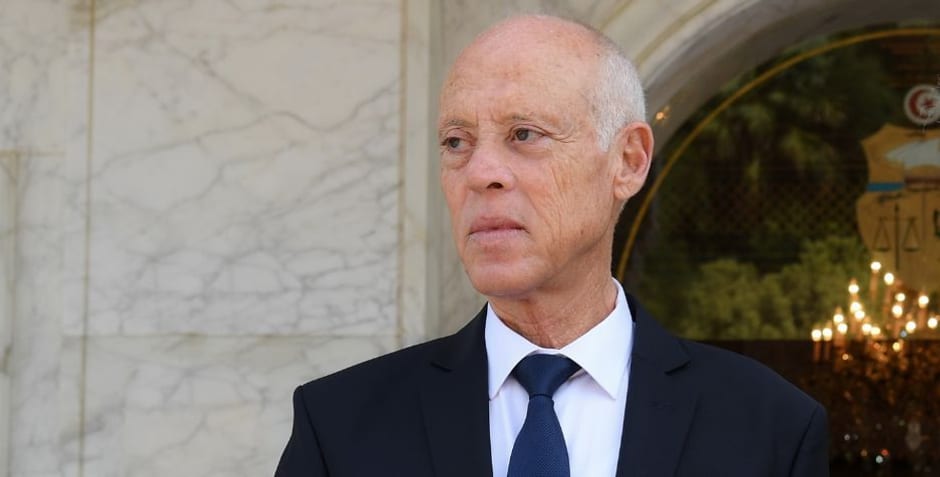
In 2019, Kaïs Saïed, a professor of constitutional law at the University of Tunis, emerged as the candidate of integrity in the face of a discredited political class. Against a backdrop of widespread rejection of traditional parties, particularly the Islamist Ennahda party, he promised to restore the rule of law and defend the achievements of the 2014 Constitution, on which he is himself a recognised expert.
His election thus appeared to be a continuation of the spirit of the revolution rather than a challenge to it. Yet, less than two years later, whilst the president had been stuck in a power struggle with the Islamists of Ennahdha for months, the economic crisis, exacerbated by the Covid-19 pandemic, provided him with the opportunity to stage a power grab in order to concentrate the bulk of power in his own hands. On 25 July 2021, invoking Article 80 of the Constitution, he suspended Parliament, dismissed part of the government and began to govern by decree.
Tunisia is taking a sharp downturn: the promise to restore the rule of law is gradually giving way to a concentration of power, and the man who claimed to be saving the Constitution is swiftly setting about replacing it. The new text, adopted in 2022, considerably strengthens presidential powers and reduces checks and balances, notably paralysing the establishment of the Constitutional Court. Since then, there has been a surge in the arrests of opposition figures and journalists (under the infamous Decree-Law 54), as well as the dismissal of judges. His election in October 2024, with over 90 per cent of the vote, dispels any remaining illusions about the state of Tunisian democracy.
Political Islam Is Retreating, While Social Islamisation Advances
One of the main arguments put forward by Kaïs Saïed to justify his authoritarian policies is the fight against the Islamist Ennahda party. Long the country’s leading political force, this movement – historically inspired by the Muslim Brotherhood – has seen its influence collapse since 2021, as the president has consolidated his grip on the institutions. Its long-standing leader and opposition figure, Rached Ghannouchi, was sentenced to life imprisonment in early June, whilst several senior figures within the movement were arrested and also handed down heavy sentences.
At first glance, this marginalisation suggests that political Islam is in decline. The reality is more complex. Whilst Saïed does not wish to create a religious state, this dismantling of Ennahdha is not accompanied by a secularisation of Tunisian society either. On the contrary, Islam remains at the heart of the president’s political project: the 2022 Constitution bears witness to this. Admittedly, it does not explicitly proclaim Islam as the state religion, but Article 5 stipulates that ‘Tunisia forms part of the Islamic nation’ and that the state must work towards the realisation of ‘the aims of authentic Islam’. It should be noted that the Constitution reserves the office of President of the Republic exclusively for Muslims.
Furthermore, the Head of State peppers his speeches with references to the Qur’an and the hadiths, and presents himself as a committed defender of the country’s Arab-Muslim identity, in the name of which he adopts a rhetoric of systematic exclusion towards all minorities. In February 2023, in a statement with dramatic consequences, the president accused immigrants from sub-Saharan Africa in Tunisia of a ‘criminal plot to transform Tunisia’s demographic makeup’. This identity-based vision also underpins the policy towards religious minorities, particularly Christians.
This authoritarian drift is therefore not confined to the political sphere alone: it also shapes, more discreetly, the state’s relationship with religious diversity. Whilst opponents and journalists are the most visible targets of Kaïs Saïed’s crackdown, Christians are subjected to a derivative form of it – less spectacular but just as structural.
Religious Freedom Largely Theoretical: Christians on the Front Line
There are no official statistics in Tunisia on the number of Christians, but NGOs estimate that there are between 23,000 and 30,000 believers, mainly expatriates – Catholics, Protestants or Evangelicals from Europe or sub-Saharan Africa – to which must be added the number of Tunisian converts, which is difficult to estimate. Over the past decade or so, there has indeed been an increase in conversions, mainly amongst young people, which can be explained by a distancing from institutional Islam, a search for meaning, and a greater circulation of alternative religious discourses.
Not everyone is in the same boat: whilst Western Christians enjoy relative freedom, the situation for sub-Saharan Africans is made very precarious by their status as immigrants and by racial discrimination. Administrative procedures make it virtually impossible to open new churches, and several Protestant or Evangelical communities struggle to obtain official recognition or to secure permanent places of worship. As for Tunisian converts, they are deprived of places of worship and mainly gather in house churches.
The provisions of family law, set out in the 1956 Personal Status Code, remain largely based on Islamic tradition. In practice, a Muslim woman is still not free to marry a non-Muslim — the circular prohibiting this was repealed in law in 2017, but many mayors still refuse to solemnise such marriages — and non-Muslims are excluded from inheritance in mixed-faith couples. Most evangelical converts find themselves denied a Christian burial and are buried, against their will, in a Muslim section of the cemetery. As for the education of children: there is no legal provision allowing a converted parent to legally pass on their faith. State schools provide exclusively Islamic religious instruction, and a parent’s conversion can be used as grounds in court to strip them of custody.
Tunisian Christians who have converted from Islam are the most vulnerable. Monitored by the security services when they gather, they generally have no choice but to practise their faith in secret. Whilst apostasy is not a criminal offence, it is effectively punished in practice, and the consequences are severe: family breakdown, psychological pressure, threats, social ostracism, or even the loss of a job or career prospects. Female Christian converts may be beaten and threatened with rape or death.
Pathways Out of the Impasse
It is hard to imagine today that Tunisia was once a major centre of Christianity, a country where Mass was celebrated in Latin even before Rome. Similarly, the hopes for democracy that made this country an exception in the Arab world fifteen years ago now seem to have been buried. The gulf is widening between the fading of memory and the fading of a political promise.
Yet changes are needed to ensure that Article 27 of the current Constitution on freedom of belief and conscience is effectively guaranteed — starting with the removal of vague criminal provisions that have been used to criminalise proselytising, and through more sustained interfaith dialogue. These were, in particular, the recommendations put forward by Tunisian and international civil society organisations during Tunisia’s Universal Periodic Review in 2022. That year, the country’s various religious communities had signed a ‘National Pact for Coexistence’. Four years on, there is no indication that it has been implemented.
France and the European Union, which are engaged in an ongoing bilateral dialogue with Tunis, could usefully incorporate the issue of religion into this dialogue — for example, through European cooperation programmes or French support for Tunisian civil society organisations working to defend religious freedom.
Eight years after the last visit by a United Nations Special Rapporteur on freedom of religion to Tunisia, a new mission seems all the more justified given that the situation of Christians has deteriorated in recent years.

 Secularism, Catholic Schools, Protection of Life: Leo XIV Has Spoken OutBy Constance Avenel
 Baptism and the “right to be forgotten”By Alicja Słowik
 France: The Church's Suffering & HopeBy Grégor Puppinck
 China: Pastor Cao Must Come HomeBy CeCe Heil