
The Church's Suffering and Hope in France - Foreword
France: The Church's Suffering & Hope
French Catholics have become accustomed to living with a latent sense of suffering, a feeling of political insecurity, ostracism, and almost shame. Catholics have not only become a minority within French society but, even more seriously, they are now misunderstood. The vast majority of the population has lost sight of the essential truths of the Christian faith: the divinity of Jesus, the existence of the soul, the virtues, charity as self-sacrificing love, the reality of sin, salvation and eternal life. This lack of understanding fuels a rejection of the public expression of faith and, in particular, of natural and Christian morality.
It is essential that Catholics realise that this latent suffering is not a normal state of affairs. It is unjust and stems from choices specific to France’s political history. The Church, once at the heart of the village, has been pushed to the margins of society.
Admittedly, France is not the only country undergoing secularisation, but it is the only Catholic nation in Europe to have regularly persecuted the Church, murdered its clergy, expelled its religious orders, plundered its property and banned its apostolate. This persecution, which has been repeated since 1790, has traumatised Catholics.
France, described by the popes as the “eldest daughter of the Church”, has nevertheless produced a multitude of saints and missionaries, particularly in the 19th century, during which it experienced an extraordinary revival that was, once again, met with persecution by the Third Republic.
The Revolution was not a divorce between France and the Church, but a violent and bloody repudiation. It was from this rift that the Republic was born, founded on the principle of rejecting the religious identity upon which France was founded. Since then, the Republic has been built in opposition to Catholic France, seeking to supplant it and replace the Gospel with its atheistic philosophy. This amounts, in the words of Saint Pius X, to “de-Catholicising France”. It was in this sense that he wrote to the French people shortly after the passing of the 1905 law separating Church and State:
You know the aim of the impious sects which are placing your heads under their yoke, for they themselves have proclaimed with cynical boldness that they are determined to "de Catholicise" France. They want to root out from your hearts the last vestige of the faith which covered your fathers with glory, which made your country great and prosperous among nations, which sustains you in your trials, which brings tranquillity and peace to your homes, and which opens to you the way to eternal happiness. (Encyclical Vehementer nos, 1906, Para. 16)
In 1925, the Assembly of Cardinals and Archbishops of France also declared: “The laws of laïcité are unjust, first and foremost because they are contrary to the formal rights of God. They stem from atheism and lead to it at the individual, family, social, political, national, and international levels.” History has proved them right. The Assembly added: “Laïcité laws are not laws. They are laws in name only—a name they have usurped; they are nothing but corruptions of the law, acts of violence rather than laws…”
Subsequently, and in particular since the Second Vatican Council (1962–1965), the Church in France has come to terms with this political regime and has sought to find its place within it, striving for reconciliation through a more peaceful and inclusive conception of laïcité. It has endeavoured to redefine laïcité in a liberal manner by purging it of its anti-religious essence. Thus, in 2005, for the 100th anniversary of the law on the separation of church and state, the French episcopate defined laïcité as “the non-confessional nature of the state and its lack of jurisdiction over matters of religious faith”, and noted with satisfaction that “this conception of laïcité ensures freedom of conscience and guarantees the free exercise of religious worship”. It was, however, concerned about “the resurgence of attitudes and positions characterised by a form of laïcité that one would like to believe is a thing of the past”. (Statement “The Catholic Church and the Law of 9 December 1905, one hundred years on”, 15 June 2005).
But laïcité remains. Ten years later, in 2015, the bishops of France lamented even more explicitly that “there is a school of thought in our country seeking to move from the laïcité of the State to the secularisation of society. Some would like the whole of social life to be secular and for believing citizens to express and practise their faith only within a strictly private sphere that is becoming increasingly restricted, or even hidden.” (Statement on the occasion of the 110th anniversary of the 1905 Law, 4 December 2015). As recently as 2025, Cardinal Aveline declared his intention to resist “laïcité”.
Indeed, Catholics in France continue to be targeted by social and political forces keen to eradicate religion not only from the State, but also from the public sphere, schools, hospitals and even the minds of the younger generations. Voltaire’s aim to “crush the infamy” remains unchanged amongst his heirs.
Today, Catholics feel cornered. For decades, they have kept a low profile, accepting their own “invisibilisation” in an attempt to survive in a world that was becoming ever more alien to them. To no avail. Today, from a human perspective, they are on the verge of disappearing, along with the France they helped to forge. The Church in France is becoming a mere remnant.
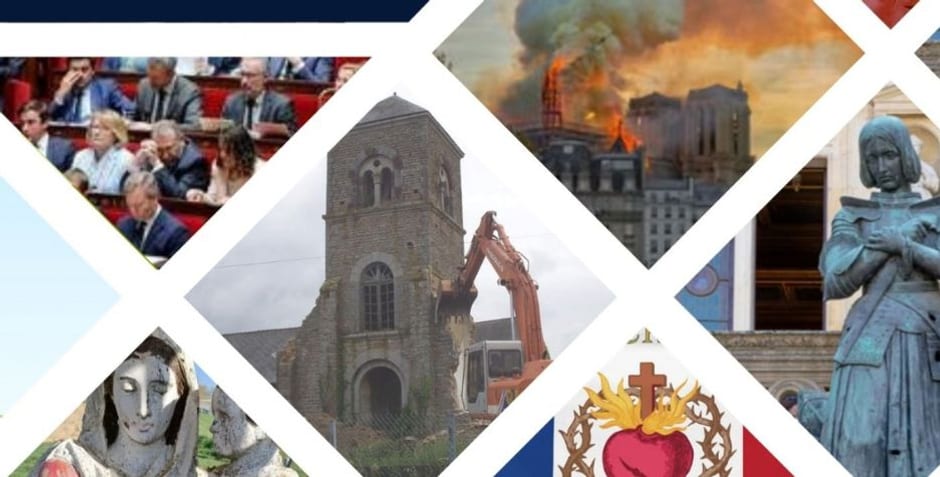
Culturally speaking, faith is generally no longer understood, and religious morality is often rejected. Institutionally speaking, churches, schools and hospitals are coming under increasing state control. Many churches are under threat, being closed, sold or demolished, whilst Catholic schools and hospitals are under intense political and financial pressure to be secularised, to teach a moral code or to carry out “medical” procedures contrary to the Catholic faith. Catholic families are becoming increasingly isolated within society, making it very difficult to provide their children with a Christian upbringing. Furthermore, Catholics are increasingly the victims of attacks on their religious symbols, vandalism and damage to their places of worship, as well as verbal and physical violence.
It is these aspects of the Church’s suffering in France that this report documents, on the occasion of Pope Leo XIV’s visit to this country. It presents a factual and legal account of the violence and injustices currently being suffered by the Church. It highlights the rise in anti-Christian acts and analyses the legal constraints imposed on the freedoms and distinctive character of Catholic schools and medical-social institutions. Recent years have been marked by a return to a “militant laïcité”, through the adoption of laws designed to facilitate the extrajudicial closure of independent schools, to tighten control over freedom of expression and school curricula, to impose sex education contrary to Catholic morality, and even to ban home schooling. The inclusion of abortion in the Constitution has also offended French Catholics, who have perceived it as a form of official blasphemy. Again this year, a majority of MPs in the National Assembly would have liked to make it a criminal offence for Catholic medical and social care institutions to refuse to perform euthanasia, which would have forced them either to renounce their beliefs or to cease to exist. Finally, beyond these legal infringements, Catholic institutions are often subjected to overzealous behaviour on the part of the administration, for example when it seeks to ban prayer in Catholic schools.
This report begins with the observation that Catholicism in France has collapsed, whilst noting the corresponding collapse of France itself, as if France and the Church were indeed bound by a shared destiny. Never has the French population been so despondent: it is losing its memory, no longer passing on life and culture, and sinking into despair. It no longer believes in its destiny.
Catholics, on the other hand, retain hope, sustained by faith, hope and charity, and enriched by the immense heritage of Christendom. They belong to a reality that transcends them. Although they are in the minority, their religion keeps them standing firm in a society that is crumbling, and this is enough to enable them to retain confidence in the future. Standing firm, they are not only a target, but also become a beacon and a rallying point for those who wish to rise again, escape the absurdity of the modern world, rediscover their roots, and restore their humanity as spiritual beings, composed of body and soul, destined for eternal life. This is undoubtedly why the Church is currently finding new vitality amongst young people.




 Secularism, Catholic Schools, Protection of Life: Leo XIV Has Spoken OutBy Constance Avenel
 Baptism and the “right to be forgotten”By Alicja Słowik
 China: Pastor Cao Must Come HomeBy CeCe Heil
 Tunisia: Christians Facing Kais Saied’s Identity-Driven ShiftBy Constance Avenel