
The ECLJ’s Commitment to Christians in Algeria Remains Unwavering
The ECLJ’s Commitment to Christians in Algeria Remains Unwavering
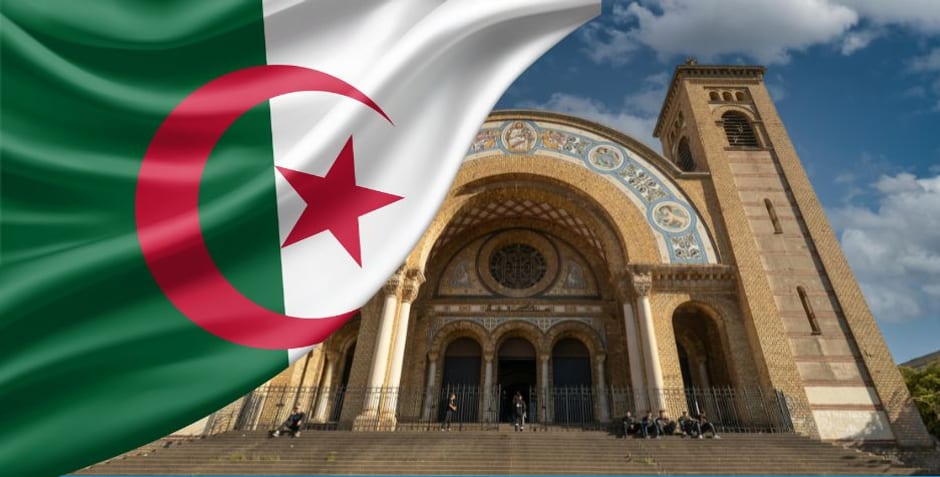
From April 13 to 15, 2026, Pope Leo XIV made a historic visit to Algeria, marking the first papal trip to this Muslim-majority country. The ECLJ seized this opportunity to carry out an intensive media campaign to raise awareness of the situation of Christians in the country and continues to bring the issue before various institutions.
In Algeria, Christians are subject to systematic repression: church closures, institutional discrimination, and legal proceedings based on abusive laws targeting proselytism, blasphemy, or the simple practice of worship—documented testimonies are numerous. On May 2, 2024, Pastor Youssef Ourahmane, Vice-President of the Protestant Church of Algeria, was sentenced on appeal to a custodial prison term for having “held an unauthorized religious service.”
The government accuses Christians of contradicting an official national identity defined as exclusively Arab and Islamic. Djamila, Monique, and Kousseila, Algerian-born converts to Christianity, testified to this repression on RCF Radio. During the Pope’s visit to Algeria, we sought to make this reality heard—a reality that the visit’s ceremonial splendor attempted to obscure, and a reality which is far removed from the images projected by the media.
The Pope’s Visit to Algeria: An Opportunity for an Awareness Campaign by the ECLJ
On the occasion of the papal visit, the ECLJ published a report entitled The Oppression of Christians in Algeria. It is based on testimonies collected from historians, diplomats, and above all, Algerian Christians—some of which are still living in the country, some of which were forced into exile because of their faith.
In order to raise public awareness of the situation of Christians in Algeria, the ECLJ appeared on several television programs (CNews: 100% Politique, En quête d’esprit, Face à l’info, Terres de mission) and on radio stations (Radio Courtoisie: Libre journal des lumières de l’espérance, Ligne droite, as well as Europe 1).
The ECLJ’s analyses were relayed by numerous print media outlets, including Paris Match, La Nef, Valeurs actuelles, Breizh-info, and France Catholique. The report also received international coverage, notably in the United States, the United Kingdom, Spain, and Germany, demonstrating its global impact.
In order to mobilize a broad range of actors in support of Christians in Algeria, the ECLJ also initiated a joint op-ed published in Le Journal du Dimanche (JDD). The article brought together more than thirty signatories—lawyers, political figures, human rights experts, journalists, philosophers, writers, and Algerian Christians—calling on French and European authorities to act in defense of Christians in Algeria. Among the signatories were Boualem Sansal, Noëlle Lenoir, MEP Nicolas Bay, and ECLJ Director Grégor Puppinck.
The Fight Continues in the Institutional and Judicial Arena
Although Pope Leo XIV’s visit did not lead to any visible improvement to the Algerian Christians’ situation, his visit appears to have opened a window of dialogue between France and Algeria. The French ambassador has returned to his post, and a series of ministerial visits has followed: Gérald Darmanin (Minister of Justice) and Laurent Nuñez (Minister of the Interior) both recently travelled to Algeria, ranking fundamental rights high on the agenda, including discussions on the release of Christophe Gleizes. The European Commissioner for the Mediterranean, Dubravka Šuica, also made an official visit on May 4-5, 2026.
With such results, the ECLJ has no intention of easing its efforts and continues its advocacy work before international institutions. On March 18, 2026, the ECLJ brought the issue of Christians in Algeria before the United Nations Human Rights Council during a side event held alongside the council’s 61st session. We continue to mobilize all relevant bodies within the UN in order to secure sustained international pressure on the Algerian authorities.
The ECLJ’s awareness-raising efforts are also resonating at the European level. On April 16, 2026, seven Members of the European Parliament submitted a parliamentary question to the Commission, stating that “the Algerian authorities have repeatedly infringed fundamental rights.” Therefore, they call for the activation of the safeguards given under the EU–Algeria Association Agreement in cases of human rights violations. On 5 May, the High Representative for Foreign Affairs, Kaja Kallas, replied that the EU “monitors developments closely” and that “Freedom of religion or belief has consistently been part of [the] exchanges” during her regular discussions with the Algerian authorities. However, the EU does not intend to activate the mechanisms provided for in the Association Agreement.
Having played a part in bringing the issue of Christians in Algeria into public debate, the ECLJ is continuing its action through international advocacy and victim support. Our objective remains unchanged: to enable Algerian Catholics and Evangelicals to live their faith freely and to worship without fear.



 France: The Church's Suffering & HopeBy Grégor Puppinck
 China: Pastor Cao Must Come HomeBy ECLJ
 Tunisia: Christians Facing Kais Saied’s Identity-Driven ShiftBy Constance Avenel
 Syria: Christians left Behind?By Thibault van den Bossche