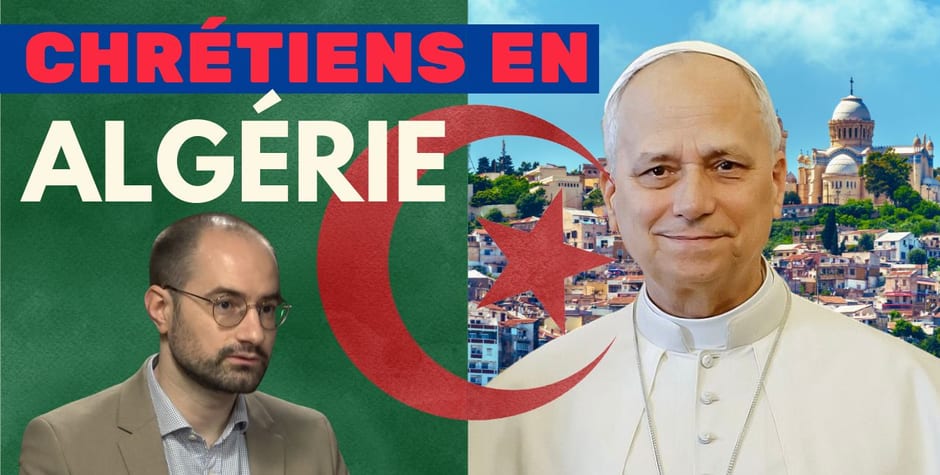
As Algeria prepares to welcome a pope for the first time, a report by the ECLJ sheds a harsh light on the situation of Christians in the country. Church closures, legal proceedings, institutional discrimination: these communities face growing restrictions on their fundamental freedoms.
From April 13 to 15, Pope Leo XIV will visit Algeria. This trip, which coincides with the 30th anniversary of the martyrdom of the monks of Tibhirine—murdered in 1996 by an Armed Islamic Group (Groupe islamique armé (GIA)) —also marks the first official visit by a pope to the country.
The man who describes himself as a “spiritual son of Saint Augustine” has stated his desire to “continue the dialogue” following a notable first trip to Turkey and Lebanon, as well as to “forge ties between the Christian and Muslim worlds.” While the vast majority of Algeria’s population is now Muslim, this region was in ancient times a major center of Christianity, before its gradual Islamization through a series of conquests.
Nevertheless, there are more than 150,000 Christians in Algeria, most of whom have converted since the 1990s. The vast majority are Evangelical Protestants, but there is also a small Catholic community, composed mainly of foreigners. Their commitment to the common good does not spare them from facing constant pressure. Christians are indeed bearing the brunt of a policy that seeks to impose a single national identity, both Arab and Muslim. Religious diversity has no place in Tebboune’s Algeria.
Today, the European Centre for Law and Justice highlights this reality in a new report.
The report is based on in-depth investigative work, drawing notably on numerous interviews conducted directly with Algerian Christians.
A political framework that marginalizes religious minorities
As Bouabdellah Ghlamallah, former president of the High Islamic Council, stated in 2021: “An Algerian can only be Muslim.” In Algeria, Islam is not merely the majority religion: it constitutes a central component of national identity and political organization. Article 2 of the Constitution indeed states that “Islam is the state religion.”
This conception leaves little room for religious pluralism. The 2020 constitutional revision removed the reference to freedom of conscience, reflecting the political hardening the country underwent following the Hirak, a vast popular movement that emerged in 2019 calling for greater democracy. In Algeria, religious minorities enjoy no specific institutional recognition. Thus, Christians in Algeria operate within an uncertain legal framework: there is neither a specific civil status nor an official mechanism to account for their religious affiliation.
This lack of recognition is particularly evident in the provisions of the Family Code, which is largely inspired by Islamic law and applies to all citizens without distinction. From birth to death, Christians thus bear the burden of an administration that is openly hostile toward them. In particular, the code prohibits a Muslim woman from marrying a Christian and deprives her of inheritance in the event of apostasy. Difficulties also arise in daily life. The administration has a list of first names deemed inconsistent with “Algerian conventions,” leading to the rejection of Christian names at the civil registry. Obstacles sometimes arise when attempting to obtain a death certificate or to bury loved ones in a Christian cemetery, especially when the deceased was a former Muslim convert.
Thus, this legal framework places Christians in a gray area: officially free to practice their religion, they remain in reality integrated into an institutional system designed primarily with Islam in mind. A situation that contributes to weakening their social position and reinforcing their invisibility in Algerian society.
A highly restricted freedom of worship: almost all Protestant churches closed
While the Constitution officially guarantees freedom of worship, it does so “in accordance with the law” (Article 51). In practice, two legal texts severely restrict the practice of Christianity: the ordinance of February 28, 2006, regarding non-Muslim religions, and the 2012 law on associations.
The 2006 ordinance establishes a particularly restrictive authorization system for the practice of non-Muslim worship. Every place of worship must obtain prior approval from a national commission specially established to that end. In practice, this system has proven extremely restrictive: since the adoption of this ordinance, the authorities have rejected all requests to open new Christian places of worship.
To further complicate the situation, a place of worship can legally exist only if it is affiliated with an approved religious association. However, the legal recognition of such an association is effectively impossible due to the provisions of the 2012 Law on Associations, which imposes a lengthy and opaque administrative procedure. This legislation also allows the authorities to exercise tight control over the entire associative sector. In particular, it led to the closure of the humanitarian organization Caritas in 2021. Religious organizations are not the only ones affected: “the only international association still present in Algeria is Amnesty International,” a journalist in Algiers tells us.
The result of this regulatory arsenal is an administrative deadlock that has gradually led to the closure of numerous places of worship. The report indicates that all those affiliated with the Protestant Church of Algeria, whose legal status has not been renewed by the authorities, are now sealed.
Deprived of official places of worship, evangelical believers are forced to gather in private homes, outdoors, or through online meetings. For many evangelicals, this situation turns simple religious practice into a clandestine activity.
While the Catholic Church is able to keep its churches open, in practice it is largely confined to the role of a showcase for “interreligious dialogue.” Its desire to remain discreet, as well as its status as an interlocutor recognized by the authorities, affords it a certain degree of protection, but at the expense of any missionary activity.
Legal Prosecutions for Proselytism and Blasphemy
The pressure is not limited to administrative restrictions. Several criminal provisions also allow for the prosecution of believers based on their religious practice.
The 2006 ordinance notably introduced the offense of proselytism. It becomes a criminal offense to attempt to “convert a Muslim” or to “undermine their faith.” Penalties can include up to five years in prison and heavy fines. The definition of this offense is vague enough to encompass numerous situations: distributing religious books, organizing a prayer meeting, or posting Christian messages online. This provision thus serves as the basis for a crackdown on Christian symbols and expressions of faith. Dozens of Christians—pastors and ordinary believers alike—have been prosecuted in recent years on grounds related to their faith.
The Penal Code also provides for penalties for blasphemy or offense against Islam, notably through Article 144 bis 2, which is often used to prosecute converts. The authorities prosecute Christian missionaries as well as Muslim apostates.
Among the most notable cases is that of Slimane Bouhafs, a former Muslim who converted to Christianity and is an advocate for religious freedom. In 2016, he was arrested after posting messages on Facebook deemed offensive to Islam. He was sentenced to three years in prison for insulting Islam and its prophet. After his release in 2018, he left Algeria and was granted political refugee status in Tunisia. But in 2021, he was abducted in Tunis and brought back to Algeria by Algerian authorities, where he was imprisoned again on charges related to national security. Even today, his situation remains particularly precarious. He recently stated that he has been deprived of all his civil rights, as well as the freedom to leave the country.
A report addressed to the Pope, governments, and the media
This report was sent to journalists, European parliamentarians, several embassies, as well as French and European lawmakers. It was also sent to the Holy See to inform the Pope, on the eve of his trip, about the context in which the country’s Christian communities live.
It alerts the international community and calls on it to respond clearly. The issue of religious freedom cannot be ignored by Algeria’s partners in their bilateral relations with the country. The European Union must, in particular, ensure that the terms of its 2002 Association Agreement are respected, which establishes respect for fundamental rights as an essential element of cooperation with Algeria.
It urges Algeria to comply with its obligations regarding fundamental freedoms and makes several recommendations to its leaders:
- The restoration of freedom of conscience in the Constitution,
- Legal recognition of religious minorities (particularly the EPA) and reform of the Family Code to ensure equal treatment between Christians and Muslims,
- The reopening of all Protestant churches,
- The resumption of Caritas’s activities,
- The reform of criminal provisions on proselytism and blasphemy.
On the eve of this historic visit, many hope that the Pope’s presence will help usher in a new era of genuine progress for freedom of conscience and religious pluralism in Algeria.






 Secularism, Catholic Schools, Protection of Life: Leo XIV Has Spoken OutBy Constance Avenel
 Baptism and the “right to be forgotten”By Alicja Słowik
 France: The Church's Suffering & HopeBy Grégor Puppinck
 China: Pastor Cao Must Come HomeBy CeCe Heil