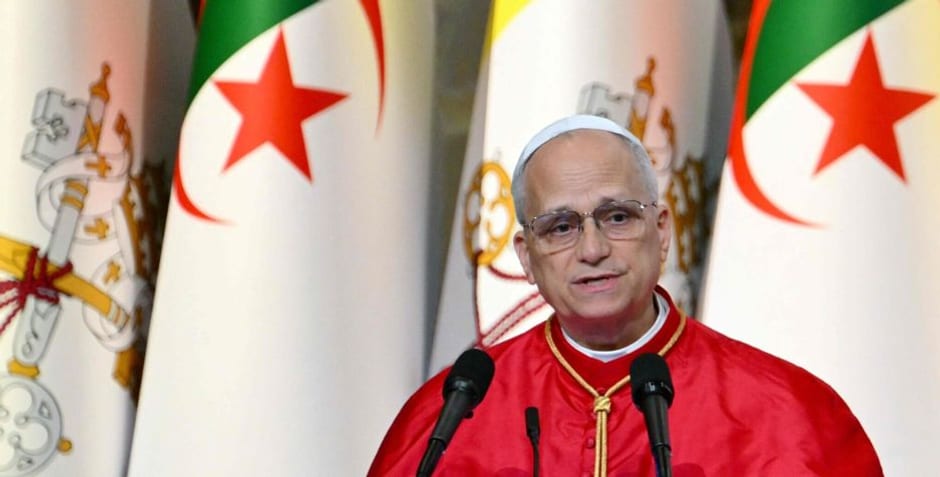

On the eve of Pope Leo XIV’s historic visit to Algeria, at a time when almost all Protestant churches there have been closed and freedom of religion is reduced to a mere formulation in the Constitution, we, the signatories of this open letter – Algerian Christians, politicians, human rights experts, journalists, philosophers, lawyers and writers – call on France and Europe to face up to the reality experienced by Christians in Algeria. A suffering that is little known, yet right on our doorstep.
Opinion published in Le JDD on April 12, 2026.
According to the Algerian Constitution, Islam is the state religion, leading the former president of the High Islamic Council to state that ‘An Algerian can only be a Muslim’ (2021).
Yet there are more than 150,000 Christians in Algeria, most of whom have converted since the 1990s. The vast majority are Evangelical Protestants, but there is also a small Catholic community, consisting mainly of foreigners. Through their commitment to the common good, Christians are a valuable asset to Algerian society. Yet they live under a climate of constant pressure, suffering the effects of a policy aimed at stifling any religious expression other than Islam. Algeria effectively imposes a single identity, both Arab and Muslim, to the detriment of minorities: in particular Jews, Ahmadis and Christians. In 2020, freedom of conscience was simply removed from the Constitution.
The system is well-established. From birth to death, Christians bear the brunt of an administration that is openly hostile towards them. The Family Code, modelled on Islamic law, prohibits Muslim women from marrying Christians and deprives them of their inheritance in the event of apostasy. Christian first names are refused by the registry office, and some are denied a Christian burial.
Furthermore, the authorities have gradually cracked down on all forms of ‘spiritual dissent’ through repressive laws. A 2006 decree subjects Christian worship to a restrictive authorization regime, whilst a 2012 law on associations tightens administrative controls over places of worship. As a result, 58 evangelical churches have now been closed by the state, forcing worshippers underground.
Practicing one’s Christian faith also exposes one to criminal penalties. That same 2006 decree punishes ‘proselytizing’ Christians with five years’ imprisonment and a heavy fine if they are deemed to have attempted to ‘seduce’ a Muslim or undermine their faith. These provisions serve to crack down on Christian symbols and public expressions of faith. The ban on blasphemy completes this arsenal. The authorities punish Christian missionaries, but also Muslim apostates, who are also subject to social stigmatization. According to the NGO Open Doors, more than 50 Christians have been prosecuted in recent years. Among them, Kabyle Christians are on the front line.
The situation of the Catholic Church, though less visible but no less constrained, remains difficult. It operates within a strictly monitored framework, where any missionary activity is prohibited. In September 2022, Caritas Algeria was consequently closed down by the government.
Against this backdrop, the Holy Father’s visit from 13 to 15 April represents a pivotal moment to highlight the situation of Christians. France must seize this opportunity within the framework of its dialogue with Algeria. Furthermore, the 2002 Association Agreement between the European Union and Algeria makes respect for human rights an essential condition for cooperation: it must be enforced.
It is also incumbent upon French leaders to explicitly place the issue of religious freedom in Algeria on the diplomatic agenda and to call, in particular, for the reopening of Christian places of worship. France fully guarantees freedom of Muslim worship on its territory: the approximately 2,300 mosques are predominantly attended by worshippers of Algerian origin. It is justified in demanding that the Algerian regime respect the rights of Christians.
The signatories:
Boualem Sansal, writer and member of the Académie française
Alexandre Jardin, writer and filmmaker
Robert Redeker, philosopher
Pierre Manent, Director of Studies at the EHESS
Noëlle Lenoir, Chair of the Boualem Sansal Support Committee and former minister
Gilles William Goldnadel, lawyer
Cédric Dubucq, lawyer
Luc Fontaine, honorary magistrate
Christophe Eoche-Duval, senior civil servant and essayist
Jean-Eric Schoettl, former Secretary-General of the Conseil constitutionnel
Koucela Kab, Kabyle Christian
Djamila Djelloul, Christian of Algerian origin, author
Monique Yakout, Kabyle Christian, author
Arnaud Benedetti, political scientist and founder of the Boualem Sansal support committee
Annie Laurent, PhD in political science, journalist specializing in relations between the Church and Islam
Bryan Gonsalves, journalist
Hamid Arab, editor of Le Matin d’Algérie
Louiza Abchiche, human rights activist
Guillaume de Thieulloy, Director of the Observatoire de la christianophobie
Moh-Christophe Bilek, founder of the Notre-Dame de Kabylie association and the Forum Jésus Le Messie
Yann Baly, President of Chrétienté-Solidarité and AGRIF
Grégor Puppinck, Director of the European Centre for Law and Justice (ECLJ), and Constance Avenel, Research Fellow at the ECLJ, initiators of the tribune
Thibault van den Bossche, Research Fellow at the ECLJ
Joel Veldkamp, Advocacy Director, Christian Solidarity International
Mourad Amellal, spokesperson for the Kabyle League for Human Rights
Ferhat Mehenni, politician, essayist, artist
Nicolas Bay, Member of the European Parliament
Dr Charlotte Touati, historian
Pierre Vermeren, university professor
Olivier Roy, professor at the European University Institute in Florence
Aurélien Véron, Paris City Councillor
Suzy Simon-Nicaise, President of the Cercle algérianiste national
 Secularism, Catholic Schools, Protection of Life: Leo XIV Has Spoken OutBy Constance Avenel
 Baptism and the “right to be forgotten”By Alicja Słowik
 France: The Church's Suffering & HopeBy Grégor Puppinck
 China: Pastor Cao Must Come HomeBy CeCe Heil