
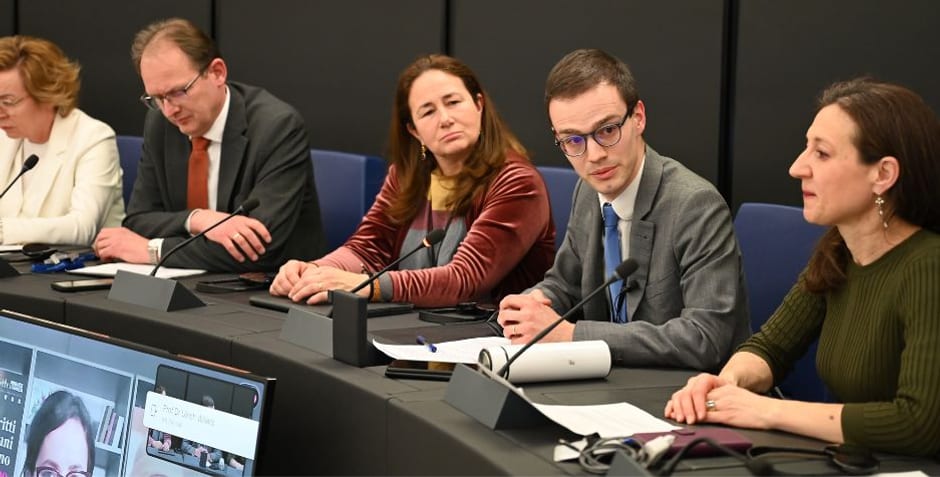
Thank you very much, Paolo Inselvini, Miriam Lexmann, Margarita de la Pisa, for organizing this conference. You belong to three different political groups, which represent half of the European Parliament. This gives a certain significance to this conference and to our message about the dignity of every human life.
If we look at the history of the European Union, we find many cases where the EU has expanded its powers against the will of the States.
The Commission’s response to My Voice My Choice is an abuse of power, but it is not the worst of them. The Commission rejected what My Voice My Choice requested, which is good news. No new legislative act will be prepared. No new European fund will be created. It is a defeat for the pro-abortion lobby, whatever they may claim.
I would like to address the current state of the law and practice. I would like to show that we need to fight not only against this Commission’s communication, but also against a broader legal framework.
The first question I would like to raise is about health and the competence of the EU in these matters.
Unfortunately, nothing prevents Member States from considering abortion to be a health service. The EU has supporting competence in the field of health; it has the power to support national health policies.
No rule definitively excludes the possibility that such European financial support may facilitate abortion. This financing is legal if it is in accordance with the will of the State where the abortion is performed.
What would be prohibited under EU law would be reserving European funding specifically for women from certain Member States. But this is not what the Commission said in response to My Voice My Choice. It stated that if European funds may be used, it should be for all women. The funds must not target Polish women or Maltese women.
I believe that this financing is already a common practice, unfortunately.
There are already programs funded by the European Social Fund that facilitate abortion. I checked this for France. For example: in 2024, the European Social Fund financed the establishment of a Women’s Center (“Maison des femmes”). It was in Le Havre, in Normandie. This funding amounts to one million euros. One of their stated objectives is to reduce unwanted and early pregnancies.
Yesterday I called this Women’s Center to find out more about their activities. I reached an automated voice saying: “You have reached the Women’s Center of Le Havre. For an abortion, press 1.” So there was no need to press 1, the answer was already clear: the European Social Fund already finances abortion programs in States where abortion is legal. These programs are available for all European women.
We can wonder how this kind of EU programs can be legal when we have in mind the Commission’s response to One of us in 2014. Two million citizens had asked the EU to prohibit the use of EU funds for practices that destroy the human embryo.
The Commission refused. It argued that it was not necessary, because safeguards already existed to ensure respect for human dignity.
But at no point did the Commission definitively exclude the funding of practices that destroy the human embryo. The Commission even justified abortion in certain circumstances.
At no point did the Commission define dignity in an objective manner. The EU law does not define dignity. When it is interpreted, the principle of dignity is reduced to individual autonomy. Dignity becomes the autonomy of the already-born individual.
The safeguards invoked by the Commission in 2014 still exist, but they have always been weak. And their interpretation has always been subject to change. So they have never been any real safeguards for unborn children.
The Commission’s response to My Voice My Choice in February 2026 is a natural consequence of this broader legal framework. The Commission’s communication is the least bad response we could have hoped for.
Conservative governments will have difficulty challenging the Commission’s communication on legal grounds. But they can protest politically.
This communication reminds us that we must continue the fight for life. This fight must be political, in order to change the law and place it at the service of life.
We, as civil society, must continue our action to give a voice to unborn children and to women.
Some women shared their stories about abortion in this Parliament last October and last November, in events organized by MEPs present here. They told us how they suffered, how they would have needed support to their maternity, and how their partners and society put pressure on them to have an abortion.
One of these women, Charlène, launched a petition calling on the EU to support maternity. The petition was registered by this Parliament last week (No. 0194/2026). It will be examined in the coming months.
This Parliament and the Commission must hear Charlène’s request. They must hear all the women who wish their maternity to be supported. We, as civil society, fully support this request. We ask again the EU to support maternity and the family.








 UN recognises “coerced” abortion as a form of violence against mothersBy Priscille Kulczyk
 Massachusetts Allows Abortion Up Until BirthBy Constance Avenel
 The Protection of Maternity in the EUBy ECLJ
 Our letter to Ursula von der LeyenBy ECLJ