
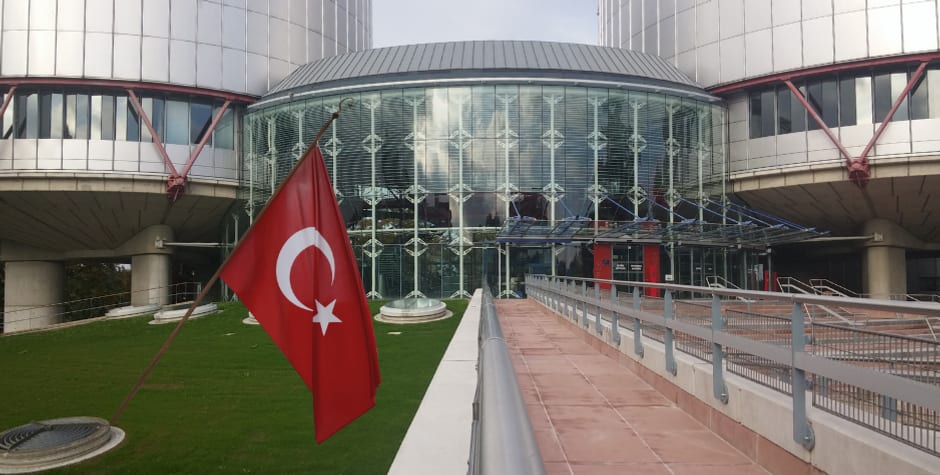

ECLJ Wins Case at the ECHR: Turkey Ruled to Have Arbitrarily Interfered with Three Christian Foundations
ECHR: Three Christian Foundations Win
The European Court of Human Rights (ECHR) has just issued an important ruling in the case of Mavrakis and Others v. Turkey (applications nos. 12549/23 and 2 others, in French only), finding Turkey guilty of arbitrarily preventing two Greek Orthodox priests from serving on the boards of directors of their own religious foundations in Istanbul. This case represents a significant victory and recognition for the ECLJ, which intervened before the Court to denounce the systemic violations against Christian communities in Turkey.
In Turkey, Greek Orthodox priests were removed from the boards of directors of their own Christian foundations…simply because they were priests! In light of the absurdity of the situation, the European Court of Human Rights (ECHR/the Court) unanimously ruled against Turkey on May 26, 2026.
The European Centre for Law and Justice (ECLJ) welcomes the fact that the Court fully took into account the religious dimension of this case, which it adjudicated on the basis of freedom of association in light of freedom of religion (Articles 11 and 9 of the European Convention). It extensively cited and took into account the anti-Christian discrimination perpetrated by the Turkish authorities, which we denounced in written observations that we were permitted to submit. However, the Court could have elaborated further on the substantive protection of the autonomy of religious communities.
Unfounded interference by the Turkish authorities
The applicants, two Greek Orthodox priests, Niko Mavrakis and Corç Kasapoğlu, were elected in 2011 to the boards of directors of Greek Orthodox community foundations in Istanbul. These are highly symbolic foundations: they represent two churches (the Virgin Mary and Aya Konstantin) and the Phanar Greek Boys’ High School, the oldest and most prestigious Greek Orthodox school in Istanbul, established in its current form in 1454.
However, these priests were dismissed by the General Directorate of Foundations, a Turkish public institution under the Ministry of Culture and Tourism, solely on the grounds that they are clergymen. The Directorate attempted to base its decision on the annexes to the 1923 Treaty of Lausanne, which internationally recognized the Republic of Turkey. According to the Directorate, these annexes prohibit clergy from holding positions in administrative and political spheres in the name of secularism. This is ironic discrimination given that imams are permitted to hold such positions.
The legal reality is quite different: the Treaty of Lausanne contains an entire section devoted to the protection of non-Muslim minorities in Turkey (Articles 37 to 45). These provisions primarily concern Greeks, Armenians, and Jews who remained in Turkey following the planned population exchanges between Turkey and Greece. Furthermore, no domestic court has disputed that the priests met all the eligibility requirements set forth in Foundation Law No. 5737 of 2008 and its applicable regulations. The Court therefore noted the complete absence of a clear, accessible, and foreseeable legal basis capable of justifying the interference.
A completely dysfunctional Turkish justice system
Not only did the Turkish government fail to invoke any provision of domestic law that could justify this interference, but it also failed to demonstrate that the Directorate had the authority to strike a duly elected person from the board on the grounds of his status as a cleric. Consequently, the administrative courts in Istanbul initially annulled the removals, but only on the grounds that the Directorate had exceeded its authority.
The Turkish Council of State, however, overturned these rulings, holding that the courts should have declined jurisdiction rather than ruling on the merits of the case. It also clarified that, in the event of an irregularity, the Directorate must bring the matter before the ordinary courts to seek the annulment or reorganization of the election.
When the case was brought in 2023, the Turkish Constitutional Court noted that the legal proceedings—begun in 2012—had dragged on until 2019 only to end with a simple finding of a lack of jurisdiction. The court held that such legal uncertainty for nearly eight years revealed a failure by the lower courts to fulfill their positive obligation to secure the applicants’ freedom of association and that the courts’ inaction had prevented the two priests from performing their duties within the Orthodox foundations. The issue of the priests’ removal was still not addressed; instead, the only issue examined was the absence of a decision on the merits within a reasonable time. The Constitutional Court therefore ordered a reexamination of the case by the lower courts.
The excessive length of the proceedings was such that one of the applicants died in 2025, before the Turkish courts had actually ruled on the merits of the case. The authorities subsequently challenged the right of his heirs to continue the proceedings, further prolonging the litigation.
This entire process is just one example of the Turkish government’s strategy of wearing down Christian communities by dragging them into endless legal battles. By failing to resolve the underlying issues, these protracted proceedings paralyze the operation of religious minority foundations and gradually contribute to the dispossession of Christian communities from their heritage.
The ECHR echoes the ECLJ’s analysis of the anti-Christian historical and structural climate in Turkey
The ECHR explicitly emphasizes the importance of religious pluralism and the vital role of religious minority community foundations, which are essential not only for the community’s survival but also for the functioning of a democratic society. In Turkey, these foundations are not merely administrative bodies: they manage churches, schools, hospitals, cemeteries, and a significant portion of Christian historical heritage.
In its report, The Persecution of Christians in Turkey (2026), the ECLJ documented the infringements on the autonomy of Christian communities, the massive expropriations of community foundations, and the administrative restrictions imposed on churches. One of the most significant aspects of the Court’s judgment is that the Court takes up several key points developed within the ECLJ’s written observations, placing the case inside a broader historical and institutional context affecting all Christian communities in Turkey.
Undermining the autonomy of these foundations equates, in practice, to directly undermining the organization, continuity, and even the very existence of the Christian communities concerned. Since the applicants are priests of the Greek Orthodox community in Turkey, currently numbering only two or three thousand, and since two of the foundations are church organizations, the Court interpreted the interference with their freedom of association in light of their right to freedom of religion.
Beyond legality: the issue of religious autonomy
The judgment rests primarily on a simple yet decisive finding: the disputed interference was not provided for by law. In the absence of a clear, accessible, and foreseeable legal basis, the Court did not need to proceed with an examination of the legitimacy and necessity of the contested measure in a democratic society. The lack of a legal basis alone was sufficient to establish a violation of the Convention.
The scope of the Court’s ruling extends far beyond the case of the two Greek Orthodox priests involved. Any comparable exclusion or restriction targeting members of other religious minority communities—whether Jewish, Armenian, Syriac, or Chaldean—must now meet the same legal requirements. In an environment where Christian minority institutions remain particularly vulnerable in Turkey, this decision serves as a reminder that public authorities may not arbitrarily intervene in the governance of community foundations.
This decision could also be invoked in other cases involving religious freedom in Turkey, particularly those concerning foreign Protestants who have been deported under vague pretexts of national security, being accused only of missionary activities that are entirely legal under Turkish law.
In the absence of a legal basis for the contested decision, the Court did not need to rule on the legitimacy of the clerics’ exclusion under Articles 9 and 11 of the Convention. However, the Court could have strengthened its reasoning by explicitly referring to its established case law on the autonomy of religious communities, particularly in the cases of Hasan and Chaush v. Bulgaria, Sindicatul “Păstorul cel Bun” v. Romania, and Fernández Martínez v. Spain.








 Baptism and the Right to Erasure of Personal Data - Key ArticleBy Alicja Słowik
 Autonomy of religious institutions under threat?By Alicja Słowik
 Armenian Minister Denies the Persecution of the Armenian ChurchBy Thibault van den Bossche