
Transition in Syria: The ECLJ organises a conference in Brussels to demand constitutional guarantees for Christians
Brussels: Conference for Christians in Syria
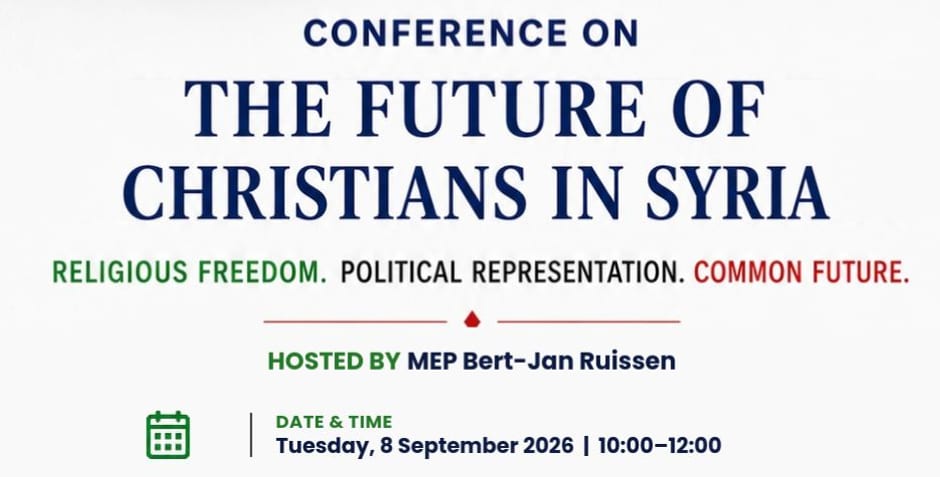
Faced with the exclusion of Christian communities by the new authorities in Damascus, the ECLJ is co-organising a high-level conference at the European Parliament in Brussels on September 8, 2026. The objective: to place religious freedom and inclusive governance at the heart of international negotiations on the Syrian transition.
European policymakers, religious leaders, and representatives of Christian communities will gather at the European Parliament in Brussels on September 8, 2026 to discuss the future of Christians in Syria. Christians are demanding concrete guarantees regarding religious freedom and genuine political representation, at a time when Syria is undergoing rapid diplomatic normalisation following the fall of the Assad regime in December 2024 and the rise to power of former Islamist terrorist Ahmed al-Sharaa.
Hosted by MEP Bert-Jan Ruissen (ECR, Netherlands), Co-Chair of the Intergroup on Freedom of Religion or Belief and Religious Tolerance, this event is co-organised by the European Centre for Law and Justice (ECLJ), the European Syriac Union (ESU), Syriac Cross Belgium, Sallux (the ECPP Foundation), and Jubilee Campaign Netherlands, and is coordinated by Ruth Daskalopoulou.
The conference will open with addresses by two major figures in international diplomacy: H.E. Mairead McGuinness, European Union Special Envoy for the promotion of freedom of religion or belief outside the EU at the European Commission, and the Honourable Nadine Maenza, Co-Chair of the International Religious Freedom (IRF) Roundtable in Washington, D.C., and former Chair of the US Commission on International Religious Freedom (USCIRF).
We will then address two essential pillars for the survival of Christian communities:
Panel 1: Religious Freedom, moderated by Thibault van den Bossche, ECLJ:
- Bishop Georges Assadourian, Armenian Catholic Bishop of Damascus
- Archbishop Georges Masri, Greek-Melkite Metropolitan Archbishop of Aleppo
- Father Vasilios Khamis, Greek Orthodox Church of Antioch
- Johannes de Jong, Sallux
Panel 2: Political Representation, moderated by Metin Rhawi, ESU:
- Sanharib Barsom, Syriac Union Party
- Waddah Al Khoury, Levantine National Council
- Ninous Icho, Assyrian Democratic Party
- Sarah Aphram, Syriac Cross Belgium
The conference comes at a historic turning point. On 24 August 2026, the United States officially removed Syria from its list of State Sponsors of Terrorism, on which the country had been listed since 1979. They also removed Hayat Tahrir al-Sham (HTS)—the former Al-Nusra Front, an Islamist group previously led by Ahmed al-Sharaa—from their list of Specially Designated Global Terrorists (SDGT). In July 2026, French President Emmanuel Macron and subsequently UN Secretary-General António Guterres visited Syria in quick succession.
Furthermore, on 25 August 2026, Mazloum Abdi, leader of the Kurdish-led Syrian Democratic Forces (SDF), announced the official dissolution of his military alliance in order to integrate tens of thousands of fighters into the central army in Damascus.
However, this transition raises serious human rights concerns and the risk of "victor's justice". While the opening of the first post-Assad trials—including the death sentence in absentia of Bashar al-Assad and the life sentence of former Grand Mufti Ahmed Hassoun—offers hope, it also reveals a critical legal vacuum. UN experts warn against the absence of a modern transitional justice framework and the persistence of deep-seated sectarian violence.
For the Christians of Syria, existential threats are intensifying critically. Reflecting this rapid deterioration, Syria has risen to 6th place on the Open Doors 2026 World Watch List. The community remains profoundly traumatised by the June 2025 suicide attack on the Mar Elias Greek Orthodox Church in Damascus, which claimed the lives of 25 worshippers. Widespread persecution and forced emigration have reduced the Christian population from nearly 1.5 million in 2011 to an estimated 300,000 to 500,000 today.
The diplomatic normalisation initiated by the EU and Western powers is progressing far faster than actual stabilisation on the ground. The new legislative authority, largely controlled by Ahmed al-Sharaa, completely excludes Kurdish and Assyrian organisations. Key powers thus remain concentrated within a new ruling elite resulting from "Idlibisation", a drift that the ECLJ denounced in its 16 July 2026 submission to the United Nations for the Universal Periodic Review of Syria.
We urge EU institutions and Member States to translate their commitments into political action. They must place freedom of religion and meaningful political representation for the various religious and ethnic communities at the heart of the Syrian transition, conditioning their future relations on two immediate criteria:
- Fundamental rights, equal citizenship, and protection: Christians and other indigenous religious communities must enjoy full freedom of worship, equal protection before the law, and property rights. It is imperative that they be able to preserve their tangible heritage, secure their assets, and rebuild their local structures safely, free from any discrimination, Islamist reprisals, or sectarian pressure.
- Meaningful political participation and inclusive governance: These under-represented communities must have a direct, democratic, and uncompromised role in reshaping the country's future. This entails a sovereign voice in drafting Syria's future permanent constitution, shaping its new political institutions, and managing decentralised local administration, basing this governance on the principle of equal citizenship rather than sectarian quotas.
Building on the European Parliament resolution of 10 July 2025, the ECLJ stresses that the survival and preservation of historic Christian communities in their ancestral lands will serve as the barometer of pluralism and democracy in the new Syria.
Practical Information:
- Title: "The Future of Christians in Syria: Religious Freedom, Political Representation, and a Shared Future"
- Date and Time: Tuesday 8 September 2026 | 10:00 – 12:00
- Venue: Room SPAAK 1A2, European Parliament, Brussels




 Christians in Syria, Algeria, and Morocco: ECLJ takes action in BrusselsBy ECLJ
 EU 2025 Human Rights Report: 7 Key Countries for the ECLJBy Thibault van den Bossche
 Venezuela: A Country Turning Against Its Own PeopleBy ECLJ