
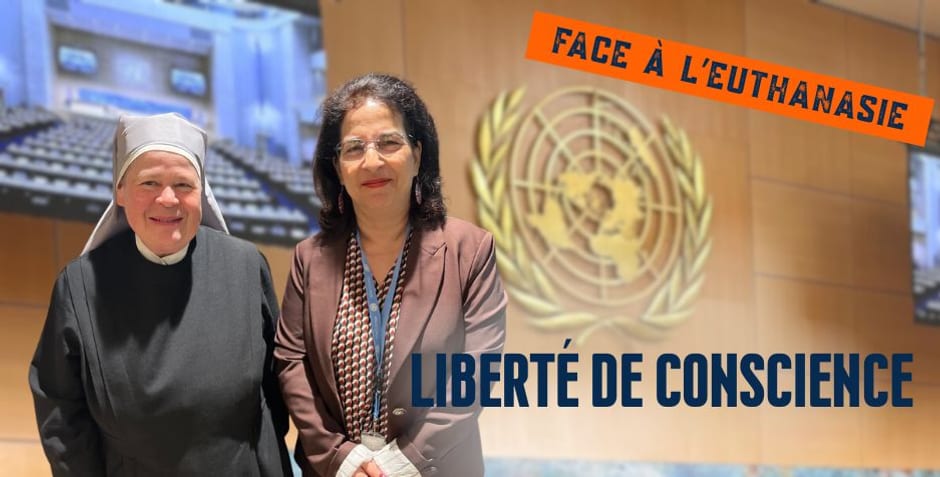
On Tuesday, March 3, 2026, Sister Agnès, a doctor with the Little Sisters of the Poor, spoke before the Special Rapporteur on Freedom of Religion or Belief at the United Nations in Geneva to defend the conscientious objection of religious healthcare institutions to euthanasia.
The proposed law on the right to aid in dying adopted by the National Assembly on February 25, 2026, compels all healthcare institutions to allow euthanasia on their premises. This is an attack on the religious freedom of people who come together for an ethical, philosophical, or religious project that is fundamentally opposed to the idea of killing. The Little Sisters of the Poor and other Christian congregations have been working for centuries to care for the sick and should not be forced to renounce God's commandments and their Hippocratic oath in order to continue their work.
Grégor Puppinck, ECLJ director, also accompanied Sister Agnès that same day to various meetings at the United Nations, notably with the Apostolic Nuncio in Geneva, Monsignor Ettore Balestrero, and with the Special Rapporteur on Freedom of Religion herself, in order to inform them of all the consequences of the law if it were to be definitively adopted.
Here is what Sister Agnès said during the 61st regular session of the Human Rights Council in an interactive dialogue with the Special Rapporteur on freedom of religion or belief:
Madam Special Rapporteur,
I have come here to alert you and ask for your help.
I am a nun from the congregation of the Little Sisters of the Poor.
I am speaking here on behalf of the French Catholic congregations that have founded and run hospitals and retirement homes.
Our mission is to care for the poor, the elderly, the sick, people with disabilities, and the most vulnerable.
However, a law currently under discussion in France would legalize euthanasia, according to a permissive, expeditious, and repressive procedure.
It would also compel all religious institutions to accept the practice of euthanasia within their walls, on their patients and residents.
It even provides for a two-year prison sentence and a €30,000 fine if we refuse euthanasia and assisted suicide. Anyone who tries to convince a loved one not to resort to euthanasia faces the same penalty.
Madam Rapporteur, we want to continue to welcome, care for, and accompany life to its natural end with gentleness and compassion. We want to relieve suffering, including that which causes people to ask to die, but our hands will not kill, even if we are condemned for it.
Madam Rapporteur, as you know, such a criminal conviction for our refusal to perform euthanasia would be a serious violation of our freedom of religion, which is guaranteed by European and international law.
We urge you to intervene with the French government to ensure that it respects human life and our freedom.
Thank you.
The ECLJ is actively engaged in opposing the legalization of euthanasia in France and around the world. In particular, we have published a detailed analysis of the French bill and all the problems it raises: read the article.
Sign our pétition and share our video to support our action:








 Noelia's Case: the ECHR to Rule Again?By Nicolas Bauer
 Are American Religious Institutions Required to Refer Patients Who Request Euthanasia?By Alicja Słowik
 France: Aid in Dying & the Rights of People with DisabilitiesBy Nicolas Bauer
 Euthanasie: liberté des établissementsBy Grégor Puppinck