On March 18, 2026, the ECLJ denounced before the UN the ongoing oppression of Christians in Algeria, marked by the closure of churches, pressure on converts, and increasing legal persecution. In light of the deterioration of religious freedom and the upcoming visit of Pope Leo XIV to the country, we called on the authorities to effectively respect freedom of conscience.
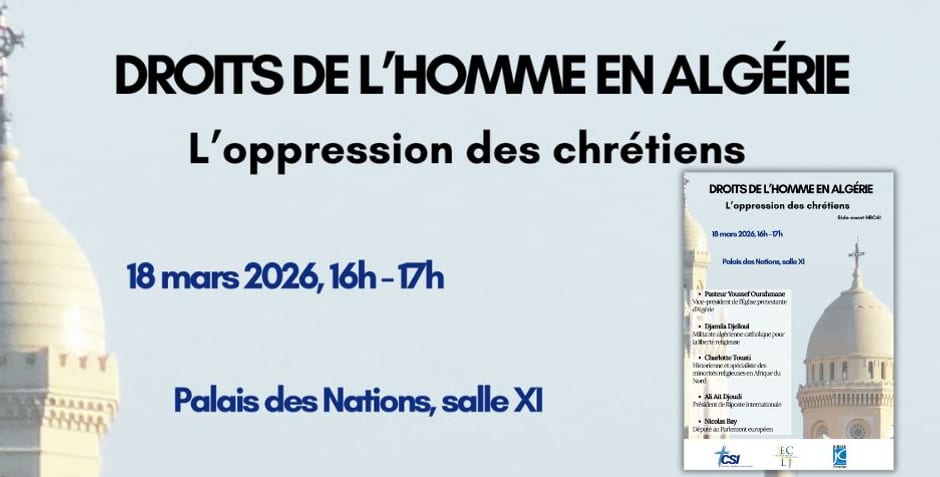
On March 18, 2026, the European Center for Law and Justice organized a conference dedicated to the human rights situation in Algeria. With Pope Leo XIV’s visit approaching from April 13 to 15, 2026, we focused particularly on the oppression faced by Christians.
Several prominent speakers took the floor:
- Pastor Youssef Ourahmane, vice president of the Protestant Church of Algeria;
- Djamila Djelloul, a Christian convert from a Muslim background, of Algerian origin, and author of the autobiographical book “Muslim, Jesus Set Me Free”;
- Dr. Charlotte Touati, historian and specialist on minorities in North Africa, researcher at the University of Lausanne;
- Ali Aït Djoudi, president of Riposte Internationale;
- Nicolas Bay, Member of the European Parliament.
This event, organized on the sidelines of the 61st session of the United Nations Human Rights Council, was held with the support of Christian Solidarity International and Jubilee Campaign.
Pope’s Visit to Algeria: The Distant Legacy of St. Augustine
Pope Leo XIV’s historic visit to Algeria will take place thirty years after the martyrdom of the monks of Tibhirine. This anniversary recalls a painful history: that of the “Black Decade” and the 19 Catholic martyrs of Algeria. But this visit also points to a two-thousand-year-old Christian presence in this land, whose continuity is embodied in our time by the Pope, a member of the Order of Saint Augustine.
On the part of the Algerian authorities, Algeria’s Christian identity is virtually denied. Abdelaziz Bouteflika had vaguely attempted to appropriate the Augustinian figure, notably through the international symposium organized in 2001 by the High Islamic Council on the theme “Saint Augustine: Africanity and Universality.” Today, under President Tebboune, what really remains of this legacy?
For the reality is clear: currently, in Algeria, one cannot freely be Christian. The Constitution adopted in 2020 removed all explicit references to freedom of conscience. In practice, Islamic identity constitutes the only fully recognized religious reference, enshrined in both the Constitution and the Family Code, and structuring all of social life, including the choice of first names.
Evangelical churches closed, the Catholic Church reduced to a showcase for “interreligious dialogue”
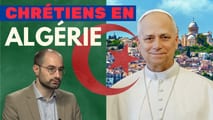
Evangelical Protestant Christians are among the most vulnerable. Their missionary commitment subjects them to constant pressure. Pastor Youssef Ourahmane, vice-president of the EPA, was sentenced on May 2, 2024, by the Tizi Ouzou Court of Appeal to one year in prison and a fine of 100,000 dinars for “conducting an unauthorized worship service.” Speaking before the UN, he highlighted the difficulties faced by the Bible Society in importing Bibles, the constant surveillance of believers, and the intimidating interrogations conducted by the police or judicial authorities. Furthermore, the 47 churches of the EPA have been closed, while the legal status of this church, recognized since 1972, is now being called into question.
Charlotte Touati points out that “the authorities generally cite the lack of administrative authorization,” required by the 2006 ordinance on non-Muslim religions and the 2012 law on associations. She notes, however, that “Christian communities explain that their registration requests remain unanswered.” The result, she adds, is “a paradoxical situation: churches are closed for lack of authorization, even though this authorization is almost impossible to obtain.”
The Catholic Church now prioritizes interreligious dialogue alone at the expense of evangelization, and the Algerian authorities use this to project an image of tolerance. The restoration of the Cathedral of the Sacred Heart in Algiers, launched on December 7, 2025, is part of this approach and receives public funding. Nevertheless, the Catholic Church is not exempt from restrictions: its humanitarian service Caritas, which has served the entire population since 1962, was closed in October 2022. The Archbishop of Algiers, Bishop Jean-Paul Vesco, announced at the time that he wished “not to enter into conflict with the authorities” and to “continue doing good without making a fuss.”
The Need to Bear Witness to Christ in a Context of Political, Civic, and Religious Repression
Djamila Djelloul, a Christian of Muslim background, takes a much more committed stance. Addressing Pope Leo XIV directly, she “implores him to demand true freedom of conscience—that is, the right to change one’s religion for those coming from Islam—not merely the freedom to practice for Christians already there.” The Holy Father must also “awaken the priests, who are the successors of the apostles,” Djamila Djelloul reminding him that “dialogue does not convert; only Jesus converts.” Finally, she urges him to “meet with the converts to tell them: you exist, you have your place, we are with you and for you.”
A powerful testimony at a time when proselytism is subject to criminal penalties: the 2006 ordinance specifically prohibits “undermining a Muslim’s faith” or converting them to another religion. But how should this prohibition be interpreted in practice? When an Algerian freely asks questions about the Christian faith and receives answers, do these exchanges constitute a violation? Following this logic, the authorities are cracking down on conversions to Christianity, which are perceived as an attack on Algeria’s Islamic identity.
More broadly, repression has affected the entire political and civic sphere since the popular uprising of February 22, 2019, known as the “Hirak” (the “movement” in Arabic). This crackdown “has intensified with the extensive use of Article 87 bis of the Penal Code, which broadens the definition of acts classified as terrorism,” observes Ali Aït Djoudi. The writer Boualem Sansal, convicted of undermining national unity and then pardoned in November 2025, and the sports journalist Christophe Gleizes, sentenced in December 2025 to seven years in prison for “glorifying terrorism” and still in detention, concretely illustrate the scope of these prosecutions.
Our contradiction regarding the early Christian martyrs and Algeria’s international commitments
Looking at history, Charlotte Touati highlights “a profound contradiction”: “We honor the Christian martyrs, executed in the early days of the Church for refusing to abandon their faith. We admire Augustine, the great convert of North Africa. But what are we doing for today’s converts? What are we doing for these men and women in Kabylie who read the same Gospels, meditate on the same texts, and follow the same spiritual path?”
“Freedom of conscience cannot be merely a tribute to the past. It must be a reality for the present,” insists Charlotte Touati. The ECLJ points out that this freedom binds Algeria to its international obligations and cannot depend on a religious majority or a political context. “We will always stand with fundamental freedoms and with Christians who are oppressed and suffering, all the more so when it comes to Christians living in territories close to Europe,” states MEP Nicolas Bay.
Algeria has had an association agreement with the European Union since 2002, Article 2 of which establishes respect for human rights and democratic principles as an essential element of cooperation. Nicolas Bay therefore calls on the European Commission to “uphold the terms of this agreement” and not to allow “the Algerian government to do as it pleases, as it goes ever further in restricting freedoms, in a headlong rush of which the entire Algerian people are the victims.”


 France: The Church's Suffering & HopeBy Grégor Puppinck
 China: Pastor Cao Must Come HomeBy ECLJ
 Tunisia: Christians Facing Kais Saied’s Identity-Driven ShiftBy Constance Avenel
 Syria: Christians left Behind?By Thibault van den Bossche