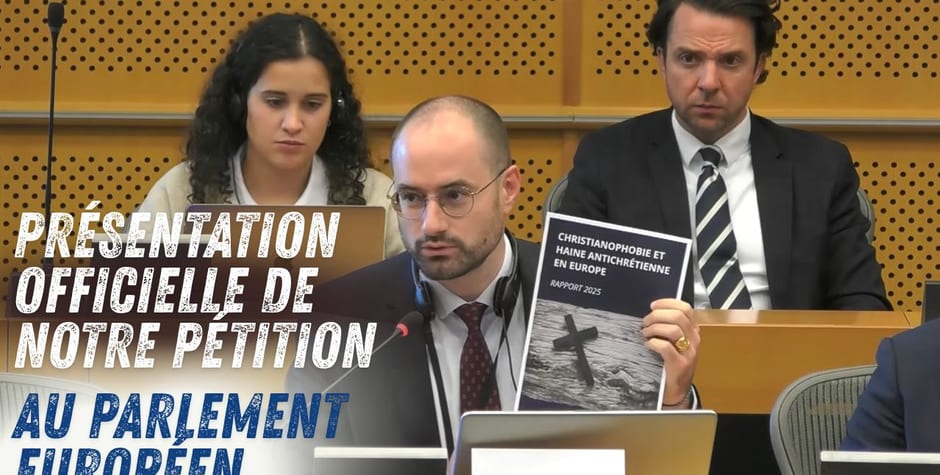
Thibault van den Bossche, our Advocacy Officer for Religious Freedom, was heard on Monday, October 12, 2026, by the European Parliament’s Committee on Petitions. Faced with Brussels’ inertia, the committee is keeping the ECLJ petition open "on the alleged rise of anti-Christian sentiments and the need for equal protection within the EU," and will push for a plenary resolution.
This is a crucial step in the institutional recognition of the rise of anti-Christian acts on the European continent and the need for equal protection throughout the European Union. On October 12, 2026, following the hearing of petition No. 0443/2026 presented by Thibault van den Bossche on behalf of the European Centre for Law and Justice (ECLJ), the European Parliament’s Committee on Petitions (PETI) decided to keep the file open.
The need for action is supported by the reality of overall figures provided by the Observatory on Intolerance and Discrimination against Christians in Europe (OIDAC Europe), which recorded 2,211 anti-Christian hate crimes on the continent for the year 2024 alone, including 274 direct physical assaults and 94 church arsons. The ECLJ opened the hearing by recalling the atrocious murder of Ashur Sarnaya, a Christian Iraqi refugee who fled ISIS in 2014 only to have his throat slit in Lyon in September 2025 by a radicalized Algerian Muslim.
The Three Faces of Systemic Invisibility
This anti-Christian violence in Europe remains largely obscured due to three major obstacles:
- Under-reporting by States, which often classify church vandalism as mere "property damage" and fail to transmit their data to international bodies such as the OSCE.
- Under-reporting by victims, who refrain from filing complaints out of resignation, fear, or a tendency to downplay the facts.
- An ideological and political bias, which perceives Christianity solely as a historically dominant religion and refuses to conceive that Christians can also be victims.
In response, the ECLJ requests in its petition the appointment of a European Union Coordinator tasked with combating attacks and discrimination against Christians, following the model of the posts created in 2015 for Muslim and Jewish communities. We also call for enhanced collaboration between communities, civil society, and States to build national cooperation frameworks, break self-censorship, and deploy effective protections.
Brussels’ Political Divide Facing the "Double Standard"
During the debates, representatives of the European People’s Party (EPP), Patriots for Europe (PfE), European Conservatives and Reformists (ECR), and Europe of Sovereign Nations (ESN) unanimously supported keeping the petition open, denouncing a "double standard" policy. Conversely, the seats of the center and left groups remained entirely empty. This glaring lack of interest was sharply criticized by German MEP Tomasz Froelich (ESN), who recalled that these are nevertheless characterized human rights violations.
For its part, the European Commission’s representative under Article 17 of the TFEU (relations with churches) delivered a particularly timid response. While conceding the unacceptable nature of the violence, the European executive stated that it intended to use existing texts but "did not plan to develop new mechanisms," thereby shifting the responsibility solely onto Member States. Illustrating this persistent immobility, French MEP Virginie Joron (PfE) recalled that a written question had been tabled as early as October 22, 2025, by Fabrice Leggeri (PfE) to demand the appointment of a European Coordinator—an interpellation that remained without a satisfactory response from the Commission.
The local situation remains no less alarming. Spanish MEP Margarita de la Pisa Carrión (PfE) condemned the institutions’ silence in the face of what amounts to the largest religious persecution on the continent, recalling that 67% of Spanish priests report having suffered insults or mockery. In France, MEP Laurence Trochu (ECR), who is leading a related petition already gathering over 15,000 signatures, pointed to a 70% explosion in attacks on Christian individuals between 2024 and 2025. She also recalled that the European Parliament had already validated the principle of such protection by adopting an amendment she proposed in a resolution on January 21, 2026, deploring the lack of a dedicated coordinator while drawing a parallel with the plight of the 380 million Christians persecuted worldwide.
Faced with the inadequacy of the executive’s responses, the PETI committee chose to keep the petition open. It now demands additional official information from the European Commission and will push for a plenary debate followed by a resolution. The appointment of a European Coordinator is a pure matter of equality and justice—a demand also widely supported by the Intergroup on Freedom of Religion, COMECE (Commission of the Bishops’ Conferences of the European Union), Apostolic Nuncio Archbishop Noël Treanor, and numerous European civil society organizations.
As a sign that a global awareness is underway, on October 8, 2026, the European Parliament adopted a major resolution on the need for the Union to equip itself with a strategy against Islamist entryism and the influence of the Muslim Brotherhood network. MEPs explicitly identified "anti-Christian hatred," alongside antisemitism, the subjugation of women, and the questioning of secularism, as a clear marker of ideological radicalization. Furthermore, on June 24, 2026, the Parliamentary Assembly of the Council of Europe (PACE) was also seized of the matter through a cross-party motion for a resolution titled "Hate crimes, intolerance, and discrimination against Christians in Europe," urging States to develop a common strategy to prevent these crimes, including online, and to secure places of worship.
Sign our petition:




 Secularism, Catholic Schools, Protection of Life: Leo XIV Has Spoken OutBy Constance Avenel
 Baptism and the “right to be forgotten”By Alicja Słowik
 France: The Church's Suffering & HopeBy Grégor Puppinck
 China: Pastor Cao Must Come HomeBy CeCe Heil