
Christians in Iraq at Risk: The ECLJ Raises the Alarm with the Institutions
Christians in Iraq at Risk: The ECLJ Raises the Alarm Again
The ECLJ has been contacted about several cases involving Christians in Iraq. Their circumstances illustrate the increasingly precarious position of this community, whose very survival in its ancestral homeland is under threat. In response, the ECLJ has raised these cases with the French authorities, European institutions and representatives of the Holy See.
Violence and Discrimination: Christians in Iraq Under Pressure
Iraq is home to one of the oldest Christian communities in the world. According to tradition, Christians were present in Iraq as early as the first century, long before the advent of Islam. Yet its Christian population has suffered an unprecedented decline: from approximately 1.5 million Christians in 2003, it is now estimated to number only around 150,000, representing less than 1% of the population. In its 2025 report on the human rights situation in Iraq, the Hammurabi Human Rights Organisation still classifies Christians among the “minorities at risk of extinction”, alongside the Yazidis, Shabaks, Turkmen and others.
Wars, the fall of Saddam Hussein, the occupation by the Islamic State from 2014 onwards, and successive waves of emigration have all contributed to this decline, as the ECLJ pointed out in its submission to the 2024 Universal Periodic Review. More recently, the conflict between Israel and Iran exacerbated the situation. Caught in the crossfire, Iraqi Kurdistan, the heartland of the Christian presence in Iraq, has seen tensions rise. Drone attacks by Shia militias have damaged several buildings belonging to the Chaldean Archdiocese of Erbil, while the town of Bartella, in the Nineveh Plains, was hit by US strikes in March 2026.
Christians are bearing the brunt of this geopolitical turmoil, but they also face domestic challenges, including institutional marginalisation and a political system that establishes Islam as the state religion.
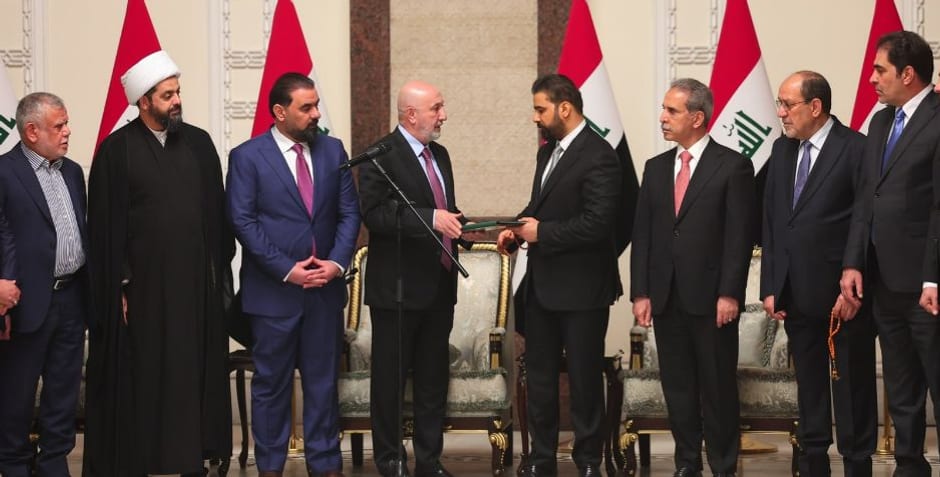
On paper, Christians enjoy religious freedom. Iraq ratified the International Covenant on Civil and Political Rights in 1971, and on 11 July 2026, the Prime Minister declared, during a meeting with the newly elected Patriarch of the Chaldean Catholic Church, that “Christians are an essential part of our society.” Yet Article 2 of the 2005 Constitution contradicts this statement. Its first paragraph establishes Islam as the state’s “official religion” and “a fundamental source of legislation”, while the second guarantees freedom of belief and religious practice to all, explicitly mentioning Christians. In practice, the tension between these two principles is resolved in favour of Islam, to the detriment of religious minorities.
The situation is particularly precarious for Christians who have converted from Islam, as Iraqi law does not recognise their conversion. They therefore remain registered as Muslims in civil records, hindering their ability to marry, undermining their position in child custody proceedings and complicating their inheritance rights. As a result, they are forced to practise their faith clandestinely.
Conversely, conversion to Islam can be imposed by law, including on children. Article 26 of Law No. 3 of 2016 on the National Identity Card stipulates that a minor must automatically be registered as Muslim if either parent converts to Islam. A parent’s conversion therefore results, by operation of law, in the conversion of their children to Islam, including children from a previous relationship, without their consent or that of the parent who remains Christian. Attempts to reform the law, first launched in 2015 and subsequently revived by civil society, have failed. Although a handful of court rulings have allowed individuals to have their status amended in civil registers, these are individual remedies that are lengthy and costly and do not challenge the law itself.
These legal constraints are compounded by social violence: family pressure and threats, unlawful confinement, forced marriage and, in the most serious cases, so-called “honour killings”. This scourge persists in Iraq, where apostasy is regarded by some families as the ultimate betrayal. Victims who file complaints receive no effective protection, while relocating to another part of Iraq offers no lasting guarantee of safety, as information circulates through wide family and tribal networks. Faced with such precarious circumstances, many Christians choose to flee the country.
The ECLJ Takes Action to Protect Christians at Risk in Iraq
The ECLJ has been approached regarding serious cases involving Iraqi Christians whose safety and fundamental rights are no longer guaranteed. These cases concern families and individuals, both Christians by birth and converts. Some are seeing their children administratively reclassified as Muslims under Article 26, a measure that directly threatens the exercise of parental responsibility and the right to raise children in their faith. Others face violent reprisals from family members or repeated extortion, against which local legal remedies have proved wholly ineffective. Deprived of effective protection in their own country, some victims have even been forced to seek temporary refuge in neighbouring countries, such as Egypt, to protect their children from forced conversion to Islam.
In response to these flagrant violations of international law, the ECLJ has taken action to bring these cases to the attention of diplomatic authorities and call for respect for religious freedom in Iraq.
We have alerted French diplomatic authorities within the Ministry for Europe and Foreign Affairs, including the Religious Affairs Adviser and the North Africa and Middle East Directorate, as well as French diplomatic missions in the region. At the European level, we have raised these cases with the European External Action Service (EEAS) and its local delegations. In Brussels, we submitted the cases directly to the Cabinet of the European Commissioner for the Mediterranean, Dubravka Šuica. We called on her to ensure that the rights of Christian minorities are fully taken into account in political dialogue and bilateral relations with the Iraqi government.
Finally, we approached the Holy See through the Apostolic Nuncios in Iraq and Egypt, seeking its support in these protection efforts.

 Secularism, Catholic Schools, Protection of Life: Leo XIV Has Spoken OutBy Constance Avenel
 Baptism and the “right to be forgotten”By Alicja Słowik
 France: The Church's Suffering & HopeBy Grégor Puppinck
 China: Pastor Cao Must Come HomeBy CeCe Heil