
Anti-Christian hatred in Europe: violence becoming commonplace as Christmas approaches
Anti-Christian hatred in Europe
Anti-Christian hatred is on the rise in Europe, taking increasingly visible and violent forms. Attacks, desecrations, church fires, discrimination, and restrictions on religious freedom are on the increase. The recurring controversies surrounding Christmas nativity scenes are in fact only the most visible and trivialized aspect of a much broader phenomenon. To alert European politicians and institutions, the European Center for Law and Justice (ECLJ) has published a landmark report entitled “Christianophobia and Anti-Christian Hatred in Europe.”
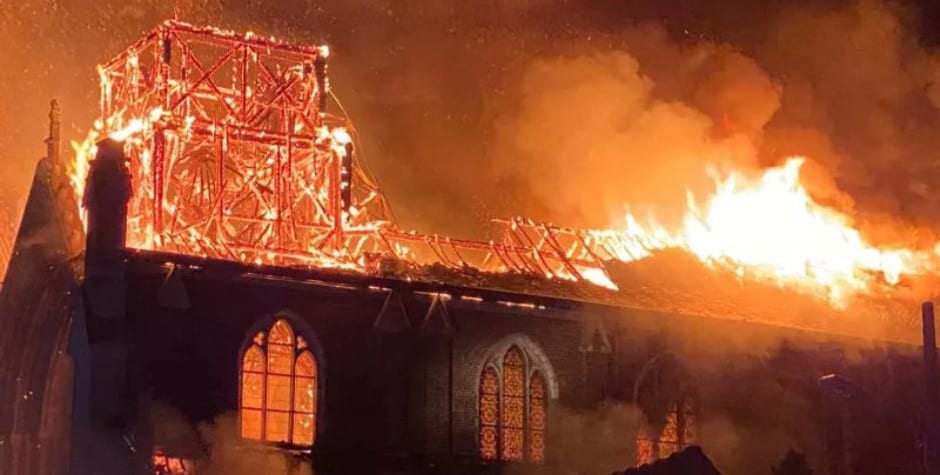
Christmas is approaching. What remains of this season of peace and reflection for millions of Christians in Europe? Never before have attacks against Christians been so numerous, so visible, and so commonplace. Churches burned or desecrated, crosses destroyed, worshippers assaulted, priests threatened, Christians silenced in public or professional spaces: anti-Christian hatred is spreading across Europe amid worrying indifference.
Christians in Europe censored, threatened, and attacked
In September 2025, Ashur Sarnaya, an Iraqi Christian who had fled to France to escape the Islamic State, was murdered by an Islamist terrorist while publicly professing his faith. According to figures from the Observatory of Intolerance and Discrimination against Christians in Europe (OIDAC), 2,211 anti-Christian acts were recorded in Europe in 2024, including more than 270 physical attacks. These figures, which are already alarming, only reflect part of the reality, as under-reporting remains widespread. Many victims do not report incidents out of fear, weariness, or to avoid being accused of “exploitation.”
At the same time, another form of violence, more diffuse but just as real, is taking hold. Christians censor themselves at work, at university, or in public spaces to avoid punishment, ridicule, or discrimination. Teachers, doctors, pharmacists, nurses, and magistrates are prosecuted or punished for remaining faithful to their Christian convictions. Christian hospitals are forced to perform abortions or euthanasia. People are convicted for praying silently or quoting the Bible. Religious freedom, although guaranteed by law, is in decline in practice.
Anti-Christian hatred, a blind spot in European politics
Faced with this reality, a striking asymmetry remains. The European Union and the Council of Europe have put in place specific mechanisms to combat anti-Semitism and anti-Muslim hatred: dedicated coordinators, targeted strategies, funding, official reports. Nothing comparable exists for Christians, yet they are the largest religious community in Europe and increasingly exposed.
It is in this context that the European Center for Law and Justice (ECLJ) is publishing a landmark report on anti-Christian hatred in Europe. Based on rigorous data and in-depth legal analysis, this report highlights the scale of the phenomenon, its causes, its manifestations, and the shortcomings of institutional responses. It also makes concrete proposals: explicit recognition of anti-Christian hatred, collection of specific data, enhanced protection of places of worship, effective respect for conscientious objection, and the creation of a dedicated European coordinator.
A report and a petition to make the voice of Christians heard
But a report, however solid it may be, is not enough without mobilization. That is why the ECLJ is launching an official petition calling on members of the European Parliament and the Parliamentary Assembly of the Council of Europe to put the fight against anti-Christian hatred on their agenda and to move towards concrete responses. This petition is part of an official institutional procedure provided for in the rules of both assemblies. It will be formally examined and will elicit an official response. This is not a symbolic gesture, but a concrete democratic lever.
Anti-Christian hatred is not a marginal issue. It concerns religious freedom, freedom of expression, human dignity and, more broadly, the cultural and spiritual identity of Europe. Fighting it is not about defending a privilege, but demanding equality and consistency. As Christmas approaches, with nativity scenes being vandalized or banned and churches burning, it is time to take concrete action.
👉 Sign this petition:





 Secularism, Catholic Schools, Protection of Life: Leo XIV Has Spoken OutBy Constance Avenel
 Baptism and the “right to be forgotten”By Alicja Słowik
 France: The Church's Suffering & HopeBy Grégor Puppinck
 China: Pastor Cao Must Come HomeBy CeCe Heil