
They now account for only 3% of Kosovo's population, half what they were thirty years ago. A quarter of a century after the end of the war, the Serb minority continues to fade away, slowly but surely, cut off from its institutions and its currency. Yet It remains attached to a land it considers the cradle of its history and faith.
By Sofia Gauruel
A key date in the Serbian calendar and a national holiday, St Vitus's Day (Vidovdan) marks the memory of the Battle of Kosovo of 1389, on which occasion the Orthodox Church pays tribute to the Serbian martyrs of that battle. On 28 June 2026, the day of this commemoration, Kosovo police arrested at least 36 Serbs who had come to attend the ceremonies at Gazimestan, a site regarded by Serbs as the cradle of their nation. For the Youth Initiative for Human Rights (YIHR), present in Pristina, this incident shows that no lasting normalization between Belgrade and Pristina is possible without genuine protection of minorities.
This episode illustrates the persistent tensions that, a quarter of a century after the war, still set the Kosovo authorities against the country's Serb minority. In a Kosovo of 1.6 million inhabitants, overwhelmingly Albanian, this community now accounts for only about 3% of the population, half what it was thirty years ago. Yet it continues to regard this territory as its national and spiritual cradle, shaped by centuries of history and by the presence of some of the oldest Orthodox monasteries in the Balkans.
An attachment to the land born of faith and history
The Serbs' attachment to Kosovo has its roots in the Battle of Kosovo in 1389, which became a symbol of Serbian sacrifice and resistance against the Ottomans. Serbs indeed refer to this province as "Kosovo and Metohija," Metohija literally meaning "church land." The term refers to territories historically attached to an Orthodox monastery, the Patriarchate of Peć having long been the seat of the Serbian Orthodox Church.
This age-old attachment collided, at the end of the twentieth century, with a conflict that permanently upended the province's demographic balance. The war between the Kosovo Liberation Army (UÇK), an Albanian separatist movement, and Serbian forces ended with NATO's intervention and then the withdrawal of Serbian forces in June 1999. According to the UNHCR, around 230,000 Serbs and members of other minorities left Kosovo at that time. Many of the others withdrew to the north, to Kosovska Mitrovica, or chose to live in enclaved villages in the south of the province. Five years later, in 2004, renewed interethnic violence killed around twenty people in two days and destroyed some thirty Orthodox churches and monasteries. Those who chose to stay nonetheless continue, two decades on, to face pressure that is now less visible but systematic.
An erasure organized through administrative measures
Since Prime Minister Albin Kurti came to power in 2021, the Kosovo government has pursued a policy of dismantling the Serb parallel structures it considers illegal. In February 2024, the Central Bank of Kosovo permanently banned the use of the Serbian dinar in payments, in the name of fighting money laundering, depriving a large part of the Serb community of the ability to directly receive their wages, pensions, and social benefits paid from Serbia. This measure had been preceded, a few years earlier, by the gradual banning of Serbian license plates from circulation. Then, during the summer of 2024, nine Serbian post offices were in turn closed and replaced by branches of the Kosovo post office, without any replacement solution ever being offered.
Each of these measures ostensibly pursues a legitimate aim, such as combating money laundering or simple administrative harmonization. Yet many of them deprive the Serb community of these essential services, with no concrete alternative. This administrative pressure is also accompanied by growing police pressure, with raids on parallel municipal offices and arrests for smuggling medicines unavailable in Kosovo. More recently, an arrest warrant was issued in 2025 against Aleksandar Arsenijević, president of the Serb Democracy party, who has been repeatedly targeted by Kosovo's justice system. Taken together, these measures raise the broader question of their compliance with international law.
A question of law before a frozen conflict
Kosovo's status lies at the heart of a sharp diplomatic rift. The territory unilaterally declared its independence in 2008, recognized by most European Union member states but still disputed by Spain, Greece, Romania, Slovakia, and Cyprus, as well as by Serbia. In this context, Pristina must reconcile the exercise of its sovereignty with its obligations to protect minorities, particularly the Serb Christian community.
This tension is first and foremost set within a precise legal framework. Freedom of religion, including in its collective and public dimension, is guaranteed by Article 9 of the European Convention on Human Rights (ECHR). Although Kosovo is not a member of the Council of Europe, its Constitution provides the direct application of several international instruments. It thus incorporates the ECHR as well as the Framework Convention for the Protection of National Minorities, which requires the authorities to guarantee minorities the preservation of their language, culture, and places of worship.
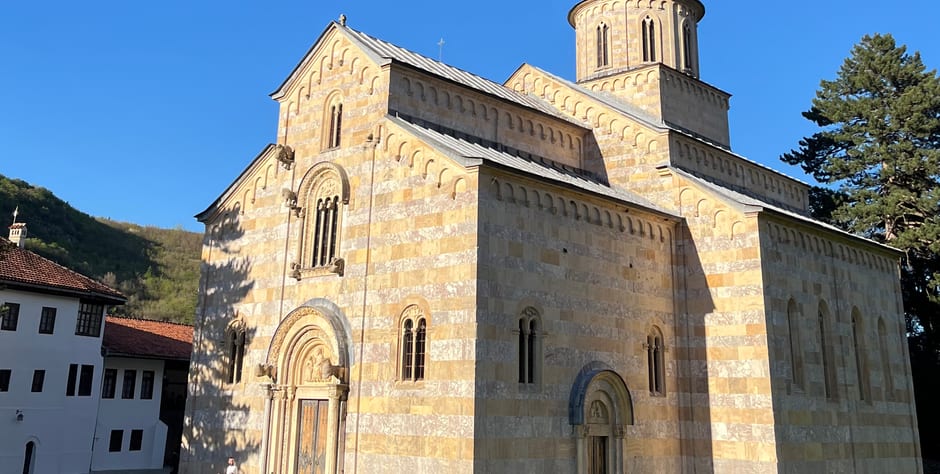
It is precisely on this basis that Kosovo's Serbian religious heritage enjoys enhanced protection. Four thirteenth- and fourteenth-century Orthodox monasteries, Dečani, the Patriarchate of Peć, the Church of the Virgin of Ljeviša, and Gračanica, are today listed as UNESCO World Heritage sites and, since 2006, on the List of World Heritage in Danger. This listing engages Kosovo's responsibility under the 1954 Hague Convention and the UNESCO 2003 Declaration concerning the Intentional Destruction of Cultural Heritage. Moreover, these sites still house monastic communities, which means their protection concerns the concrete exercise of freedom of worship, not merely the preservation of heritage.
It is against this framework, and not solely the political motivations surrounding them, that the measures taken by Pristina toward the Serb minority must be assessed. The principle of proportionality then makes it possible to distinguish, among Kosovo's decisions, those that constitute legitimate public policy from those that place an excessive burden on the rights of this minority.
A Belgrade-Pristina dialogue still stalled
Faced with this situation, several organizations regularly come to the aid of the Serb minority on the ground. The best known in France is Solidarité Kosovo, founded in 2004 by Arnaud Gouillon, which runs humanitarian convoys and funds the renovation of schools.
The European Centre for Law and Justice (ECLJ), whose mandate includes raising alarm on the situation of Christians around the world, also follows the fate of this minority with particular attention, addressing itself directly to the relevant European and international bodies. The ECLJ advocates for an independent proportionality review of the administrative measures targeting Serbs, for strengthened UNESCO protection of the monastic sites, and for recognition by the OSCE and the UN of religious communities' right of access and worship, independent of the territory's political status.
These are all recommendations that could find a natural channel in the dialogue between Belgrade and Pristina, steered by the European Union since 2011. The plan currently under discussion in Brussels further provides for de facto mutual recognition of the two states, as well as the creation of the Association of Serb Municipalities of Kosovo. Yet this association was already agreed on paper back in 2013, without ever being implemented, for lack of agreement on the scope of its powers. Pristina sees in it a risk of secession in the north, whereas the Serbs see in it only the sole concrete guarantee of their collective rights.
The fact remains that, for most observers on the ground, the key to any lasting improvement lies less in new diplomatic pressure than in a return to direct, good-faith dialogue between Belgrade and Pristina. A condition that neither Serbian President Aleksandar Vučić nor Kosovo Prime Minister Albin Kurti seems, to date, politically ready to fulfill.


 Christians in Syria, Algeria, and Morocco: ECLJ takes action in BrusselsBy ECLJ
 EU 2025 Human Rights Report: 7 Key Countries for the ECLJBy Thibault van den Bossche
 Brussels: Conference for Christians in SyriaBy ECLJ
 Venezuela: A Country Turning Against Its Own PeopleBy ECLJ