
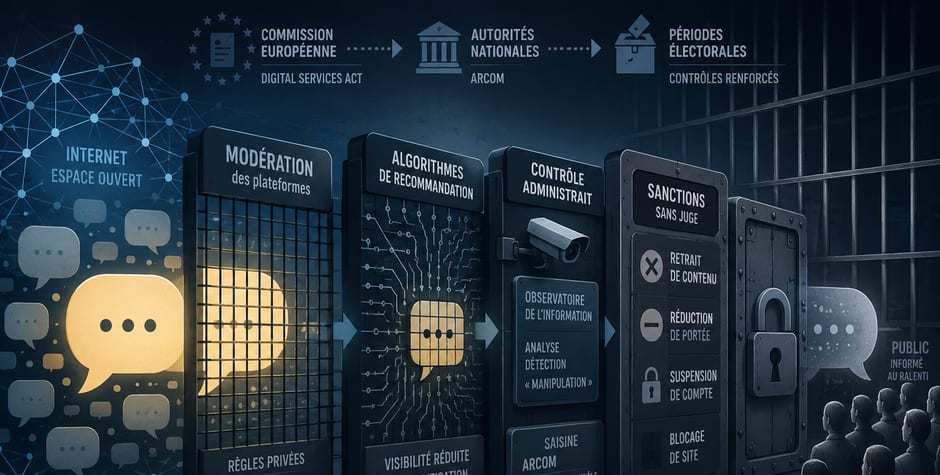

The Architecture of Growing Control Over Digital Freedom of Expression
The Control Over Freedom of Expression
by Antoine Geli
On 8 July 2026, a Senate fact-finding mission delivered a report aimed at curbing domestically-originated online disinformation[1]. The stated intention is beyond reproach. The arsenal it proposes is far less so.
No one disputes that disinformation damages public debate. But the Senate report of 8 July illustrates a method that has become familiar: starting from a legitimate concern to arrive at tools of permanent surveillance.
To grasp the gravity of this report, one must recall what VIGINUM actually is. Originally, it is a state service designed to protect us from a specific enemy: foreign digital interference.
Yet the Senate report proposes creating the equivalent of this service for the “domestic” sphere — that is, to monitor French citizens themselves. Aware that a “Ministry of Truth” would cause a scandal, the authors resort to a sleight of hand: they entrust this mission to an “independent observatory” made up of researchers, but funded by the State. The reality remains the same: a body set in motion by public authority will be tasked with tracking down “information manipulation” among ordinary citizens, activists, or associations.
More serious still: the conclusions of this observatory would not be mere opinions. They could trigger direct sanctions from Arcom or the electoral campaign oversight commission — all without judicial involvement, without any possibility of defending oneself at the moment of accusation, and without any genuine recourse for the person targeted.
The report goes even further in Recommendation No. 4, which specifically targets electoral periods. It suggests imposing far stricter content-removal obligations on platforms, going as far as “suspending algorithms” during campaigns.
The paradox is total: it is precisely at the moment when democratic debate should be at its most intense, and when citizens most need information to circulate freely — ahead of a presidential election, for instance — that the plan is to cut off distribution systems and intensify censorship. At the same time, the report wants to give Arcom a “striking force” to obtain even faster website blocking. The goal is to accelerate repression, without ever strengthening the safeguards that protect freedom of expression.
On 21 July 2026, the National Assembly adopted a law banning social media for those under 15. Here too, the intention is noble, but the means employed are dangerous: they require every individual to have their identity document verified in order to connect to a social network. This is the end of online anonymity — all of it steered by the European Commission.
These texts are not accidents. They are the latest stones in an edifice built over several years, in France as in Europe, brick by brick.
The Tipping Point: When the Judge Disappears
Since the Act of 29 July 1881[2] on freedom of the press, the French rule was simple: only an independent judge, at the end of adversarial proceedings, could censor speech. Freedom was the principle; judicial sanction, the exception, pronounced after the fact.
This model has been overturned. The power to police speech has shifted toward an administrative duo: the European Commission at Union level, and Arcom at national level. Oversight no longer intervenes after content has been disseminated, but increasingly upstream — before it has even had the chance to circulate.
The development of digital technology has considerably transformed freedom of expression by horizontalising speech and giving every citizen the capacity to be their own media outlet. Faced with such a phenomenon, retaining a purely judicial form of repression, as was the case before the twenty-first century, would have been anachronistic. Even so, one is entitled to worry about the consequences such a shift could have for public debate and the future of our democracies.
This shift — from a logic of after-the-fact repression to a logic of prior prevention, that is, of censorship — is the keystone of everything that follows.
The Digital Services Act: Europe's Weapon
The European regulation on digital services[3], which entered into force in 2022 and was transposed into French law by the Act to secure and regulate the digital space (SREN)[4], is the central instrument of this shift.
Its effectiveness rests on fear: platforms are exposed to fines that can reach 6% of their worldwide turnover. The result: for an operator like Meta, Google, or TikTok, it is always more rational and prudent to remove doubtful or contentious content — even if lawful — than to risk a colossal financial penalty. This is preventive censorship; out of fear of the fine, content is removed and censored far more broadly than the law actually requires.
The DSA introduces a “trusted flagger” mechanism (Article 22), through which certain associations obtain privileged status to have content they consider unlawful removed as a priority. The principle can be justified when it comes to associations protecting children, animals, or combating trafficking. But it becomes problematic when these flagging powers fall to organisations that pursue a political agenda and whose impartiality can legitimately be questioned.
Such organisations will tend to flag only the content of their political “opponents”, thereby generating a bias of omission caused by certain trusted flaggers who use their dominant position in the flagging process to advance their political agendas on social networks.
The Democratic Shield and the Grip on Elections
Article 34 of the DSA requires very large platforms to monitor electoral periods through a “rapid response system”, underpinned by a “code of good practice against disinformation”. Private actors, members of civil society, benefit from a privileged channel to obtain the accelerated removal or demonetisation of content they deem problematic — an administrative and private form of censorship, even though the organisation of national elections is, in principle, a matter for the member states alone.
The European Commission extended this logic with its communication on the “European Democracy Shield”[5]. Behind this reassuring name lies a considerable centralisation of power: a “European Centre for Democratic Resilience” backed by NGOs selected and funded by Brussels, a “European network of fact-checkers” tasked with officially determining what is true and what is false, growing interference in the funding of local newsrooms, and even school “prebunking” programmes designed to instil reading grids in pupils before they have even been confronted with contested information. All of it built through non-legislative means, bypassing both national parliaments and the European Parliament.
The “Chat Control” Project
The initial project provides for imposing “detection orders” forcing messaging services (such as WhatsApp or Signal) to proactively track suspicious content. While targeting already-catalogued content is one thing, the project goes much further by requiring the detection of unknown content and suspicious conversations through automated algorithms. To analyse these end-to-end encrypted messages, the system must operate directly on the user's device, in plain text, before the message is encrypted and sent. This is precisely where the shift toward a form of mass surveillance lies: this analysis applies generally and indiscriminately to all citizens, without the slightest prior individualised suspicion — something the Legal Service of the Council of the EU has officially described as a “general search” incompatible with the Charter of Fundamental Rights of the European Union.
The European Parliament firmly opposed this drift by rejecting, on 26 March 2026, the extension of the temporary “Chat Control 1.0” derogation that authorised these scanning practices. Faced with this democratic veto, the executive bodies (the Commission and the Council) orchestrated a genuine procedural workaround. They presented a text officially described as “new”, but almost identical to the previous one, and activated an emergency procedure (based on Article 163 of the European Parliament's Rules of Procedure) to force an immediate new vote in plenary session, thereby bypassing rigorous examination in parliamentary committee. It was through an abusive use of institutional rules that this text was ultimately imposed on 9 July 2026. Indeed, at this second-reading vote, EU law required an “absolute majority” of 361 votes (out of the Parliament's 720 members) to reject the text. Although a majority of the members present voted against the project (314 votes against and only 276 in favour), parliamentary absenteeism on the eve of the summer recess made it impossible to reach the 361-vote threshold. Having failed to secure this absolute majority, the motion to reject failed. It is thus through technocratic opacity and the subtleties of the Rules of Procedure that a surveillance mechanism disapproved of by the majority of voting members was authorised until 2028.
Arcom and Control of the Small Screen
The broadcasting regulator has also changed in nature, without even going through a parliamentary vote. It was a decision of the Conseil d'État, seized by the NGO Reporters Without Borders, that transformed Arcom from a mere counter of speaking time into a genuine arbiter of internal pluralism within television channels. Its 2026-2028 action plan extends this trajectory, with a generalisation of age verification for internet users and an algorithmic “appropriate visibility” policy which, under the guise of protecting the public, weighs directly on the economic survival of media outlets not aligned with the dominant narrative.
On the National Front: The Avia Act, a Precedent and a Warning
In 2020, the Avia Act[6], which required platforms to remove certain hateful content within 24 hours, was almost entirely struck down by the Conseil constitutionnel[7]: the judges found that the deadline was too short to allow a serious assessment of the manifestly unlawful nature of content, and that the risk of “over-censorship” was too high in light of freedom of expression. This decision remains, to this day, the main jurisprudential safeguard against texts that attempt to remove speech-related censorship from the judicial sphere.
The Yadan Bill: Rejected but Not Buried
More recently, in April 2026, the bill[8] put forward by Renaissance MP Caroline Yadan, supposedly aimed at combating renewed forms of antisemitism, crystallised intense controversy. The text notably sought to sanction certain speech critical of the policies of the State of Israel by equating it with antisemitism. A petition gathering more than 700,000 signatures called for its withdrawal; the Conseil d'État itself, asked for its opinion, warned of the risks to freedom of expression and pointed out that existing law already made it possible to punish antisemitic acts and statements. The text was ultimately rejected by the National Assembly.
But this rejection is not total: in early June 2026 the government announced the upcoming presentation, in the Council of Ministers, of a new bill against antisemitism and racism, which takes up several provisions of the earlier bill. The debate is therefore not closed; it continues under a different label, with the risk that the same ambiguities over the boundary between legitimate criticism and hate speech will simply be reworded rather than corrected.
Two Final Reports, the Same Logic
Two Senate reports complete this picture. The first[9], devoted to “masculinism”, proposes incorporating this movement among the DSA's systemic risks, even though Arcom representatives who were heard reminded the committee of a simple principle: what is not prohibited offline should not be prohibited online. Yet the “Mascus” report recommends the automatic demonetisation of accounts and the extension of the fixed criminal penalty to remarks deemed problematic. It even recommends creating “radicalisation referents” connected to intelligence services within schools. The real danger of this report is that it punishes speech not because it incites hatred of women, but because it participates in a dynamic supposedly similar to it. Such a vague definition of the speech being incriminated makes no legal sense whatsoever.
Finally, the report on the grey areas of information[10] follows exactly the same logic: tracking down “disinformation” and “malinformation”, terms it is itself incapable of distinguishing and defining.
What This Overall Picture Reveals
The question is not to entirely deny the reality of the dangers invoked. It is to ask, for each new mechanism, what an unscrupulous or ill-intentioned ruler would make of it, and whether today's checks and balances — the judiciary, the Conseil constitutionnel, Parliament — are still able to contain it.
Looking at the Avia Act, struck down and then circumvented by European means, and the Yadan bill, rejected and then reintroduced under another name, one is forced to conclude that the answer is less and less reassuring.
Across the whole of these reforms, a dizzying observation imposes itself: our institutions display a panicked fear of dissenting opinion and hold a dramatically narrow vision of freedom of expression. How can one not see in this a drift, and a deliberate desire to place thought under guardianship.
In this respect, the next presidential election will bear close watching. There is no doubt that these mechanisms of filtering and rendering invisible are intended to steer public debate and have a direct impact on the outcome of the vote.
If technocrats entrenched in Brussels, or ministers in Paris, can now dictate to us what to think, how to speak, and when to remain silent, then what remains of this edifice of freedoms we have inherited, built at the cost of so many years of suffering and bloodshed?
Several major lessons must be drawn from this legislative frenzy. The first is demanding: freedom, whether of expression or of any other kind, is never definitively won. It is a constant struggle, an effort that every generation must carry on without respite. The second lesson is that the citizen's salvation will never come from an algorithm configured to “protect” them, nor from a paternalistic law that denies them access to certain content. It will come from a demand of the soul that we must demonstrate. For no text, no court, no constitutional guarantee can ever substitute for the virtue of a citizen who refuses to have their thinking dictated to them and who is capable of making the effort to seek out and recognise the truth. True resistance to the censorship of our time is not only legal: it is moral. It requires that singular courage — the courage to form one's own judgment, to distinguish through one's own reason what belongs to opinion and what belongs to fact, to recognise beauty without having it imposed, to name evil without being forbidden to do so, to approach truth without an algorithm mapping out the path for you.
To resist, then, is not only to plead before courts or invoke conventions; it is to cultivate, step by step, that irreducible part of oneself which no technocratic deliberation can ever reach: free conscience, sole sovereign in a democracy worthy of the name.
[1]Sénat, Médias en ligne : les zones grises de l'information [Online media: the grey areas of information], Information Report No. 812 (2025-2026) submitted on behalf of the Committee on Culture, Education, Communication and Sport by A. Evren and C. Rojas, tabled on 8 July 2026.
[2]Act of 29 July 1881 on freedom of the press, JORF of 30 July 1881, p. 4261.
[3]Regulation (EU) 2022/2065 of the European Parliament and of the Council of 19 October 2022 on a Single Market For Digital Services and amending Directive 2000/31/EC (Digital Services Act), OJEU L 277 of 27 October 2022, p. 1-102.
[4]Act No. 2024-449 of 21 May 2024 to secure and regulate the digital space (known as the SREN Act), JORF No. 0118 of 22 May 2024, text No. 1.
[5]European Commission, Communication, European Democracy Shield, COM(2025) 150 final, 10 September 2025. See also: European Parliament, Resolution of 18 December 2024 establishing the Special Committee on the European Democracy Shield (EUDS).
[6]Act No. 2020-766 of 24 June 2020 to combat hateful content on the internet (known as the Avia Act), JORF No. 0156 of 25 June 2020, text No. 1.
[7]Conseil constitutionnel, 18 June 2020, No. 2020-801 DC, Act to combat hateful content on the internet, JORF No. 0156 of 25 June 2020, text No. 3.
[8]Private member's bill of Ms Caroline Yadan and several colleagues to combat renewed forms of antisemitism, No. 575, tabled in the National Assembly on 3 December 2024; Report submitted on behalf of the Constitutional Law Committee by Ms C. Yadan, No. 2358, 20 January 2026.
[9]Sénat, Mascus : la nouvelle offensive contre les femmes [Mascus: the new offensive against women], Information Report No. 776 (2025-2026) submitted on behalf of the Delegation for Women's Rights and Equal Opportunities between Men and Women by B. Gosselin, O. Richard and L. Rossignol, tabled on 23 June 2026.
[10]Sénat, Médias en ligne : les zones grises de l'information [Online media: the grey areas of information], Information Report No. 812 (2025-2026) submitted on behalf of the Committee on Culture, Education, Communication and Sport by A. Evren and C. Rojas, tabled on 8 July 2026.






.jpg) Pakistan: ECLJ Raises Alarm at the UN Over the Death Penalty for Blasphemy Against IslamBy Constance Avenel
Pakistan: ECLJ Raises Alarm at the UN Over the Death Penalty for Blasphemy Against IslamBy Constance Avenel
 Sweden Abandons the Term “Islamophobia”By Youssef Ayed
 Is Wokism One of the EU's Values?By Nicolas Bauer