

Massachusetts Now Allows Abortion Through the End of Pregnancy
Massachusetts Allows Abortion Up Until Birth
A new milestone has been reached regarding abortion in a U.S. state. In Massachusetts, the procedure can now be performed through the end of pregnancy, subject only to the doctor’s approval. This reform places the state among those with the most permissive laws in the country on this issue.
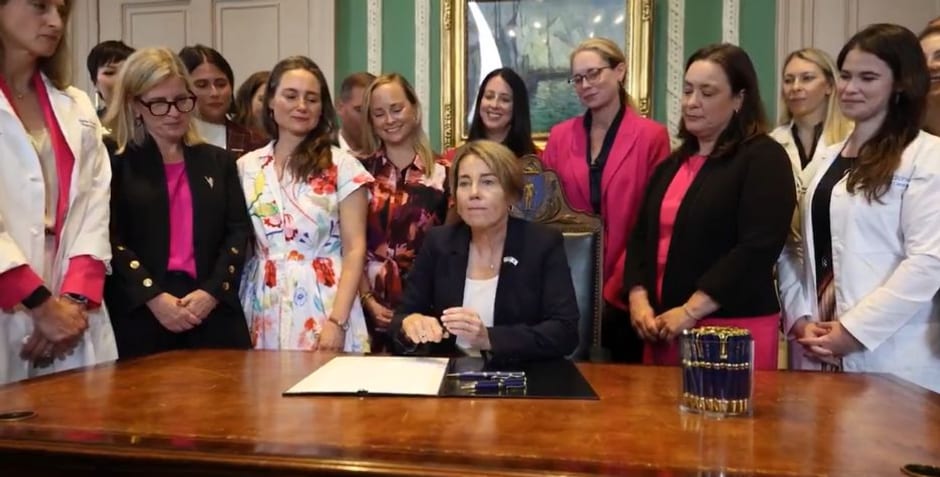
On August 10, 2026, Massachusetts’ Democratic Governor Maura Healey signed into law the “Prioritizing Patient Access to Care Act,” which fundamentally changes the legal framework for abortion in the state. Until then, the procedure was freely permitted during the first 24 weeks of pregnancy—already 10 weeks longer than in France. Beyond that, it was authorized only in four specific situations: danger to the mother’s life, danger to her physical or mental health, a fetal malformation leading to death, or a diagnosis incompatible with life outside the womb.
This framework, already permissive, has just been outright eliminated. It has now been replaced by a single, vague clause: abortion “may be performed by a physician based on professional judgment.” Nothing now prohibits terminating a pregnancy even at full term. This law removes not only any time limit but also any objective medical criteria. All that remains is the practitioner’s discretion—unfettered discretion, without any legal guidelines to govern it.
The Abolition of Safeguards
With this legislation, Massachusetts joins nine other U.S. states—Alaska, Colorado, Maryland, Michigan, Minnesota, New Jersey, New Mexico, Oregon, and Vermont—that have already removed all time limits on abortion. Governor Healey presented this reform as a guarantee that “reproductive health decisions must be made by the patient and her doctor,” without “legal uncertainty.” But behind this procedural rhetoric lies a bloody reality: a perfectly viable unborn child can now be aborted right up to term, based solely on a discretionary medical judgment. And when a viable child is aborted, there are cases where the child survives the abortion and is then killed after birth, as the ECLJ demonstrated in this report:
According to statistics from the Massachusetts Department of Public Health, 99 abortions were performed after 24 weeks of pregnancy in 2024, compared to 84 in 2023—an increase that the new law will certainly prolong.
Local pro-life organizations, such as Massachusetts Citizens for Life, have denounced a law that “normalizes the death of fully formed children” and “pushes vulnerable women to let their unborn children die through acts of extreme violence.” The four Catholic bishops of Massachusetts had called on elected officials to reject the bill, describing the removal of restrictions after 24 weeks as a “radical” and “gravely immoral” measure.
A “compassionate law” at odds with human dignity
Maura Healey presents this bill as a necessary response to very difficult situations. She cites the case of women forced to travel hundreds of kilometers and spend thousands of dollars to obtain an abortion in another state; testimonies, she says, “marked by great pain, anguish, and heartbreak.” She asserts the right of these women to “receive the care they need in Massachusetts.”
The argument of compassion is inappropriate when one considers that in the third trimester, the unborn child has a fully developed nervous system, feels pain, and—without any medical intervention—would be capable of surviving outside the mother’s womb. Advances in neonatal medicine now make it possible to save extremely premature babies at increasingly early stages of gestation. Every year in Massachusetts, thousands of babies are born prematurely, and the vast majority of them survive.
This new law highlights the limits of the U.S. Supreme Court’s decision overturning Roe v. Wade in June 2022 (Dobbs decision). The Supreme Court found that the U.S. Constitution does not guarantee a right to abortion and restored full authority to each state to allow or ban abortion. Some states have therefore restricted access to abortion, but others, such as Massachusetts, have permitted abortion until the end of the pregnancy. The fight to protect the right to life is therefore far from over.







 UN recognises “coerced” abortion as a form of violence against mothersBy Priscille Kulczyk
 The Protection of Maternity in the EUBy ECLJ
 Our letter to Ursula von der LeyenBy ECLJ
 The European Parliament Opens a Debate on AbortionBy Nicolas Bauer