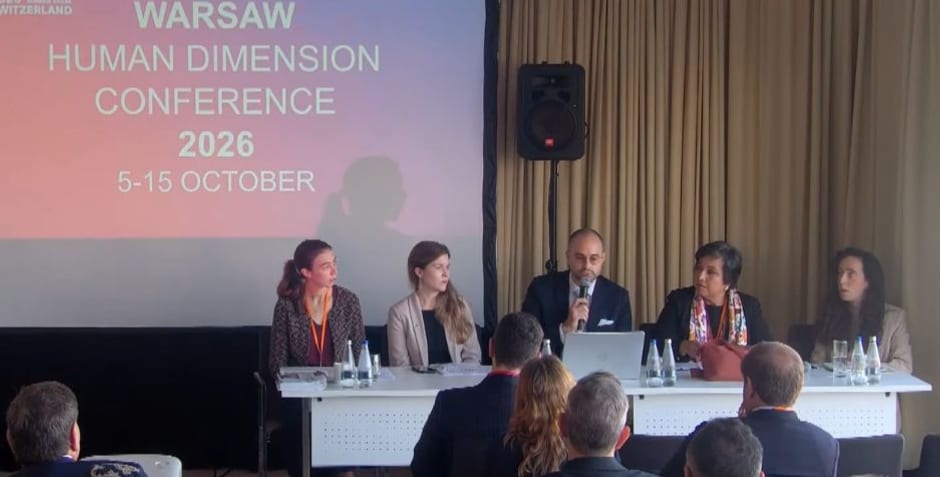
Meeting in Warsaw on October 7, 2026, during the Organisation for Security and Co-operation in Europe (OSCE) Human Dimension Conference, the ECLJ and its partners highlighted the concrete tools developed by the OSCE to combat the explosion of anti-Christian hate crimes in Europe. While the European Union remains trapped in an alarming state of institutional inertia, civil society demands that the EU end its "double standard" policy and finally appoint a dedicated Coordinator for the protection of Christians. The success of our hearing on October 12, 2026, before the European Parliament's Committee on Petitions is highly encouraging.
On the occasion of the Organisation for Security and Co-operation in Europe (OSCE) Warsaw Human Dimension Conference, the European Centre for Law and Justice (ECLJ) and the Observatory on Intolerance and Discrimination against Christians in Europe (OIDAC Europe) co-organized, on October 7, 2026, a major side event dedicated to anti-Christian hate crimes. In the face of a documented surge in violence across the continent, we sent a unanimous message: to overcome its inertia, the European Union must urgently draw inspiration from the mechanisms of the OSCE.
The Unforgiving Reality of Figures and the Trap of Under-Reporting
The EU can no longer close its eyes to the reality of anti-Christian intolerance. Anja Tang, Executive Director of OIDAC Europe, revealed alarming figures: 2,211 anti-Christian hate crimes were identified on the continent for the 2024 reporting period alone. While property damage (vandalism, desecration) still accounts for the majority of incidents, the most severe forms of violence are sharply rising. The report documented 274 direct physical assaults alongside 94 arsons targeting churches.
Yet, this assessment is merely the tip of the iceberg due to massive under-reporting by both victims and States. In Poland, a study by the Institute for Catholic Church Statistics showed that 80% of priests who fell victim to assaults did not file a complaint with the police. In Spain, the local situation is equally concerning: Maria García, Director of the Observatory of Religious Freedom (Observatorio para la Libertad Religiosa), recorded 305 attacks in 2025 (a 26% increase in one year), 70% of which targeted Christians. However, she denounced the fact that official Spanish data transmitted to the OSCE lacks a specific category for "Christianophobia," leaving civil society to shoulder this vital documentation work alone. France, despite having highly accurate figures on anti-religious acts, also neglects to transmit them to the OSCE for its annual report.
Anti-Christian hostility is fueled by a toxic cultural climate involving media stereotyping and legislative restrictions. Examples include the criminalization of silent prayer around abortion clinics, threats to the freedom of conscience of healthcare personnel regarding euthanasia, and aggressive ideological pressure targeting Catholic schools. As highlighted by Marcela Szymanski, Head of European Advocacy at Aid to the Church in Need (ACN), there is a direct link between the erosion of religious freedom and the rise of laws that tend to turn certain believers into second-class citizens, even though Christians represent 60% of the population in the OSCE region.
Thibault van den Bossche, Advocacy Officer for the ECLJ, broke a major taboo regarding Christian asylum seekers and converts from Islam within the OSCE area. They face a tragic human reality marked by insecurity, secrecy, and systemic violence. Although they flee religious persecution in their countries of origin, these refugees often encounter the exact same hostility within European reception structures where, being in the minority, they suffer insults, boycotts, and severe physical assaults. This vulnerability is amplified by intersectional threats: conversion cuts refugees off from the sole solidarity network of their diaspora, while converted women face a double penalty—exposed to both sexual and religious violence inside reception centers amidst the indifference of authorities and an asylum administration that unduly suspects the sincerity of their faith.
👉 Watch Thibault van den Bossche's intervention on Christians in asylum centers at 31':
The OSCE Model: Concrete Tools and an Adapted Structure
In the face of these findings, the OSCE has developed an expertise and institutional structure that the European Union cruelly lacks.
On the operational level, Mikaela Christiansson, Adviser on Combating Racism, Xenophobia, and Intolerance against Christians and Members of Other Religions at the OSCE Office for Democratic Institutions and Human Rights (ODIHR), presented a series of practical guides designed to address the security needs of communities. Following guides on anti-Semitic crimes in 2017 and anti-Muslim crimes in 2020, the guide dedicated to anti-Christian hate crimes was published in 2025. Tailored for law enforcement, these tools aim to improve crime recording, build trust, and encourage reporting on the ground through national workshops.
On the political level, Carmen Correas, Legal Officer at Alliance Defending Freedom International, praised the balance of the OSCE model, which relies on three Personal Representatives for Tolerance and Non-Discrimination. They are respectively dedicated to combating anti-Semitism, intolerance and discrimination against Muslims, and racism, xenophobia, and discrimination—including intolerance and discrimination against Christians and members of other religions. Although imperfect, this comprehensive architecture without blind spots is completely missing in Brussels.
Success of the Petition in Brussels: The European Parliament Pushes for Action
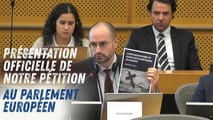
This advocacy in Warsaw translated into a major institutional success in Brussels just a few days later, on October 12, 2026. Backed by massive citizen mobilization, Thibault van den Bossche was heard by the European Parliament's Committee on Petitions (PETI) to demand equal protection for the rights of Christians in the EU.
Defying the hesitation of the European executive, the PETI committee made a strong decision by choosing to keep the petition open. Supported across a wide political spectrum, the PETI committee will demand accountability from the European Commission and push for a plenary session debate followed by the vote on an official resolution.
The ECLJ and its partners remind the European Union that it must urgently end its "double standard" policy. Following the model of the coordinators appointed in 2015 for Muslim and Jewish communities, and in perfect alignment with the proven structure of the OSCE, the EU must appoint without further delay a European Coordinator to combat attacks and discrimination against Christians.
👉 Watch the video of the hearing and read our press release
👉 Sign our petition:







 Secularism, Catholic Schools, Protection of Life: Leo XIV Has Spoken OutBy Constance Avenel
 Baptism and the “right to be forgotten”By Alicja Słowik
 France: The Church's Suffering & HopeBy Grégor Puppinck
 China: Pastor Cao Must Come HomeBy CeCe Heil