
Expulsion of Foreign Christians: Ursula von der Leyen’s Inaction Against Turkey’s Silent Purge
Expulsion of Foreign Christians: Ursula von der Leyen’s Inaction Against Turkey’s Silent Purge
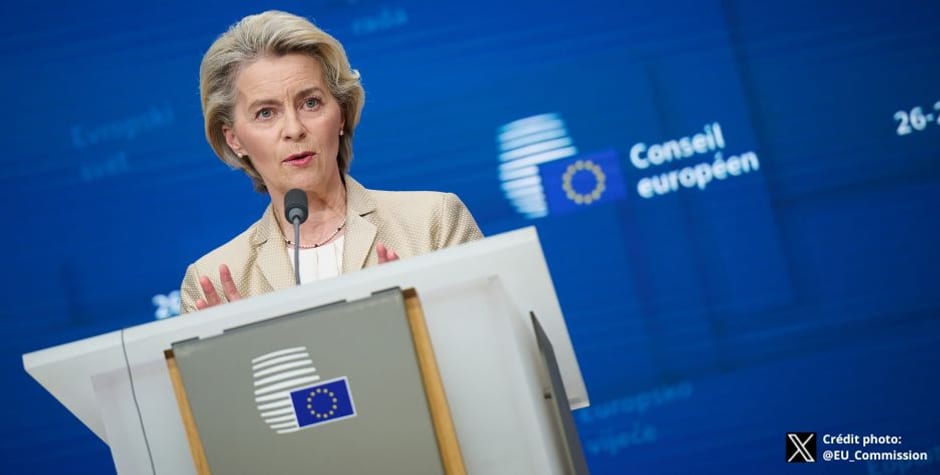
In a resolution adopted on February 12, 2026, the European Parliament strongly condemned the targeted expulsions of foreign Christians in Turkey under the pretext of national security. These measures amount to a systemic violation of freedom of religion, with dramatic consequences for local Protestant communities. Meanwhile, cases are multiplying before the European Court of Human Rights. The President of the European Commission, Ursula von der Leyen, cannot remain silent.
Op-ed published in French in Le Journal du Dimanche.
A single administrative code can be enough to turn an entire family’s life upside down: N-82. Turkey no longer imprisons foreign Christians. Instead, upon returning from a trip abroad, they are informed at the airport that they are no longer allowed to re-enter the country on the grounds that they pose a “threat to national security.” No criminal charges. No trial. No evidence disclosed. For some, more than thirty years of lawful residence have been wiped away overnight.
A policy of targeted expulsions under the pretext of national security
Between 2019 and 2024, at least 132 foreign Christians were individually expelled or banned from re-entering Turkey—303 people when family members are included. Some had attended Protestant family gatherings, Christian conferences, or activities that Turkish authorities classify as “missionary work.” Their only common denominator is a visible Christian commitment, entirely lawful in Turkey, yet used to justify their expulsion.
This system of administrative expulsions marks a turning point. In 2016, American pastor Andrew Brunson was arrested and detained for nearly two years, accused of involvement in the attempted coup. The case triggered a serious diplomatic crisis with the United States. Since then, foreign Christians are still portrayed as foreign agents, but the method has changed. There are no longer images of pastors behind bars. The expulsions have become discreet, almost invisible.
The European Parliament condemns the targeted expulsions
Members of the European Parliament brought the debate to Strasbourg. On February 12, they adopted a resolution denouncing the “targeted expulsions of foreign journalists and foreign Christians in Türkiye under national security pretexts.” Bert-Jan Ruissen stressed the urgency of bringing this “serious violation of religious freedom,” affecting “deliberately marginalized” Protestant communities, to the attention of the European Union—especially at a time when the Commission is strengthening its relations with Turkey.
Tomislav Sokol also called for a clear political response: “Christians are the most persecuted religious community in the world. Europe’s credibility depends on its ability to defend freedom of religion consistently, everywhere, and without double standards.” He has already submitted a written question to the European Commission, which is expected to respond officially in the coming weeks.
The organized weakening of local Protestant communities before the ECtHR
Faced with a domestic judicial system that largely upholds these decisions, expelled Christians have only one effective remedy left: the European Court of Human Rights (ECtHR). Litigation is expanding. The Wiest case, brought by an American Protestant, could become a landmark judgment in the months ahead. At least twenty similar applications are expected to follow, including those grouped under the Wilson case, which involve several European citizens—two Germans, one Spaniard, one Dutch national, and one Swiss national.
At its core, the issue concerns freedom of religion. These expulsions reflect a broader vision of a homogeneous, Sunni Muslim Turkish nation marked by suspicion toward Christians. Foreign missionaries are targeted because they support local Protestant communities, some of whose members are converts from Islam. As a result, these communities are weakened in their organization, spiritual leadership, and continuity.
Religious freedom: Europe faces its responsibilities
What is unfolding in Turkey is not without precedent. In 2010, Morocco expelled around 150 foreign Christians in the name of combating proselytism. There too, administrative measures were used to avoid immediate public scandal. But Turkey is a candidate for membership in the European Union and a member of the Council of Europe. As such, it cannot indefinitely instrumentalize national security to restrict a fundamental freedom. It is now up to the judges of the ECtHR, as well as to the President of the European Commission, Ursula von der Leyen, and other European political leaders, to clearly denounce these practices.



 Secularism, Catholic Schools, Protection of Life: Leo XIV Has Spoken OutBy Constance Avenel
 Baptism and the “right to be forgotten”By Alicja Słowik
 France: The Church's Suffering & HopeBy Grégor Puppinck
 China: Pastor Cao Must Come HomeBy CeCe Heil