
Algeria: Two Police Raids on Christian Communities in One Month
Algeria: Two Police Raids on Christian Communities in One Month
Within four weeks, Algerian police intervened twice at Christian places of worship in the Oran region. These operations are part of a long series of measures which, far from easing, confirm the continued pressure exerted on Christians in the country, particularly Protestants. Pope Leo XIV’s visit to Algeria last April had, however, offered some signs of improvement: those hopes were short-lived.
Two Police Raids One Month Apart
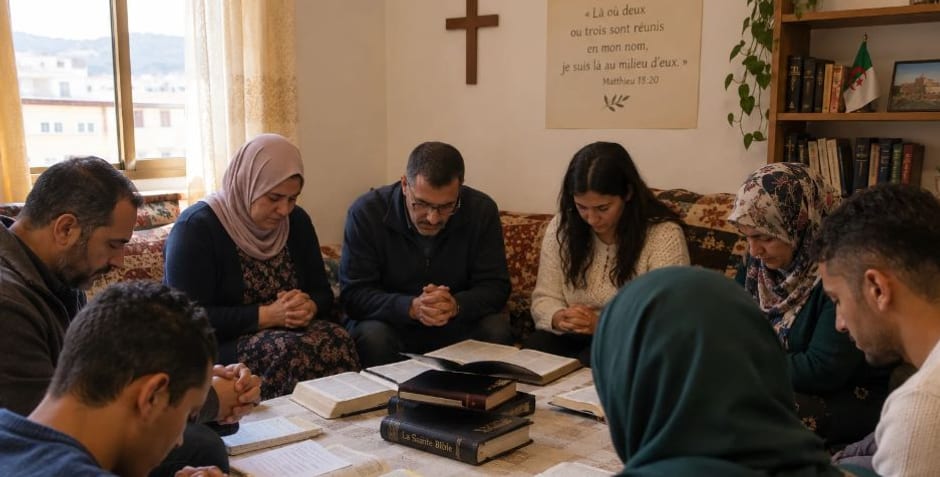
On September 4, 2026, twelve Christians were arrested in the small town of El Ayaïda, in Oran Province, while gathered for a worship service. The operation, carried out by members of the police special forces, targeted the “House of Refuge” center, which provides support in particular to vulnerable women and their families. Books, mobile phones and the believers’ identity cards were seized at the scene, and the Christians were taken to the police station in Bethioua, around 40 kilometres from Oran. The women were released and summoned for questioning the following day, while the men were detained until late into the night. Several members of the Protestant Church of Algeria (EPA) continued to receive police summonses in the days that followed.
These Christians were arrested on suspicion of participating in an unauthorised non-Muslim religious gathering. One of the centre’s rooms had already been closed by the authorities in October 2019, and the premises had been placed under surveillance. Nevertheless, the Christians had continued to meet there.
On 4 October, exactly one month after this operation, police once again intervened at a Christian place of worship, this time in Aïn El Turk, also in Oran Province. A Christian woman was taken to the police station and questioned by the authorities.
Legislation Used Against Non-Muslim Worship
These events take place against a backdrop of growing repression of Christian communities, particularly Protestants. In 2020, Algeria removed freedom of conscience from its Constitution and has since continued to severely restrict freedom of worship.
This repressive system is based on the 2006 ordinance adopted by President Bouteflika in the aftermath of the Algerian Civil War, which regulates “religions other than Islam”. It subjects the practice of these religions to a system of prior authorisation and provides for criminal penalties. The ordinance is invoked to close churches and arrest pastors and believers on charges of proselytism, “undermining the faith of a Muslim” or conducting unauthorised worship. This system of “double standards against Christians” runs counter to Algeria’s international commitments, as highlighted in the ECLJ’s report published in April 2026 on The Oppression of Christians in Algeria.
Since 2017, almost all Protestant churches have been closed and sealed by the authorities, while the EPA continues to be denied legal recognition. Legal proceedings have also targeted its leaders. Pastor Youssef Ourahmane was convicted of “holding an unauthorised religious service” in an “unauthorised building” after organising a spiritual retreat lasting several days in March 2023 at a site that housed a chapel closed by the authorities. His sentence of one year’s imprisonment, with six months suspended, was upheld on appeal in May 2024.
Deprived of officially recognised places of worship, believers have been forced to seek alternative ways to continue meeting. Many gather in small groups in private premises, but are subject to increased surveillance by the authorities.
Meanwhile, on 13 October 2026, the National Commission for Non-Muslim Worship, meeting under the authority of the Minister of Religious Affairs and Endowments, reaffirmed the principle of freedom of worship for non-Muslims “in accordance with the law”. It also called for people to “avoid any confusion” and “not to rely on unverified or misleading information” about the actual practice of religion in Algeria, particularly information circulated on social media. The Commission’s statement concluded by invoking Algeria’s purported longstanding tradition of tolerance and respect, referring to Pope Leo XIV’s recent visit in April.
An Authoritarian Crackdown
The pressure exerted on Christians is accompanied by a broader hardening of the regime. On October 13, Algeria adopted an amendment to its Penal Code extending the scope of the death penalty to a wider range of crimes. One month after wildfires ravaged the country’s north-east, the reform now provides, among other things, for the death penalty for those responsible for deliberately setting forest fires.
The reform also reflects an explicit political determination to resume executions. Although the death penalty has been suspended de facto since 1993, no executions have taken place for more than thirty years. Yet, at the end of August, President Tebboune had insisted: “The death sentences will be carried out” once all avenues of appeal had been exhausted.
This hardening of the regime, which runs counter to the provisions of the International Covenant on Civil and Political Rights, to which Algeria is a party, poses a particular threat to the Kabyle population, which is already disproportionately represented among Christians facing persecution.
The ECLJ continues to alert international bodies to the situation of Christians in Algeria, urging them to raise the issue of religious freedom in their bilateral discussions with the Algerian authorities.


 Baptism and the Right to Erasure of Personal Data - Key ArticleBy Alicja Słowik
 ECHR: Three Christian Foundations WinBy Thibault van den Bossche
 Autonomy of religious institutions under threat?By Alicja Słowik