
Online Sexual Exploitation: UN Highlights the Responsibility of Actors in the Pornography Ecosystem
Online Sexual Exploitation: UN Highlights Responsibilities
Pornography platforms, tech companies, and financial networks are complicit in online sexual exploitation. This is the strong conclusion reached by two UN Special Rapporteurs in a joint statement released on May 15, 2026. It is based on documented cases of victims and includes calls for widespread accountability among all relevant actors.
By Sofia Gauruel
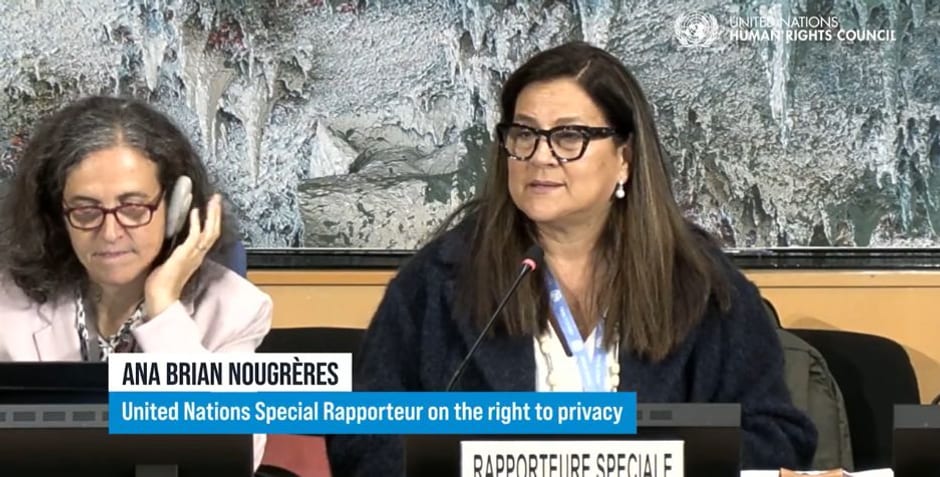
On May 15, Reem Alsalem and Ana Brian Nougrères, two UN Special Rapporteurs, issued a joint statement denouncing the complicity of pornography platforms, tech companies, and payment networks in the sexual exploitation of women and girls.
This statement follows the implementation of the United Nations Special Procedures communication mechanism: their respective mandates, concerning violence against women and girls and the right to privacy, had received complaints regarding cases of online sexual violence.
The two experts thus issued a clear warning: “A red line must be drawn, […] systems that facilitate and profit from the sexual exploitation of women and girls cannot simply be regulated at the margins, they must be fundamentally confronted.”[1]
It was in this context that, on February 13, 2026, they sent an official letter to Aylo Holdings, a Canadian company that operates several of the world’s largest pornography platforms (including Pornhub). Letters with similar recommendations were also sent to the governments of the United States and Canada, as well as to several major technology and financial companies.[2]
Exploitation identified and documented
These ten communications concern two victims, one being Katelynn Spencer, a U.S. citizen from Massachusetts whose two intimate videos were posted without her consent on Pornhub by a former partner. One video was filmed when she was 18 and after she had been manipulated and coerced into making it. This content was then downloaded and reposted on other pornographic sites, accompanied by degrading comments, and viewed millions of times.
Far from being isolated incidents, these cases are part of a much broader reality: the distribution and monetization of content depicting sexual abuse and exploitation, including that involving minors, is made possible or facilitated by numerous pornographic platforms.
In their statement, the Special Rapporteurs also highlight structural failures in policies moderating pornographic content. A 2024 investigation by the Office of the Privacy Commissioner of Canada revealed that Aylo Holdings was unable to demonstrate that it had properly conducted consent and age verifications for individuals appearing in videos. The company also acknowledged that content could remain online for up to two weeks while awaiting the required documentation. Even more concerning, a company director overseeing the consent validation process had indicated that in approximately 70% of cases, third parties distributing content on the platform did not provide the required identification and consent forms.[3]
Aylo Holdings responded to the Rapporteurs’ February 2026 letter by detailing its internal policies and security measures, while emphasizing that most of the alleged incidents reportedly occurred prior to its current management.[4] However, this response did not alleviate the Special Rapporteurs’ concerns.
Strengthening moderation and requiring the removal of abusive content
The Rapporteurs thus urged the relevant governments to prosecute the companies that own these platforms. They also called on them to adopt binding legislation to hold pornographic website operators civilly and criminally liable for hosting, distributing, or monetizing content produced without consent or involving minors.
The ECLJ, which has been raising the issue of pornography for several years and has notably documented the connection between the pornography industry and human trafficking,[5] welcomes this new intervention by the UN Special Rapporteurs. As early as May 2024, Reem Alsalem also addressed this connection in her report Prostitution and Violence against Women and Girls, in which she clearly established that pornography and its industry constitute a form of sexual exploitation inextricably linked to the dynamics of trafficking.[6]
The experts are also calling for the implementation of strict content monitoring and moderation measures as well as a requirement to immediately remove violent images. To this point, the responses from States questioned by the UN are revealing. While the U.S. government provided no response, the Canadian government, for its part, acknowledged the need to modernize its privacy legislation and adopt a framework that holds platforms accountable for the harmful content they host.[7]
The Special Rapporteurs also call for the implementation of systematic measures to verify the age and consent of individuals depicted in content published on applicable websites. The aim is to ensure, prior to any content being posted online, that every individual appearing in such content has indeed consented to its dissemination and was of legal age at the time of creation.
Finally, the experts highlight the responsibility of major companies such as Google and Meta whose search engines and algorithms facilitate access to this content, as well as payment networks, particularly Visa and Mastercard, who enable the monetization of abusive content. The ECLJ welcomes the acknowledgment, having addressed this very issue in response to a call for contributions regarding the role of the financial sector in eliminating contemporary forms of slavery (launched in 2025 by the UN Special Rapporteur on contemporary forms of slavery, Mr. Tomoya Obokata). In its contribution, the ECLJ demonstrated that pornography serves as a hub for human trafficking, and that the financial sector—on which this industry necessarily depends—could serve as a decisive lever to bring about its reform. In particular, we recommended that states prohibit financial institutions from providing services to illegal pornography platforms or to those lacking safeguards to protect minors. Unfortunately, this point was not included in the Special Rapporteur’s final report, which makes the initiative by Reem Alsalem and Ana Brian Nougrères all the more significant: by directly addressing Visa and Mastercard, they have now placed the financial component at the heart of the UN debate on online sexual exploitation.
In addition to North America, this issue also concerns France, which remains one of the leading countries in the global pornography market. Banks and online payment providers operating in France cannot ignore the nature of the content they enable to be monetized and from which they themselves profit. By continuing to provide services to online platforms without demanding sufficient safeguards, these financial institutions risk being considered complicit in the illegal content disseminated there.
Ongoing cases and an ongoing fight
While the events underlying these communications from the Special Rapporteurs took place in the United States and Canada, survivors of the pornography industry face the same challenges in Europe. Indeed, the European Court of Human Rights recently issued a ruling regarding online exploitation in A. v. France, in which one victim in the high-profile “French Bukkake” case complained about the impossibility of removing from the internet the images and videos of the sexual assaults she suffered during pornographic film shoots.[8] Although the responsible parties have been indicted for aggravated rape and pimping (among other acts), aggravated human trafficking as part of an organized criminal group, and distributing recordings of images related to a deliberate violation of personal integrity, the dissemination of this content continues with complete impunity. This specific case clearly illustrates the lack of effective removal mechanisms and the powerlessness of victims facing continued digital dissemination of the abuse they suffered.
Such recent cases confirm the urgent need of a sustained and coordinated effort by several key groups: States, who must legislate and exercise due diligence; online platforms and the pornography industry, who must take responsibility; the financial sector, who can no longer ignore its role as a facilitator; and major tech companies, who must regulate algorithms which contribute to the visibility and accessibility of this content. The ECLJ has been engaged in this fight for several years at both the European and international levels through its interventions in the European Parliament, its contributions to the United Nations, and its monitoring of UN reports on pornography and related issues.
_____________
[1] UN experts alarmed by the complicity of online pornography platforms and other intermediaries in the sexual exploitation of women and girls, Press Release, UN, (May 15, 2026).
[2] Joint Communications from UN Special Rapporteurs, Special Procedures, references AL USA 40/2025, CAN 7/2025, OTH 155/2025, OTH 156/2025, OTH 157/2025, OTH 159/2025, OTH 160/2025, OTH 7/2026, OTH 8/2026, and OTH 9/2026.
[3] Office of the Privacy Commissioner of Canada, PIPEDA Findings No. 2024-001: Investigation into Aylo’s (formerly MindGeek) Compliance with PIPEDA (Feb. 29, 2024).
[4] Aylo Holdings S.A.R.L., Response to Communication AL OTH 157/2025 (Apr. 14, 2026).
[5] ECLJ, Human Trafficking in Pornography: Europe Must Open Its Eyes, (June 27, 2023).
[6] Prostitution and Violence against Women and Girls, Report of the Special Rapporteur on violence against women and girls, its causes and consequences (A/HRC/56/48), UN (May 7, 2024).
[7] Permanent Mission of Canada to the United Nations in Geneva, Response to Communication AL OTH 160/2025 (Apr. 29, 2026).
[8] ECHR, A v. France, App. No. 17650/25 (Mar. 17, 2026).






 Protecting Children from Porn***: Dialogue Goes On with New UN RapporteurBy Priscille Kulczyk
 Violent Pornography: PACE Calls for a BanBy Priscille Kulczyk
 CEDAW Recommendation on Gender Stereotypes: ECLJ RespondsBy Alicja Słowik