
The Council of Europe’s Parliamentary Assembly calls for a ban on violent pornography
Violent Pornography: PACE Calls for a Ban
A new European resolution warns of the serious harmful effects of pornography and once again urges States to protect their citizens from this scourge. The ECLJ is proud to have contributed to improving this text, which nevertheless has a number of shortcomings. Explanations.
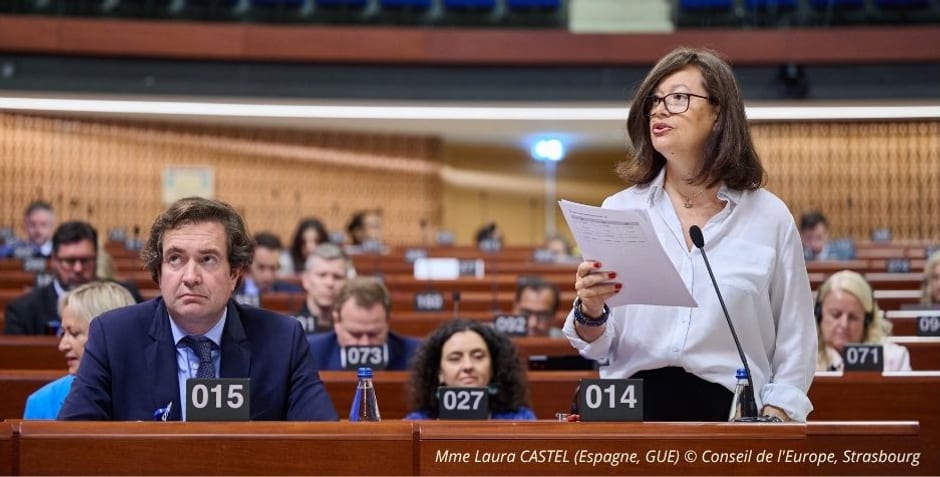
On Thursday 25 June 2026, the Parliamentary Assembly of the Council of Europe (PACE) debated in plenary session a report entitled “Violent pornography: a test for human rights” (No. 16422), drafted by Spanish Senator Laura CASTEL (Group for a United European Left). PACE adopted Resolution 2670, as well as Recommendation 2310 addressed to the Committee of Ministers of the Council of Europe. The European Centre for Law and Justice (ECLJ) welcomes this new milestone in the international fight against pornography. Drawing on its expertise in this area, it contributed to the process by proposing improvements to the original text, some of which were incorporated.
For a ban on violent pornography
In this resolution, which sets out the PACE’s position on this issue, the Assembly explicitly recognised the link between violence in pornography and in the real world. It has indeed declared itself “deeply concerned about the growing dissemination of violent and extreme pornographic content, as it normalises gender-based violence and creates an environment conducive to an increase in such violence. Such content also encourages the imitation of violent acts” (§1).
To prevent such violence, PACE therefore calls for a ban on violent pornography (§15). In its recommendations to States, it calls on them to “prohibit, including through criminal sanctions, the production, dissemination, hosting and possession of violent pornographic material, including non-consensual sexually explicit material, sexually explicit deepfakes and intimate images produced with any technical mean without the depicted person’s consent” (§19.1.3).
A broad definition of violent pornography
Prohibiting violent pornography, including through criminal law, requires a definition of the term. PACE defines pornography as “sexually explicit material designed to arouse the viewer” (§4) and violent pornography as “sexually explicit material that depicts or simulates acts of aggressive physical or psychological violence, coercion, sexual assault, degradation, or non-consensual conduct, in a manner that eroticises, endorses, trivialises, or normalises such acts” (§3). This must also include “intimate image abuse, often referred to as “revenge porn” and to deepfakes or other images sexualising individuals” (§8). PACE therefore calls on States to provide in their national law “a clear definition of violent pornography, which includes content depicting rape, coercion, humiliation, degradation, life-threatening acts, psychological and physical harm, non-consensual sexual acts and all forms of sexual violence or degrading treatment” (§19.1.1).
This definition is therefore broad. However, numerous studies show that violence is omnipresent in pornographic content,[1] most often perpetrated against women and children. According to an analysis of the fifty most popular pornographic videos, 88 per cent of scenes contain physical violence and 49 per cent contain at least one instance of verbal abuse, whilst 87 per cent of aggressive acts are perpetrated against women, whose response is either neutral or an expression of pleasure in 95 per cent of cases.[2] As Lorraine Questiaux, the lawyer representing the victims in the French Bukkake case, explains: “If we were to sift through all the videos on the internet and filter them against the Criminal Code, absolutely nothing would pass the test. Even images that are relatively mild in terms of the symbolic violence they perpetuate constitute pimping”.[3] It must therefore be acknowledged that the definition formulated by the PACE, on which the ban is based, could potentially apply to almost all pornography available on the internet.
The term “violent pornography” does indeed seem like a pleonasm, given how inherent violence is to pornography. It is, in itself, a form of violence – both in what such content depicts, and in its production, which is often characterised by the exploitation of vulnerable human beings, as well as in the wide-ranging consequences of its consumption, not only by children – sometimes very young ones – but also by adults. Whatever its form, it instils in society a seriously distorted view of women and sexuality and constitutes a violation of human dignity, as it objectifies the human beings depicted. There is no such thing as “ethical” pornography: it is pornography itself that constitutes “a test for human rights”.
A lessening of the distinction between pornography and violent pornography
Distinguishing between “pornography” and “violent pornography” appears illusory. Yet this artificial distinction already underpinned Resolution 1835 (2011) on “Violent and extreme pornography”, adopted by the PACE in 2011. It remained prominent, fifteen years later, in the initial version of this resolution, even though the findings made by the Assembly in 2011 remain as relevant as ever: the pornification of society continues at the expense of numerous victims, particularly women and children. The consumption of pornography remains widespread among both adults and young people, and its consequences remain just as harmful to individuals, families and society as a whole. Furthermore, new harmful practices are emerging in this area as a result of technological developments.
Although this regrettable distinction did not disappear from the text that was ultimately adopted, it was mitigated, notably through amendments tabled by Irish senators Rónán Mullen (EPP) and Joseph O’Reilly (EPP). PACE thus recognises that no form of pornography can be considered entirely free of violence: “even where not ostensibly violent or extreme, the making and distribution of pornographic content may proceed and benefit from situations where participants are affected by violence, coercion and a lack of freedom, including situations of social or economic disadvantage or addiction or where participants have been victims of abuse, and may perpetuate these situations” (§2). Furthermore, the parliamentarians call on States to “support research on the social, psychological and behavioural effects of violent and non-violent pornography” (§19.3.7), whereas the original text referred only to violent pornography.
Further amendments have made it possible to express the PACE’s concerns regarding pornography in general, in view of its harmful effects on children. Thus, the final text highlights “in particular the negative impact of pornography consumption on children’s mental health, emotional and sexual development” (§5) and strongly affirms that “Children must be protected from exposure to any form of pornography” (§6). With regard to raising public awareness, States are finally called upon to “support […] campaigns addressing the dangers posed by children’s exposure to all forms of pornography” (§19.3.4). These clarifications are welcome because, as Polish MP Paweł Jabłoński (ECPA) rightly pointed out during the debate, it concerns “how our children will perceive sexuality, how they will treat each other, as future wives and husbands, how they will be able to form functioning marriages and families and this is a question of our existence, of our survival. […] This is a culture war we should all be fighting, if we refuse to fight, we will be defeated”.
A wide range of measures to combat pornography violence
As part of a comprehensive approach to the problem of pornography violence, numerous recommendations are made to States in various areas: the definition and legal regulation of violent pornography; co-operation with online platforms and internet service providers; education and awareness-raising; international cooperation in criminal matters; and safety and crime prevention in the production of pornography.
In particular, the aim is to hold all links in the pornography chain more accountable in order to limit the spread of violent pornography and child sexual abuse material, notably by imposing dissuasive penalties on pornography platforms that fail to meet their obligations (§19.1.6). It is worth noting that some of these recommendations were also recently put forward by Reem Alsalem and Ana Brian Nougrères, two UN Special Rapporteurs, in a joint statement denouncing the complicity of pornography platforms, technology companies and payment networks in the sexual exploitation of women and girls.
At the production phase, the PACE calls on States to ensure that pornography producers carry out age verification checks on the majority of performers (§19.5.2), to prosecute any acts of violence committed in the context of such production (§19.5.3) and to provide protection and assistance to people who are “victims of violent pornographic films, online sexual abuse and non-consensual dissemination of intimate content” (§19.1.8 and 19.5.7).
With regard to distribution, States are urged to engage in dialogue and collaboration with the various stakeholders in the online pornography ecosystem (§12), namely “online platforms, hosting providers, search engines, payment networks and internet service providers” (§19.2.1). To limit the dissemination of violent pornography, they should, for example, require pornography platforms “to prevent private individuals from uploading violent content and to put in place effective systems to verify the age and consent of the individuals appearing in the content the platforms host” (§19.2.3). They should also be required to implement age verification for their users in order to protect minors (§19.2.2).
To ensure the prompt removal of violent content, it is important that States put in place procedures to enable this (§19.1.4) and require platforms to establish effective reporting mechanisms (§19.2.8) and to use technological solutions to detect violent content (§19.2.4-5).
Regarding awareness-raising, PACE promotes the organisation of campaigns at both national and global levels (§19.3.5), and encourages research into the impact of pornography “on children and adolescents, gender relations, mental health and attitudes towards violence” (§19.3.7). It is nevertheless regrettable that the solution most frequently advocated for protecting children is “comprehensive sexuality education in schools [as] mandatory, age appropriate, medically accurate and evidence-based” (§19.3.1). This approach is, however, criticised by many child welfare specialists, psychologists and legal experts, particularly due to structural problems and abuses. PACE overlooks the fact that parents are their children’s primary educators and that international law requires States to respect parents’ rights to provide their children with an education and teaching in accordance with their convictions. In any event, whilst PACE affirms the primacy of consent in matters of sexuality, it appears to disregard this principle when it comes to sex education, which is to be compulsory.
Ultimately, as Irish Senator Joseph O’Reilly (EPP) puts it in the conclusion to his opinion on behalf of the PACE Committee on Social Affairs, it is to be hoped “that in the future all forms of pornography will be considered to be violent and dangerous enough to be prohibited”. Condemning only “violent pornography” is to overlook the fact that, far from being an expression of any kind of sexual freedom, pornography is in itself an act of violence and a violation of human dignity. As Senator Mullen stated during the debates, “violent pornography is a result, not a cause”. Thus, Bossuet’s maxim that “God laughs at men who deplore the effects whilst cherishing the causes” is more relevant here than ever. Convincing not only politicians but also the whole society of the harmful nature of all pornography, with the aim of abolishing it, is indeed a step that remains to be taken if we want to cure society of the cancer that is pornography.
_________________
[1] Shor E, Liu X. The Rise of Spanking, Hitting, and Strangulation: A Longitudinal Evaluation of Aggression in Pornography. J Sex Res. 2025 Oct 9:1-13; Fiona Vera-Gray, Clare McGlynn, Ibad Kureshi et Kate Butterby, “Sexual violence as a sexual script in mainstream online pornography”, The British Journal of Criminology, vol. 61, No. 5, 2021; Carrotte ER, Davis AC, Lim MS, “Sexual Behaviors and Violence in Pornography: Systematic Review and Narrative Synthesis of Video Content Analyses”, J Med Internet Res, 2020 May 14;22(5):e16702.
[2] Ana J. Bridges, Robert Wosnitzer, Erica Scharrer, Chyng Sun, Rachael Liberman, “Aggression and Sexual Behavior in Best-Selling Pornography Videos: A Content Analysis Update”, Violence against Women 16, no. 10 (2010): 1065-1085.
[3] Lorraine Questiaux, in À l’air libre, « Pornographie : l’industrie de la violence », Médiapart, 11 January 2022.






 Protecting Children from Porn***: Dialogue Goes On with New UN RapporteurBy Priscille Kulczyk
 Online Sexual Exploitation: UN Highlights ResponsibilitiesBy ECLJ
 CEDAW Recommendation on Gender Stereotypes: ECLJ RespondsBy Alicja Słowik