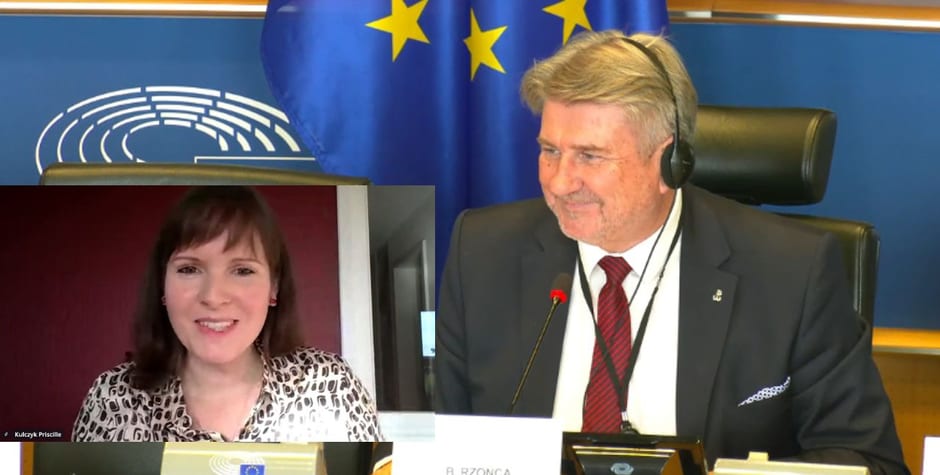
The European Centre for Law and Justice (ECLJ) was invited by the European Parliament’s Committee on Petitions (PETI) to participate, as an expert, in a public hearing held on 4 November 2025. Entitled “Protecting children and adolescents in digital environments: challenges and policy solutions”, it provided an opportunity to draw attention to the challenge of minors’ exposure to online pornography. This hearing was held jointly with the Committee on the Internal Market and Consumer Protection (IMCO), which had recently drafted a motion for a resolution on “The protection of minors online”. This resolution was adopted by the European Parliament on 26 November 2025 and highlights the dangers associated with children’s exposure to pornographic content.
The design of online platforms, addictive functionalities, harmful content and age-verification mechanisms were among the issues raised by the PETI and IMCO Committees, which questioned the European Commission and invited experts to clarify these matters during the joint public hearing on 4 November 2025. Its purpose was to inform Members of the European Parliament about the current state of play, the main challenges and possible policy responses in the field of online protection of minors.
Risks, challenges and regulation of the online environment: experts and the European Commission heard by MEPs
Among the experts invited, Urs Buscke, legal officer at BEUC (The European Consumer Organisation), outlined several threats to the online safety of minors, including the addictive design of digital platforms, influencer marketing that minors struggle to recognise as commercial content, and problematic video game practices such as loot boxes, which constitute a gateway from gaming to gambling.
Priscille Kulczyk, research fellow at the ECLJ, then addressed the major societal challenge posed by minors’ exposure to online pornography. Relying on statistical data, she demonstrated that such exposure is increasingly widespread, occurs at an ever younger age and is becoming more intensive, notably due to increased access to smartphones, longer time spent online and the policies of certain pornographic platforms. She underlined that the consequences of consuming content in which violence is omnipresent are deeply damaging, not only for minors—leading to relational and psychological difficulties, addiction, harmful sexual behaviours and violence—but also for society as a whole, which some rightly describe as a “pornified” society. She further stressed the need to ensure the full effectiveness of the European legal framework, so as to prevent online actors from exploiting loopholes to evade their responsibilities in protecting minors. In France, for instance, some pornographic websites invoked the country-of-origin principle of the e-commerce directive in order to avoid complying with national age-verification requirements. To ensure equal protection for minors across the European Union, Members of the European Parliament were therefore urged to definitively adopt an amendment introduced in June 2025 to the proposed directive on combating the sexual abuse and sexual exploitation of children. This amendment requires Member States to criminalise the online dissemination of pornographic content in the absence of a robust age-verification tool.
Marina Fernández and Noemí Puigdellivol, members of the organisation Adolescència Lliure de mòbils, addressed the harmful effects of mobile phone use by minors, including sleep deprivation, increased cyberbullying and rising mental health disorders. They presented a “family pact” whereby parents commit to postponing children’s access to smartphones until the age of 16, in line with paediatric recommendations and despite growing social pressure on parents to provide devices at an earlier age. They also called for a precautionary-principle-based moratorium, comparable to the ban on electric scooters for children under 16, as well as effective age-verification mechanisms, a ban on social media before the age of 16, corporate transparency obligations regarding the potential harms of digital products and enhanced education on screen-time use.
Bolesław Michalski, an expert in child digital education and cybersecurity and founder of Opsec4Kids, advocated a shift in mindset, recalling that “age is a number; readiness is a skill”. In his view, age verification must not conceal the essential need to properly prepare minors for online activity. Establishing “gates” is of little value without the necessary knowledge to navigate the digital environment safely once access is granted. The key question is therefore not the age of a minor, but whether they are ready, how they can be prepared and who should be responsible for that preparation.
Representatives of the European Commission presented the EU regulatory framework for the protection of minors online, centred in particular on the Digital Services Act and the Guidelines on the protection of minors in the digital environment published in July 2025. They also referred to ongoing initiatives, including the preparation of an action plan to combat cyberbullying and the forthcoming Digital Fairness Act on consumer protection, including the protection of minors. This future regulation is expected to address, inter alia, addictive design practices, influencer marketing and unfair advertising.
Parliamentary committees mobilised to protect minors online
This hearing formed part of the broader work of the organising parliamentary committees. The PETI Committee is currently examining several petitions submitted by European citizens concerned about the risks posed by the digital environment to minors. Particular concern has been expressed regarding the extensive use of social media by children and adolescents, including public exposure of private life, cyberbullying, exposure to inappropriate content and dangerous online challenges, as well as the resulting harmful consequences such as violent behaviour, social isolation and mental health disorders including anxiety, depression and suicidal ideation. Petitioners also highlight the addictive design of social media platforms, notably the proliferation of short-form videos and algorithm-driven content. While some call for stricter regulation of platform design to better protect minors, others advocate mandatory minimum age limits and the introduction of age or identity verification for access.
For its part, the IMCO Committee adopted an own-initiative report (2025/2060(INI)), the resulting resolution on “The protection of minors online” having been adopted by the European Parliament in plenary session in Strasbourg on 26 November 2025. The ECLJ welcomes the fact that this non-binding resolution identifies, inter alia, the dangers of minors’ exposure to online pornography. Members of the European Parliament acknowledged that “evidence from several countries in the EU shows that minors have access to pornographic content, sometimes involuntarily, at a very young age; whereas the viewing of pornography can expose children to violent and age-inappropriate content, which has been proven to increase aggression and sexual violence and may trigger harmful sexual behaviours among children and teenagers” (recital L). Consequently, the European Parliament “recalls that the Commission, on 27 May 2025, initiated formal proceedings against major pornographic platforms for breaches of obligations arising from the DSA; emphasises that the Commission’s investigations specifically focus on the protection of minors online and the lack of effective measures to verify users’ age; recalls that pornographic content, as well as violent content and content that perpetuates misogynistic, racist or homophobic views, can cause extremely serious physical, social and emotional consequences for minors, with harmful effects on their psychological development” (§5).
As a member of the European Child SHIELD Platform, a network of medical, legal and field experts representing around thirty NGOs from nearly twenty European countries, the ECLJ has been actively engaged for several years in efforts to protect children from exposure to pornography. While significant challenges remain, the ECLJ nevertheless welcomes the European Union’s growing attention to the work of civil society in this field and its increasing awareness of the urgent need to act in response to the scale of this phenomenon and its consequences.







 Online Sexual Exploitation: UN Highlights ResponsibilitiesBy ECLJ
 CEDAW Recommendation on Gender Stereotypes: ECLJ RespondsBy Alicja Słowik
 Exposure to Pornography & Sexual Abuse: ECLJ contribution to UN SRBy Priscille Kulczyk