
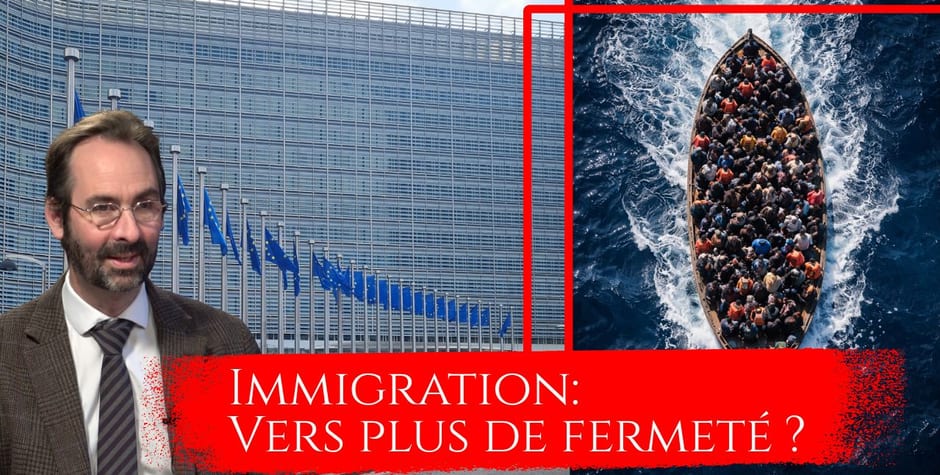
A major change is taking place before our very eyes: opposition to European migration policy has become the majority view. European states have begun to facilitate the deportation of foreign criminals and illegal immigrants. It is this profound upheaval that Grégor Puppinck discusses in this month's Interview of the Month.
On December 18, 2025, the governments of the European Union and the European Parliament (Brussels) reached a provisional agreement on new EU legislation aimed at facilitating the return of illegal immigrants and criminals. This is an important agreement that “deconstructs” the European Pact on Migration and Asylum adopted in 2024. That pact aimed to distribute illegal migrants throughout Europe, rather than return them.
The rallying of the center-right (EPP) to the conservative right (ECR, RN) has swung the European Parliament's majority in favor of immigration control, while governments, led by the Czech Republic, are threatening to leave the European Pact on Migration and Asylum. Together, this new majority has decided to facilitate the procedures for expelling illegal foreigners and to allow heavy penalties for those who refuse to leave European territory.
This decision comes a week after 27 of the 46 member states of the Council of Europe (Strasbourg [1]) issued a joint statement calling on the European Court to respect their sovereignty in matters of immigration control. In particular, they want the European Court to revise its case law to make it easier to deport foreign criminals. They also want to be able to conclude agreements with non-European countries to deport irregular migrants and relocate the processing of their asylum applications.
This December 10 statement is worth quoting, as it reflects a real change in policy. These 27 governments state in particular:
Our governments have a duty to guarantee our populations’ human rights and fundamental freedoms, including the right to live in peace, freedom and security, to preserve the values of our societies, and to effectively protect borders, prevent unlawful border crossings and counter migrant smuggling networks. Yet, the rights and freedoms of our populations are challenged by: people who take advantage of our hospitality by committing serious crime; trafficking in human beings and instrumentalisation of migrants. . . . Failing to recognise and respond to these challenges, we risk undermining the very fundamental rights and freedoms that the Convention protects, thereby eroding confidence in the whole Convention system.
On the same day, the 46 member states of the Council of Europe committed to preparing a joint political declaration on this subject for May 2026.
The ECLJ welcomes this awareness, to which it has contributed by exposing certain excesses of the ECHR in protecting foreign offenders. In particular, the ECLJ revealed that the Court had created a genuine “right of return to Europe” for expelled foreign offenders. We have also demonstrated how the Court has granted itself, against the will of the states, the power to suspend expulsion proceedings.
It is essential for the future of Europe that states regain control of immigration.
The ECLJ will continue its work in this direction.
________
[1] Denmark, Italy, Albania, Austria, Belgium, Bulgaria, Croatia, Czech Republic, Estonia, Finland, Hungary, Iceland, Ireland, Latvia, Lithuania, Malta, Montenegro, Netherlands, Norway, Poland, Romania, San Marino, Serbia, Slovakia, Sweden, Ukraine, and the United Kingdom.








 Ethiopia: Burials on Election DayBy ECLJ
 India: Christian NGOs Under ThreatBy Constance Avenel
 Poland: The Rule of Law à la Carte for the European CommissionBy ECLJ
 About Armenia’s June 7 ElectionsBy ECLJ