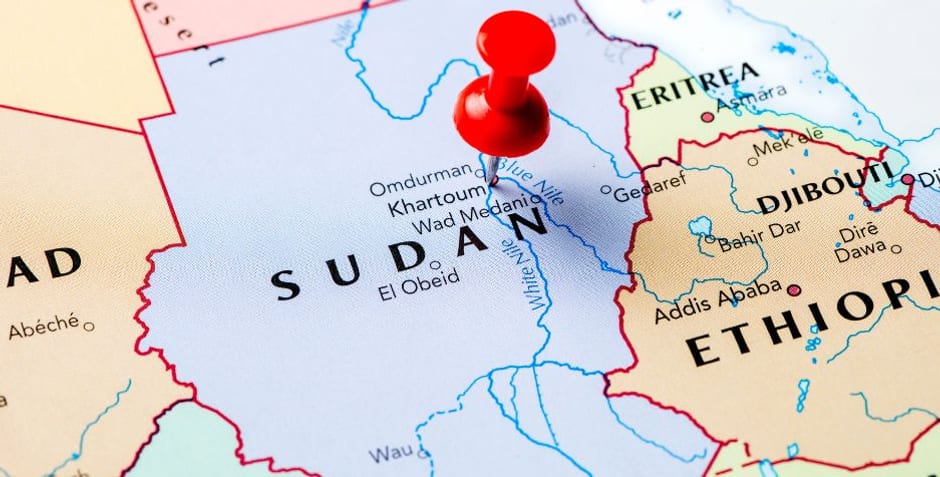

Since the outbreak of the civil war in April 2023, the situation of Christians in Sudan has deteriorated dramatically. Caught between the warring parties, they have seen their churches destroyed and have been subjected to forced conversions, forced marriages, arbitrary detention, and systematic discrimination. The ECLJ documents these persecutions and calls on the international community to act.
Sudan’s civil war has pushed the population to the brink of collapse, and the country’s small Christian community—estimated at around 2.2 million people (out of a total population of 50.6 million) before the conflict began three years ago—has been significantly reduced. In Open Doors’ 2026 World Watch List, Sudan ranked as the 4th worst country in the world for Christian persecution.[1]
1. Christians Devastated by a Destructive War
Since April 2023, Sudan has been engulfed in a civil war—often referred to as the “war of the generals”—between the Sudanese Armed Forces (SAF), led by General Abdel Fattah al-Burhan, and the Rapid Support Forces (RSF), commanded by Mohamed Hamdan Dagalo, commonly known as “Hemedti.” This war, described by the United Nations as “the world’s largest humanitarian and displacement crisis,”[2] has displaced nearly 14 million people and caused thousands of deaths and injuries, while more than 40% of the population faces acute food insecurity.
Due to widespread violence and institutional collapse in Sudan, the conflict has destroyed the significant progress made following the overthrow of President Omar al-Bashir in 2019, particularly in the areas of human rights and more specifically, freedom of religion. Sudan continues to be in serious breach of its international obligations in this area. In its submission presented during the 39th session of the Universal Periodic Review in 2021, the ECLJ reminded the committee that Sudan is a party to the International Covenant on Civil and Political Rights (ICCPR), ratified in 1986, Article 18 of which guarantees freedom of thought, conscience and religion.
Christians constitute a minority of the population estimated at around 5%, mainly composed of Catholics, Anglicans, Copts and Evangelical communities. They have historically existed in several regions of the country, notably in Khartoum, the Nuba Mountains, and Blue Nile State. Today, they face persecution with near-total impunity.
According to Aid to the Church in Need, “before the war, the local Church was tolerated, although it was not permitted openly to proclaim the faith.” Today, in the face of an unprecedented humanitarian crisis and growing Islamic extremism, “the small Christian community is now but a shadow of its former self.”[3] In a letter addressed to his community on April 6, 2026, Catholic Bishop Yunan Tombe Trille of the Diocese of El Obeid described a conflict that has “devastated our people and scattered our families.” He stressed that Christians in the Nuba Mountains have been particularly affected, as the region has witnessed some of the fiercest fighting.
2. Destruction and Arbitrary Occupation of Christian Places of Worship
In affected areas, hundreds of churches and Christian institutions have been damaged, looted or overtaken by armed forces. Indiscriminate attacks by both parties to the conflict have forced the closure of more than 165 places of worship.[4] In addition, the SAF has directly targeted churches and Christian religious gatherings.
On July 8, 2025, the Pentecostal church in Haj Yousef, north of Khartoum, was destroyed by bulldozers in the presence of police forces.[5] On Christmas Day, 2025, the SAF launched an air strike on Julud, a village in the western Jebel region of the Nuba Mountains, killing more than 19 people and injuring others. The Christian Solidarity International (CSI) representative for Sudan explains, “This was a deliberate SAF attack against Christians in the region; to them, human life has absolutely no value so long as the victims are not Muslim.”[6]
In March 2025, the army regained control of Khartoum, allowing the Christian community to return to the capital, but the government is preventing the reconstruction of churches there.[7] According to the President of the Sudan Evangelical Community Council, “the urban planning department refuses reconstruction permits for any building damaged by the war unless it has a permit. Yet a very large number of our churches do not have permits, because the State does not issue them to any church, regardless of how many conditions are fulfilled.”[8]
Since April 2024, the Khartoum seminary has closed its doors, and seminarians have been forced to continue their formation in South Sudan because of the regional insecurity.[9] Brother John Gbemboyo, from the Catholic Bishops’ Conference of Sudan and South Sudan, assured us that reopening the seminary in the near future is currently inconceivable.
3. Violent Oppression of Christian Communities: Forced Conversions and Marriages, Arbitrary Detention
Forced conversion to Islam has become a systematic tool of persecution. The US Commission on International Religious Freedom has reported an increase in forced conversions to Islam and corporal punishment inflicted on those who refuse. The Commission also denounced religious discrimination in the distribution of humanitarian aid, stating that both the SAF and the RSF force Christians into an impossible choice: renounce their faith or endure violence and starvation.[10]
Furthermore, both the SAF and the RSF have subjected Christians to systematic and arbitrary detention under deeply concerning conditions. In March 2025, the SAF reportedly arrested 19 Christians belonging to the Sudan Council of Churches in Madani while the group was travelling to a prayer meeting, releasing them only a week later.[11] Christians of Muslim background are particularly exposed to the risk of imprisonment.
According to the UN Independent International Fact-Finding mission, the RSF and their allies are allegedly responsible for gang rape, forced marriages with fighters, and acts amounting to sexual slavery—all targeted at women and girls from non-Arab communities, with some girls reportedly as young as 12 years old. These practices are reportedly meant to consolidate control over occupied territories. Christian families have been particularly affected by these abuses, notably in Gezira State.[12]
4. Marginalization of Christians in a Highly Islamized Society
The war has merely accelerated a process of exclusion already affecting Christians. “Christianity in Sudan continues to survive a brutal campaign aimed at undermining its very existence,” explained the CSI representative for Sudan.[13]
Public expressions of the Christian faith have become increasingly dangerous, leading some churches to limit public services and religious gatherings. Christians face discrimination before the courts, in the workplace, and in schools. They also remain underrepresented in political and administrative positions.
Moreover, the morality police, which had operated for three decades under Omar al-Bashir’s regime and the enforcement of Sharia law, was reintroduced in a new form in 2022 by the military authorities led by General Abdel Fattah al-Burhan through the creation of a “Community Police” force. Public order laws continue to criminalize forms of dress and behavior deemed “indecent,” exposing many women to flogging, harassment, and public humiliation.
In northern Sudan, preaching Christianity in public remains prohibited under the public order laws and any participants are exposed to prosecution or imprisonment. Although reforms in 2020 abolished the death penalty for apostasy, converting from Islam to Christianity continues to place converts at risk of persecution, including extrajudicial violence by individual actors or extremist groups.[14]
Sudan’s civil war has displaced nearly 14 million Sudanese people, many of them Christians originating from the Nuba Mountains in South Kordofan, Blue Nile State. Major urban centers now lie in ruins. Entire Christian neighborhoods have been emptied of inhabitants. This permanent displacement of Christians creates the risk of complete physical disappearance of Sudanese communities with roots stretching back several centuries.
5. Recommendations
In light of this critical situation, the ECLJ calls upon the Human Rights Council of the United Nations to:
- Strengthen the mandate of the United Nations Independent International Fact-Finding Mission for Sudan, ensuring that its investigations expressly address violations against religious minorities, including Christians.
- Publicly condemn all acts of religious persecution, including forced conversions, use of religion as grounds for arbitrary detention, and the destruction of places of worship.
- Strengthen targeted sanctions against those responsible for persecution, forced conversions, detentions, and the destruction of places of worship.
- Call on all parties in the conflict to immediately cease attacks against civilians and religious sites.
- Ensure the protection of displaced Christians and provide durable solutions for their relocation.
______
[1] Open Doors, 2026 world watch list
[2] UN, https://unric.org/fr/crise-au-soudan-la-reponse-de-lonu/
[3] Aid to the Church in Need, https://aed-france.org/soudan-plus-aucun-seminariste-dans-le-pays/
[4] USCIRF, Sudan Issue Update
[5] Open Doors, https://www.portesouvertes.fr/persecution-des-chretiens/profils-pays/soudan
[6] CSI, Franco Majok, 8 mai 2026
[7] https://fr.christianitytoday.com/2026/05/urgent-guerre-civile-soudan-destruction-hopitaux-eglises-fr/
[8] Open Doors, https://www.opendoorsuk.org/news/latest-news/sudan-church-demolished/
[9] Aid to the Church in Need, https://aed-france.org/soudan-plus-aucun-seminariste-dans-le-pays/
[10] USCIRF, Sudan Issue Update
[11] USCIRF, Sudan Issue Update
[12] Portes ouvertes, https://www.portesouvertes.fr/informer/actualite/les-chretiens-victimes-oubliees-de-la-guerre-civile-soudanaise
[13] CSI, Franco Majok
[14] CSI, Franco Majok
 Armenia: After Nagorno-Karabakh, the Trap of AppeasementBy Thibault van den Bossche
 Christians in Syria, Algeria, and Morocco: ECLJ takes action in BrusselsBy ECLJ
 EU 2025 Human Rights Report: 7 Key Countries for the ECLJBy Thibault van den Bossche
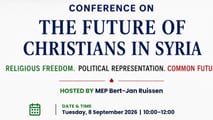 Brussels: Conference for Christians in SyriaBy ECLJ