

Anti-Christian Hatred in Europe: European Parliament Resolution Expected in March 2027
Anti-Christian Hatred in Europe: EP Resolution Expected Early 2027
The European Parliament’s Committee on Petitions has decided to keep open our petition calling for action against rising anti-Christian incidents, paving the way for a plenary debate and vote in March 2027.
As Christmas approaches and attention turns to persecuted Christians around the world, the situation of Christians in Europe must not be overlooked. The latest report by the Observatory on Intolerance and Discrimination against Christians in Europe (OIDAC) records 2,465 anti-Christian incidents in 2025, with France sadly topping the list. In response, we are calling for a European Coordinator to be appointed to combat anti-Christian hatred.
Petition Moves Closer to a Parliamentary Vote
On October 12, Thibault van den Bossche, the ECLJ’s Advocacy Officer for Religious Freedom, was invited to address the European Parliament’s Committee on Petitions (PETI) in Brussels. He pointed to a clear double standard: while the European Union introduced dedicated mechanisms to combat antisemitism and anti-Muslim hatred as early as 2015, no equivalent mechanism exists to address anti-Christian hatred. We are therefore calling for the creation of a post of European Coordinator tasked with tackling attacks and discrimination targeting Christians.
The Committee decided to keep the petition open, making it possible for a possible plenary debate and a resolution to be put to a vote as early as March 2027. Several MEPs from across the political spectrum have supported this initiative, including Laurence Trochu (ECR), who is leading a parallel petition entitled “Stop Christianophobia”. A committed defender of Christianity in Europe, she is among those campaigning for recognition of Europe’s Christian roots.
Sharp Rise in Violence, with France at the Top of the List
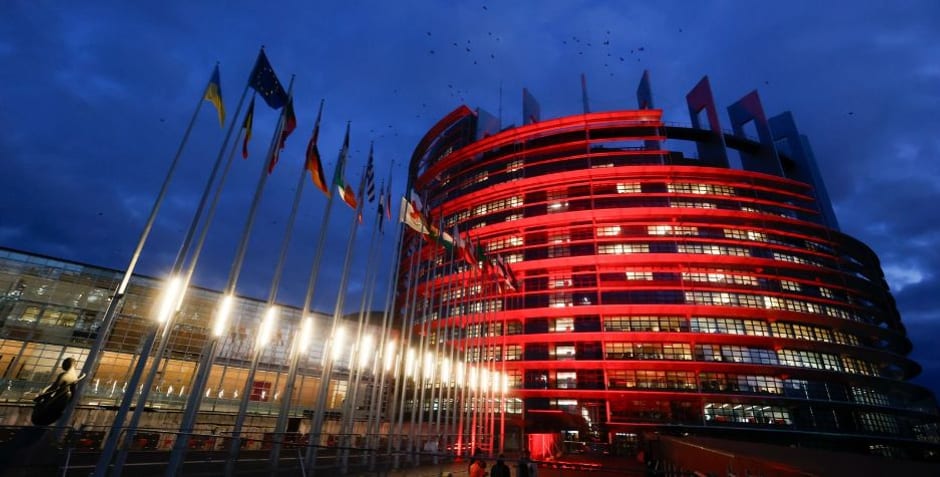
Each year at this time, the plight of persecuted Christians comes back into focus. Last week, Aid to the Church in Need (ACN) held its traditional “Red Week” campaign: hundreds of buildings were lit up in red in tribute to the approximately 380 million Christians facing persecution worldwide. On 8 November, Open Doors also held its annual “International Day of Prayer for the Persecuted Church”.
Europe itself is not immune. We all remember the horrific murder of Ashur Sarnaya, an Iraqi Christian refugee who had fled Islamic State in 2014 and was brutally killed in Lyon in September 2025 by a radicalised man who slit his throat. Yet this murder is only the tip of the iceberg.
OIDAC’s annual report, published on 16 November and drawing, among other sources, on data from the Organisation for Security and Co-operation in Europe (OSCE), records 2,465 anti-Christian hate crimes and incidents in 2025 alone, compared with 2,211 in 2024. It also highlights an alarming 44% increase in violent attacks against individuals.
France remains at the top of the list, with 843 incidents recorded by the French Ministry of the Interior and a fourfold increase in attacks targeting priests and church leaders. This worrying deterioration in the situation in France had already been documented in our report, “The Church’s Suffering and Hope in France”, published in September to coincide with the Pope’s visit.
Real Violence Going Unnoticed
Examples of anti-Christian incidents across Europe are not hard to find. Almost every week, sometimes even every day, local news reports describe desecrated tabernacles and assaults on priests and ordinary Catholics. The recent attack on a group of young Catholics in Rouen, whose only offence was to sing “Resucitó” on their way to the fair, illustrates the growing climate of hostility towards Christians – a trend that should worry us all. In Leipzig, Germany, five churches were vandalised within just a few days at the end of October.
In many cases, the anti-Christian motive behind such acts goes unacknowledged, even when it is obvious. During the night of 30 September to 1 October, in Porto-Vecchio, Corsica, two seasonal workers desecrated a statue of the Virgin Mary and posted a video in which one of them mimicked a sexual act with it. Yet, at their trial on 16 November, the prosecutor claimed there was “no certainty” that the act had been religiously motivated. In Saint-Nicolas-de-Port (Meurthe-et-Moselle), at the end of October, an individual stole and later destroyed a relic of Saint Nicholas, claiming that he wanted to “fight fetishism”. The regional press ran the headline: “More a misguided thief than an anti-Catholic vandal”. Yet this was the third attack on the basilica in 2026.
Your Signature Can Make a Difference
The petition remains open, and a vote is expected in March 2027, although this date is not yet guaranteed. Every signature strengthens our voice with MEPs and brings us closer to the appointment of a European Coordinator dedicated to combating anti-Christian hatred.
Sign the petition:






 Q. Ayub: A Pakistani Christian Convicted of Blasphemy Awaiting ExecutionBy Thibault van den Bossche
 Save Qaiser Ayub from the Death Penalty in PakistanBy ECLJ
 Jordan: Attack on St George’s Greek Orthodox ChurchBy ECLJ