

Armenia’s June 7 Elections: Peace, Identity, and the Future of the Nation
About Armenia’s June 7 Elections
On June 7, 2026, parliamentary elections in Armenia will take place, with the results having the potential to change Armenian political alliances forever. Armenia has had a longstanding trade relationship with Russia and the Eurasian Economic Union (EAEU). Recently, Armenian Prime Minister Nikol Pashinyan of the Civil Contract Party, the incumbent party, has expanded relations with the European Union (EU), the United States (US), and even with Azerbaijan, a country with which Armenia has historically been at odds. These newfound alliances have angered several key groups: Russia itself, which has demanded that Armenia choose sides; the Armenian Apostolic Church, which the current administration considers a political threat; and Armenians displaced from the Nagorno-Karabakh region (historically known as Artsakh), which is now being controlled by Azerbaijani forces.
By Sarah Leiford, Juris Doctor Candidate, Regent University School of Law.
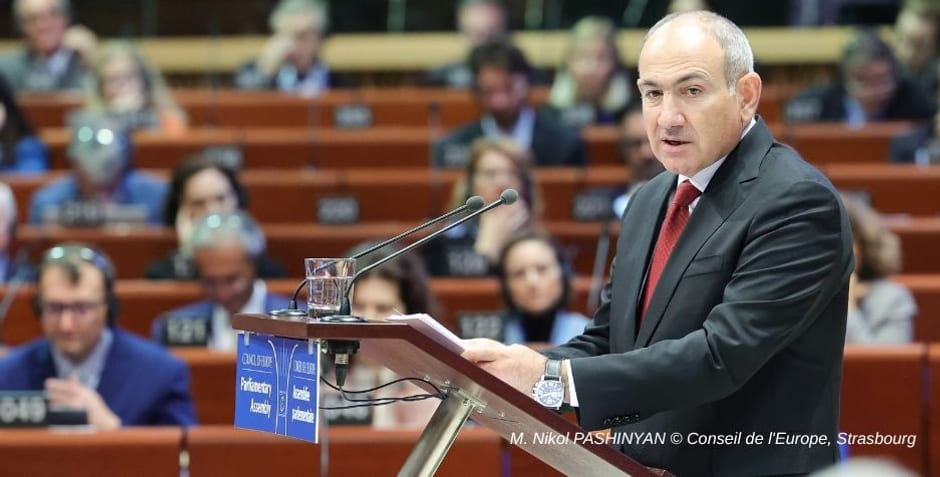
Pashinyan has called for the creation of a “Fourth Republic” to be established if his party wins the elections on June 7. This so-called “Fourth Republic” is part of Pashinyan’s vision of a “True Armenia,” which includes several distinct characteristics. First, “True Armenia” means peace with Azerbaijan. Second, “True Armenia” means integration into the EU, a close relationship with the US, and a gradual distancing from Russia. Third, “True Armenia” is also associated with Pashinyan’s effort to redefine the role of the Armenian Apostolic Church and to reject any claims to the Nagorno-Karabakh region, which came under full Azerbaijani control following the September 2023 offensive.
This path to peaceful alliances is not without difficulty, however. Pashinyan’s campaign for “True Armenia” has created a surge of political opposition to challenge the Civil Contract Party for control of the Armenian geopolitical arena. These challengers reject Pashinyan’s stance on Russian alliances, the Apostolic Church, and Nagorno-Karabakh.
The United States: Peace, Connectivity, and Strategic Resources
On May 26, 2026, US Secretary of State Marco Rubio met with Armenian Foreign Minister Ararat Mirzoyan in Yerevan to finalize agreements relating to US-Armenian economic cooperation, particularly in the extraction and processing of critical minerals and rare earth elements.[i] These agreements also support the development of the Trump Route for International Peace and Prosperity (TRIPP) initiative, a road and rail route crossing Armenia’s Syunik region and connecting mainland Azerbaijan with its exclave of Nakhchivan.
The initiative is intended to facilitate regional trade and economic integration while advancing a broader American strategy of opening east-west transit routes through the South Caucasus that bypass both Russia and Iran. The TRIPP initiative emerged from the peace agreement brokered by US President Donald Trump between Armenia and Azerbaijan in August 2025. Ahead of Armenia’s elections, Trump publicly endorsed Pashinyan on Truth Social,[ii] signaling that additional US political and economic support will follow election results in Pashinyan’s favor.
Despite the peace agreement brokered between Armenia and Azerbaijan in 2025, the President of Azerbaijan has previously declared that there can be no peace until Armenia rejects all claims to Nagorno-Karabakh: “[T]he [Armenian] Declaration of Independence […] clearly poses a territorial threat to Azerbaijan, because it deals with the unification of so-called Nagorno-Karabakh with Armenia. So, until this paragraph is there, a peace agreement is not possible.”[iii] In efforts to make peace with Azerbaijan, Pashinyan has consistently denounced Armenian claim to Nagorno-Karabakh.
The regional normalization agenda also extends to Türkiye. Although Armenia and Türkiye still have no full diplomatic relations and their shared border has remained closed since 1993, the two countries have pursued a cautious rapprochement since late 2021 following Armenia’s defeat in the Second Nagorno-Karabakh War. The latest example came on May 5, 2026, when the two governments signed an agreement to jointly restore the historic Ani Bridge on their shared border. Nevertheless, a major obstacle remains the legacy of the Armenian Genocide, which Türkiye continues to reject despite its recognition by numerous States, international bodies, and historians.[iv]
The European Union: Reform, Integration, and Democratic Resilience
Pashinyan’s peace-making efforts coincide with his broader objective of deepening Armenia’s integration with the EU. While Armenia has not formally applied for EU membership and remains outside the accession process (unlike Ukraine, Moldova, and Georgia), the government has taken significant steps toward closer alignment with the Union. On March 26, 2025, the Armenian Parliament adopted legislation formally launching a process aimed at future accession to the European Union,[v] while successive reforms have sought to bring Armenian laws and institutions closer to EU standards.
Until recently, Armenia has relied on trade with Russia, which accounts for 36% of Armenia’s foreign trade,[vi] but Pashinyan has begun to move away from this relationship. On May 5, 2026, in the first-ever EU-Armenian summit, Pashinyan met with President of the European Council António Costa and President of the European Commission Ursula von der Leyen to create a joint statement affirming EU support for Armenia’s alignment of its laws with those of the EU.[vii]
Russia’s Struggle to Preserve Its Influence
Russia has voiced its concern and disagreement with Pashinyan’s pro-EU stance. On May 30, 2026, Moscow announced its recall of the Russian ambassador to Armenia following Armenia’s rapprochement with the EU.[viii] Russian Deputy Foreign Minister Mikhail Galuzin declared that Armenia cannot be a member of both the EU (a pro-Western alignment) and the EAEU (a pro-Russian alignment).[ix] Russian Deputy Prime Minister Alexey Overchuk also stated that “memberships in the EAEU and the EU are incompatible.”[x]
Russian president Vladimir Putin himself demanded that Armenia choose between the EU and the EAEU. In a statement to the press, Putin indicated that there would be economic consequences if Armenia joined the EU: “[C]ombining the two systems [of the EU and EAEU] in one day is virtually impossible. As a result, we would be forced […] to scale back almost all of our cooperation with Armenia in the economic sphere.”[xi]
The deterioration in relations is particularly striking given that Armenia joined the International Criminal Court in 2024 despite the ICC arrest warrant issued against Putin, a move strongly criticized by Moscow. At the same time, however, Russia continues to maintain its 102nd Military Base in Gyumri, underscoring Armenia’s continued security dependence on Russia even as it deepens ties with the West.
With Armenian loyalty split between western and Russian alliances, the party that wins the June 7 elections may change Armenia’s geopolitical future. Reports of Russian cyberattacks in Armenian media indicate that Russia has attempted a disinformation campaign to turn the tide against Pashinyan, whose party is currently projected to win the elections.[xii] Putin’s concern over the future of Russian-Armenian relationships was further emphasized in an April 1, 2026 meeting where the Russian president encouraged Pashinyan to allow “all these political parties” (with pro-Russian positions) to participate in the elections.[xiii]
Putin’s statement referred to one of Pashinyan’s political opponents, Samvel Karapetyan of the “Strong Armenia” party. Karapetyan, a businessman with a pro-Apostolic Church stance, has citizenship in both Russia and Armenia, which would prevent him from running under the Armenian constitution.[xiv] He is currently under house arrest after being accused by Armenian authorities of attempting to destabilize the government. In addition to Karapetyan, several other parties running in the June 7 elections have pro-Russian stances—notably the Prosperous Armenia party[xv] and the Armenia Alliance party.[xvi]
In response to growing concerns of Russian influence on the June 7 elections, several European institutions have established safeguards against outside influence. On April 30, 2026, in a landslide vote of 476 to 47 (with 28 abstentions), the European Parliament adopted a resolution supporting “free, fair, and transparent elections” in Armenia and condemned Russia’s attempted disinformation campaign.[xvii] The Office for Democratic Institutions and Human Rights (ODIHR) has already deployed an election observation mission throughout the country beginning May 1.[xviii] Several delegates from the Parliamentary Assembly of the Council of Europe (PACE) also visited Yerevan between May 12-14 to hear concerns on cybersecurity and disinformation campaigns,[xix] highlighting the severity of the situation.
The Armenian Apostolic Church at Odds with Pashinyan’s Goals
Another institution accused of attempting to influence the elections is the Armenian Apostolic Holy Church. On April 3, 2026, the Civil Contract party released its pre-election program for 2026-2031, notably declaring that the Apostolic Church has “created an opportunity for external forces” to undermine Armenian sovereignty, for which the Civil Contract party planned to reform the Apostolic Church in order to “fully restore the constitutional order of the Republic of Armenia.”[xx]
The current Constitution of the Republic of Armenia provides that religious organizations shall be separate from the State (Article 17).[xxi] At the same time, Article 18 recognizes the Armenian Apostolic Holy Church’s “exclusive historical mission” in the spiritual life of the Armenian people and in the preservation of Armenian national culture and identity. Armenia is widely recognized as the first State to adopt Christianity as its official religion, traditionally dating to AD 301. Throughout centuries of Persian, Ottoman, and Soviet domination, the Church served not only as a religious institution but also as a guardian of Armenian language, culture, and historical memory. For many Armenians, the Church remains closely intertwined with the nation’s identity, making any attempt by the State to reform its leadership or governance particularly sensitive.
Recent trends, however, indicate that the Armenian government intends to decide who leads the Apostolic Church. On his Facebook page, Pashinyan posted a draft of the Civil Contract party’s program, which includes an objective to remove the “de facto head” of the Armenian Apostolic Holy Church.[xxii] The current head of the Church, Catholicos Karekin II, was not named, yet this statement clearly suggests that the Armenian government will have the power to remove Karekin II from his role. The Armenian government clashed with Karekin II previously when it opened a criminal case against him for his refusal to reinstate an archbishop on the orders of an Armenian court.[xxiii] Pashinyan himself has called for Karekin II to resign based on claims that Karekin II broke his vows of celibacy and fathered a child.[xxiv]
Arrests, Travel Bans, and Allegations of Political Interference
In addition to attacks on the Catholicos, Pashinyan’s government has also censured political speech from various clergymen who have criticized Pashinyan’s handling of the Nagorno-Karabakh conflict with Azerbaijan. On June 27, 2025, Archbishop Mikael Ajapahian was arrested for an interview in which he voiced regret that the Armenian military could not “save” Armenia and Nagorno-Karabakh during the Second Karabakh War with Azerbaijan.[xxv] Ajapahian’s arrest closely followed Archbishop Bagrat Galstanyan’s arrest for “terrorist acts” (after he openly criticized Pashinyan).[xxvi] An additional thirteen clergymen (priests and a bishop) were arrested in October 2025.[xxvii]
On December 5, 2025, Archbishop Arshak Khachatryan, a close ally of Catholicos Karekin II, was arrested in connection with allegations that drugs had been planted on anti-Karekin II protesters during demonstrations in 2018.[xxviii] In February 2026, Armenian authorities also imposed travel bans on several senior members of the Armenian Apostolic Church, including Catholicos Karekin II and six bishops, preventing them from attending an emergency assembly of bishops in Austria, constituting interference in the Church’s internal affairs.[xxix]
Despite the Armenian constitution guaranteeing a separation of Church and State, the arrests of clergymen coinciding with political commentary indicate that the current government will not tolerate anti-government rhetoric from the Church. In his address to PACE in Strasbourg on January 28, 2026, Armenian Foreign Minister Ararat Mirzoyan rejected the notion that the Apostolic Church was under attack and instead declared that the Church was involved in violent political rhetoric.[xxx] In a statement to the European Parliament on March 11, 2026, Pashinyan referred to the clergymen as “using the altar of Christ to preach conflict” and colluding with “supporting opposition forces.”[xxxi]
Neither ODIHR nor PACE has characterized the Armenian Apostolic Church as being under persecution. While acknowledging tensions between the government and the Church, ODIHR noted that several opposition parties, including a number of pro-Russian political forces, openly support the Apostolic Church.[xxxii] At the same time, PACE, in its Resolution 2635 (2026) on the progress of the monitoring procedure in Armenia, expressed regret over the “excessive polarisation and stigmatisation of political opponents by all sides” and voiced concern about both the escalating tensions between Prime Minister Pashinyan and Catholicos Karekin II as well as reports of alleged plots by certain clergymen to seize power.[xxxiii]
Nevertheless, should the Civil Contract party secure a parliamentary majority, it may proceed with its stated objective of reforming the governance of the Armenian Apostolic Church, including the adoption of a new Church charter and the election of a new Catholicos.[xxxiv] Such reforms would fundamentally reshape the relationship between Church and State and could redefine the scope of ecclesiastical autonomy in Armenia.
Nagorno-Karabakh: a Clash between Regional Peace and National Memory
Much of the Apostolic Church’s dissent against Pashinyan stems from the Armenian government’s withdrawal from Nagorno-Karabakh, which many clergymen view as an abandonment of Armenian heritage and an offense to displaced Armenians. After Azerbaijan took complete control of the region in 2023, nearly the entire population—comprised of 120,000 people who were almost all ethnic Armenians—fled to Armenia. Despite earlier claims that the Nagorno-Karabakh region would remain Armenian, Pashinyan now declares that Nagorno-Karabakh belongs to Azerbaijan.
The Prime Minister has gone so far as to question the notion that Nagorno-Karabakh ever belonged to the Republic of Armenia. On May 10, 2026, a video of Pashinyan circulated on social media in which the Prime Minister asks, “Did we build a school there, did we build a kindergarten, did we build a factory […] how was it ours? It was not ours.”[xxxv] Such a statement dismisses the suffering of Armenians who fled the region after subsequent Azerbaijan attacks following the Second Karabakh War.[xxxvi] Pashinyan’s denial of Armenian heritage in Nagorno-Karabakh accordingly dismisses the protection of religious relics that many Armenians hold sacred. The European Centre for Law and Justice (ECLJ) reported in 2024 that scores of churches and khachkar (hand-carved stone crosses) previously existing in Nagorno-Karabakh for centuries are being systematically removed and replaced by Azerbaijan.[xxxvii]
In 2023, the European Parliament condemned Azerbaijan’s destruction and denial of Armenian cultural heritage in Nagorno-Karabakh, demanding that Azerbaijan protect religious and historical sites and allow UNESCO to take inventory of them.[xxxviii] Azerbaijan itself had previously assured the International Court of Justice during hearings held on October 12, 2023 that it would “protect and not damage or destroy cultural monuments, artifacts and cultural sites in Karabakh.”
The Caucasus Muslims Board in Baku, however, contends that these holy sites were illegally constructed during Armenian “occupation” and therefore Azerbaijan has a right to remove them: “[S]tructures built by an occupying power in an occupied territory without consent are considered illegal, regardless of their purpose, and, as a rule, must be demolished.”[xxxix] Despite Azerbaijan’s assurances before the ICJ and the European Parliament’s condemnation, the destruction of holy sites continued with the April 2026 losses of both the Holy Mother of God Cathedral and the Church of St. Jacob in Khankendi (formerly Stepanakert), Nagorno-Karabakh.[xl]
The Right of Return and the Fate of Armenian Detainees
The European Parliament’s April 30, 2026 resolution regarding Armenian elections reaffirmed the right of Armenians to return to Nagorno-Karabakh and called for the protection of their cultural heritage.[xli] This position is consistent with the International Court of Justice’s provisional measures of November 17, 2023, which ordered Azerbaijan to ensure that persons displaced from Nagorno-Karabakh who wish to return are able to do so in a safe, unhindered and dignified manner, while preserving records relating to their identity and property.[xlii]
The humanitarian consequences of the conflict also extend beyond displacement and cultural destruction. Around twenty Armenian detainees, including several former political and military leaders of Nagorno-Karabakh such as Ruben Vardanyan, remain imprisoned in Azerbaijan. In its resolution of April 30, 2026, the European Parliament condemned the “arbitrary detention” of Armenian prisoners of war, detainees and hostages, demanded their “immediate and unconditional release,” and called on Azerbaijan to fully comply with international humanitarian law and international human rights law.
In response, the Milli Majlis (National Assembly) of the Republic of Azerbaijan suspended its cooperation with the European Parliament and the Euronest Parliamentary Assembly on May 1, 2026.[xliii] Instead of endorsing the European Parliament’s position, Pashinyan has declared that Nagorno-Karabakh refugees should be “permanently settled in the Republic of Armenia.”[xliv] This position was reinforced on May 26, 2026, when an Armenian court approved the Prosecutor General’s request to seize the Permanent Representation of the Republic of Artsakh in Yerevan, where the exiled leadership and parliament of Nagorno-Karabakh continue to operate.[xlv]
Azerbaijan’s reaction, combined with Pashinyan’s renunciation of Armenian claims to Nagorno-Karabakh, raises serious questions about the future of a right of return that is recognized under international law but receives little tangible support from either Baku or Yerevan. The ECLJ therefore reiterates its support both for the right of displaced Armenians to return to Nagorno-Karabakh safely and with dignity and for the release of Armenian detainees held in Azerbaijan.[xlvi]
The Heart of the Tension: Competing Visions of Armenia’s Future
At the heart of the June 7 elections lies a conflict between Pashinyan’s goal of securing peace and the price many Armenians believe is being paid to achieve it. Closer ties with the European Union and the United States, normalization with Azerbaijan, and a gradual break with Russia have become central elements of his political project. Yet these policies remain controversial among those who view them as requiring concessions on Nagorno-Karabakh, Armenian cultural heritage, and the role of the Apostolic Church. The election results will therefore reveal not only which political forces govern Armenia but also which vision of Armenia’s future prevails.
_____
[i] Michael Martina & Lucy Papachristou, “US and Armenia sign partnership agreement ahead of Armenian election,” Reuters (May 26, 2026 at 09:10 ET), https://www.reuters.com/world/us-armenia-sign-strategic-partnership-agreement-ahead-armenian-elections-2026-05-26/.
[ii] Donald J. Trump (@realDonaldTrump), Truth Social (May 28, 2026 at 12:54 ET), https://truthsocial.com/@realDonaldTrump/posts/116648998520896910.
[iii] “Meeting of the President Ilham Aliyev with the Participants of the 2nd Shusha Global Media forum,” President of the Republic of Azerbaijan Ailham Aliyev (July 20, 2024 at 16:00 ET), https://president.az/en/articles/view/66533.
[iv] Le Figaro, “Turkey and Armenia sign an agreement to jointly restore a historic bridge on their border” (May 6, 2026), https://www.lefigaro.fr/international/la-turquie-et-l-armenie-signent-un-accord-pour-restaurer-ensemble-un-pont-historique-a-leur-frontiere-20260505.
[v] Le Monde, “Armenia National Assembly votes for starting EU accession bid” (March 26, 2025), https://www.lemonde.fr/en/europe/article/2025/03/26/armenia-national-assembly-votes-for-starting-eu-accession-bid_6739535_143.html.
[vi] “European Union, Trade in goods with Armenia,” European Commission (May 8, 2025), https://webgate.ec.europa.eu/isdb_results/factsheets/country/details_armenia_en.pdf.
[vii] “Joint declaration following the first Armenia-EU summit,” The European Council and the Council of the European Union (May 5, 2026 at 09:10), https://www.consilium.europa.eu/en/press/press-releases/2026/05/05/joint-declaration-following-the-first-armenia-eu-summit/.
[viii] “Russia recalls envoy to Armenia over EU ties ahead of vote,” Reuters (May 30, 2026 at 05:05 ET), https://www.reuters.com/world/russia-recalls-envoy-armenia-over-eu-ties-ahead-vote-2026-05-30/.
[ix] “The Kremlin has called Armenia’s course toward EU accession unacceptable,” UNN (May 21, 2026 at 00:05 ET), https://unn.ua/en/news/the-kremlin-has-called-armenias-course-toward-eu-accession-unacceptable.
[x] Diplomatrutube, “Armenia will have to choose: Overchuk warned that the EAEU and the European Union and incompatible” at 1:09 (YouTube, May 21, 2026), https://www.youtube.com/watch?v=vyD0MO8Cukk.
[xi] “Vladimir Putin answered media questions,” President of Russia (May 29, 2026 at 19:30), http://en.kremlin.ru/events/president/transcripts/79910.
[xii] Beka Bajelidze, “Armenia: Russian Pressure Rises Ahead of Polls,” Institute for War & Peace Reporting (May 28, 2026), https://iwpr.net/global-voices/armenia-russian-pressure-rises-ahead-polls.
[xiii] “Nikol Pashinyan and Vladimir Putin meet,” The Prime Minister of the Republic of Armenia (April 1, 2026), https://www.primeminister.am/en/press-release/item/2026/04/01/Nikol-Pashinyan-Vladimir-Putin/.
[xiv] Alexander Pracht, “Who is who in Armenia’s 2026 elections?” CivilNet (May 14, 2026 at 12:06 ET), https://civilnet.am/en/news/1011838.
[xv] “Charter and Program,” Prosperous Armenia Party (last viewed June 1, 2026), https://www.bhk.am/en/charter-program.
[xvi] Alexander Pracht, “Who is who in Armenia’s 2026 elections?” CivilNet (May 14, 2026 at 12:06 ET), https://civilnet.am/en/news/1011838.
[xvii] Resolution on supporting democratic resilience in Armenia, Eur. Parl. Doc. 2026/2701(RSP), § F (April 30, 2026).
[xviii] “ODIHR opens election observation mission in Armenia,” OSCE Office for Democratic Institutions and Human Rights (April 23, 2026), https://odihr.osce.org/odihr/663466.
[xix] “Armenia’s elections must not be endangered by foreign interference and a level playing field for all contestants is essential, says PACE pre-electoral delegation in Yerevan,” Parliamentary Assembly (May 13, 2026), https://pace.coe.int/en/news/10295/armenia-s-elections-must-not-be-endangered-by-foreign-interference-and-a-level-playing-field-for-all-contestants-is-essential-says-pace-pre-electoral-delegation-in-yerevan.
[xx] “The pre-election program of the ‘Civil Contract’ party in the 2026 regular elections to the National Assembly,” Civil Contract Party (April 3, 2026), https://www.civilcontract.am/news-inner/924.
[xxi] Constitution of the Republic of Armenia, Art. 17 (adopted June 12, 2015), https://www.president.am/en/constitution-2015/.
[xxii] “Ruling Party in Armenia Releases Anti-Church Platform,” International Christian Concern (April 27, 2026), https://persecution.org/2026/04/27/ruling-party-in-armenia-releases-anti-church-platform/.
[xxiii] “UPDATED: Prosecutors Mount Criminal Case Against Catholicos Karekin II, Bar Him from Leaving Armenia,” Asbarez (February 14, 2026), https://asbarez.com/prosecutors-mount-criminal-case-against-catholicos-karekin-ii-bar-him-from-leaving-armenia/.
[xxiv] Alexander Pracht, “Pashinyan demands Catholicos Karekin II resign,” CivilNet (June 9, 2025), https://civilnet.am/en/news/955555.
[xxv] Naira Bulghadarian, “Jailed Archbishop To Appeal To European Court,” Radio Free Europe (January 7, 2026), https://www.azatutyun.am/a/33642379.html.
[xxvi] Raffy Boudjikanian, “Canadian cleric arrested in Armenia in connection to alleged coup attempt,” CBC News (June 26, 2025), https://www.cbc.ca/news/politics/bagrat-galstanyan-arrested-armenia-1.7572054.
[xxvii] Radio Free Europe, “Another Armenian Bishop Moved To House Arrest” (February 12, 2026), https://www.azatutyun.am/a/33676132.html.
[xxviii] Lucy Papachristou, “Armenian archbishop arrested on drug-related charges amid crackdown on clerics,” Reuters (December 5, 2025), https://www.reuters.com/world/armenian-archbishop-arrested-drug-related-charges-amid-crackdown-clerics-2025-12-05/.
[xxix] Christian Solidarity International, “Armenia bans Catholicos from travel, disrupting Episcopal Assembly” (February 17, 2026), https://www.csi-int.org/news/armenia-bans-catholicos-from-travel-disrupting-episcopal-assembly/.
[xxx] Ararat Mirzoyan, Minister of Foreign Affairs of Armenia, Response to a question at the winter plenary session of the Parliamentary Assembly of the Council of Europe (January 28, 2026 at 12:28:04), https://pace.coe.int/en/verbatim/2026-01-28/am/en#theme-2466.
[xxxi] Nikol Pashinyan, Prime Minister of Armenia, Remarks at the Proceedings on Wednesday, March 11 at the European Parliament in Strasbourg, (March 11, 2026), https://www.europarl.europa.eu/doceo/document/CRE-10-2026-03-11-ITM-006_EN.html.
[xxxii] OSCE Office for Democratic Institutions and Human Rights, “Armenia, Parliamentary Elections, 7 June 2026: Interim Report,” 3 (May 22, 2026), https://odihr.osce.org/odihr/664522.
[xxxiii] Parliamentary Assembly of the Council of Europe, “Progress of the Assembly's Monitoring Procedure (January-December 2025), Resolution 2635 (2026),” para. 5.1 (January 26, 2026), https://pace.coe.int/en/files/35803/html.
[xxxiv] “Ruling Party in Armenia Releases Anti-Church Platform,” International Christian Concern (April 27, 2026), https://persecution.org/2026/04/27/ruling-party-in-armenia-releases-anti-church-platform/.
[xxxv] Video posted by Clash Report (@clashreport), X (May 10, 2026 at 20:27 ET), https://x.com/clashreport/status/2053361373908709470?ref_src=twsrc%5Etfw%7Ctwcamp%5Etweetembed%7Ctwterm%5E2053361373908709470%7Ctwgr%5E3a0202b98c06a79c0a3af83924deffc69a74607f%7Ctwcon%5Es1_&ref_url=https%3A%2F%2Fwww.euronews.com%2F2026%2F05%2F11%2Fpashinyan-says-karabakh-was-not-ours-as-armenia-and-azerbaijan-look-to-future.
[xxxvi] George Wright, “Nagorno-Karabakh: Armenia says 100,000 refugees flee region,” BBC News (September 30, 2023), https://www.bbc.com/news/world-europe-66969845.
[xxxvii] “The Systemic Erasure of Armenian Christian Heritage in Nagorno-Karabakh,” European Centre for Law and Justice (June 2024), https://eclj.org/the-systematic-erasure-of-armenian-christian-heritage-in-nagorno-karabakh?lng=en.
[xxxviii] Joint Motion for a Resolution on the situation in Nagorno-Karabakh after Azerbaijan’s attack and the continuing threats against Armenia, Eur. Parl. Doc. RC-B9-0393/2023 (2023).
[xxxix] “Statement of the Caucasus Muslims’s Board on the allegations of demolition of illegal buildings in Khankendi” (April 27, 2026), https://caucasus-muslims.org/en/statement/qafqaz-muselmanlar-idaresinin-xankendi-seherinde-qanunsuz-tikililerin-sokulmesi-ile-bagli-iddialara-dair-beyanati.
[xl] Amos Chapple and Mark Krutov, “Photo Exclusive: Cathedral, Church Demolished in Nagorno-Karabakh,” Radio Free Europe (April 27, 2026), https://www.rferl.org/a/cathedral-church-demolished-nagorno-karabakh-azerbaijan-armenia-conflict/33743489.html.
[xli] Resolution on supporting democratic resilience in Armenia, Eur. Parl. Doc. 2026/2701(RSP), § 12 (April 30, 2026).
[xlii] See Application of the International Convention on the Elimination of All Forms of Racial Discrimination (Armenia v. Azerbaijan), Provisional Measures, Order of 17 November 2023, I.C.J. Reports (2023), https://www.icj-cij.org/sites/default/files/case-related/180/180-20231117-ord-01-00-en.pdf; see also ECLJ, International Court of Justice: Armenians Must Be Able to Return to Nagorno-Karabakh (November 24, 2023), https://eclj.org/geopolitics/un/cour-internationale-de-justice--les-armeniens-doivent-pouvoir-retourner-au-haut-karabakh-?lng=en.
[xliii] The Milli Majlis of the Republic of Azerbaijan, “Regarding the European Parliament’s activities against Azerbaijan,” trans. by author (May 1, 2026), https://meclis.gov.az//documents/397-VIIQR.pdf.
[xliv] The Prime Minister of the Republic of Armenia, “Prime Minister Nikol Pashinyan’s speech at the European Parliament” (March 11, 2026), https://www.primeminister.am/en/statements-and-messages/item/2026/03/11/Nikol-Pashinyan-Speech/.
[xlv] Christian Solidarity International, “Armenian authorities seek to evict Artsakh government in exile” (May 29, 2026), https://www.csi-int.org/news/armenian-authorities-seek-to-evict-artsakh-government-in-exile/.
[xlvi] ECLJ, “Human rights violations in Azerbaijan: the European Union and the Council of Europe must act!” (November 21, 2024), https://eclj.org/geopolitics/eu/violations-des-droits-de-lhomme-en-azerbaidjan-lunion-europeenne-et-le-conseil-de-leurope-doivent-agir-?lng=en.



 Christians in Syria, Algeria, and Morocco: ECLJ takes action in BrusselsBy ECLJ
 EU 2025 Human Rights Report: 7 Key Countries for the ECLJBy Thibault van den Bossche
 Brussels: Conference for Christians in SyriaBy ECLJ
 Venezuela: A Country Turning Against Its Own PeopleBy ECLJ