

«Laissez-les vivre!»: la liberté d'expression en Italie
«Laissez-les vivre!»: la liberté d'expression en Italie
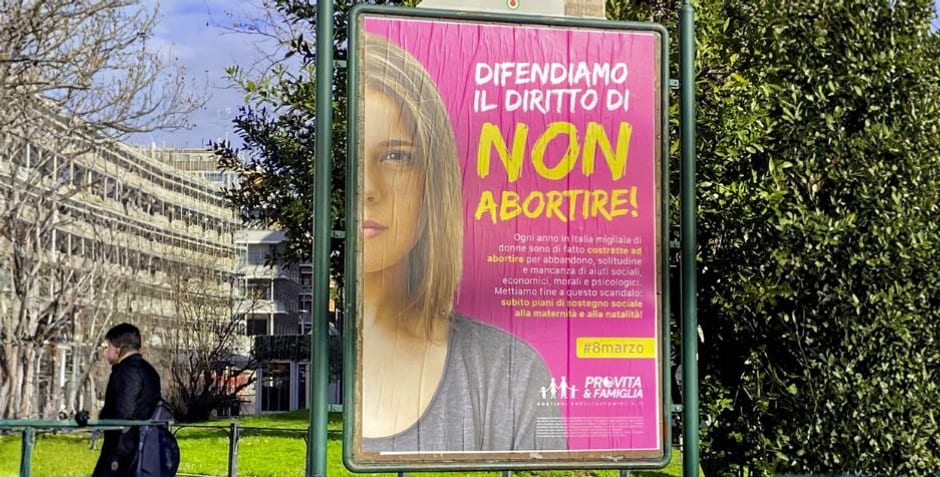
In Rome, posters addressing abortion and gender education did not provoke violence or disturb public order. Even so, they vanished quietly at the stroke of an administrative decision. Their disappearance was not justified by illegality, but by appeals to dignity and institutional neutrality, delivered in the measured language of authority.
The cases brought by the Italian organisation Pro Vita & Famiglia, now pending before the European Court of Human Rights (ECtHR), expose a deeper problem for European democracy: when public authorities decide which views on life and gender may appear in public space, where does legitimate regulation end and the censorship of dissent begin?
By Yeram Jeon, Law student intern.
In Italy, as the saying goes, Rome was not built in a day, and neither was the erosion of freedom of expression. No dramatic prohibition was proclaimed. No overt “Big Brother” appeared. Instead, what emerged was something quieter: routine administrative decisions, procedural language, and an appeal to “neutrality” that gradually silenced certain voices. One such voice, now seeking justice before the European Court of Human Rights, belongs to Pro Vita & Famiglia.
The Facts: Two Poster Campaigns
Pro Vita & Famiglia is an Italian civil-society organisation active in public debates on bioethics, family policy, and education. The organisation has long relied on public posters as a means of conveying its views directly to the public. The present cases arise from two such campaigns, both of which were removed or denied authorisation by the Rome authorities.
“Power to Women? Let Them Be Born”

▲“Power to women? Let them be born!” poster campaign, Rome, March 2022 © Pro Vita & Famiglia
In early March 2022, shortly before International Women’s Day, the organisation displayed posters across Rome bearing the slogan: “Power to women? Let them be born. #8March.” The posters featured the image of an unborn child. Although abortion was not explicitly mentioned, the message conveyed a clear pro-life position by associating women’s empowerment with the protection of unborn girls.
On 4 March 2022, Roma Capitale ordered the immediate removal of the posters. The municipality argued that the message offended women’s dignity and their freedom to choose whether to terminate a pregnancy. Pro Vita & Famiglia challenged the decision before the administrative courts. The Italian courts, however, did not side with the applicants. They all upheld the removal as a lawful exercise of municipal discretion in regulating public advertising space.
“Stop Gender in Schools”

▲“Do not confuse children’s sexual identity. #StopGenderInSchools”
poster campaign, Rome, August 2025 © Pro Vita & Famiglia
The second case concerned a later poster campaign opposing the introduction of gender identity concepts in schools. The posters read: “Do not confuse children’s sexual identity. #StopGenderInSchools.” They depicted a young boy being offered a ribbon and lipstick.
This time, Roma Capitale refused authorization from the outset. The authorities considered that the posters could stigmatize individuals on the basis of sexual orientation or gender identity, particularly given their visibility to minors. Once again, the Italian courts deferred to the municipality’s assessment. In August 2025, the Council of State confirmed the refusal, accepting that the message was capable of producing discriminatory effects even though it contained no insults, threats, or calls to violence.
Domestic remedies have been exhausted in both cases. Applications are currently pending before the European Court of Human Rights, raising issues primarily under Article 10 of the European Convention on Human Rights (freedom of expression), as well as under Articles 9 (freedom of thought, conscience and religion) and 14 (prohibition of discrimination).
Legitimate Regulation or Censorship of Opinion?
The Courts’ Reasoning: Neutral Regulation of Public Space
In both poster cases, the Italian authorities justified their actions as a form of neutral regulation. Public billboards, they argued, are not open forums for free expression but a public service administered by public authorities. As such, they may be subject to content-based control in order to protect dignity, prevent discrimination, and ensure institutional neutrality.
The Italian administrative courts endorsed this reasoning. They accepted that posters perceived as offensive or potentially stigmatising could be excluded from public space, particularly where minors might be exposed. The removal and refusal of the posters were therefore treated not as restrictions on freedom of expression, but as ordinary exercises of municipal discretion in managing public advertising space.
At first glance, this approach appears measured. It presents the State not as a censor, but as a neutral administrator entrusted with balancing competing interests in public space.
The Legal Error: From Regulation to Control of Opinion
The difficulty lies not in the legitimacy of regulating public space as such, but in how that power was exercised. By permitting public authorities to exclude messages on the basis of their perceived meaning or social impact, the courts converted regulation into content-based selection.
Under the European Convention on Human Rights, neutrality has a specific legal meaning. It does not empower the State to decide which moral, philosophical, or political views deserve public visibility. Rather, neutrality requires restraint. As the European Court of Human Rights has consistently held, freedom of expression applies not only to information or ideas that are favourably received, but also to those that “offend, shock or disturb”[1].
Once public authorities begin filtering viewpoints according to acceptability or discomfort, they cease to act as neutral regulators and assume the role of arbiters of opinion. This shift is incompatible with Article 10 of the Convention, which requires that any restriction respond to a “pressing social need” and be supported by “relevant and sufficient reasons.”
In the present cases, that threshold was not met. The posters contained no insults, no threats, and no calls to violence. They expressed conservative positions on abortion and education, rooted in moral and religious conviction, yet remained within the bounds of lawful public debate.
Offence Is Not Harm: Dignity and the Threshold for Restriction
The central justification relied upon by the Italian authorities was the protection of dignity. In the first case, this concerned women’s dignity in relation to abortion. In the second, it concerned the dignity of vulnerable groups and minors in the educational context. In both instances, dignity was treated as sufficient grounds for intervention.
What the judgments did not establish, however, was any concrete harm. There was no evidence of incitement to violence, no promotion of hatred, and no interference with the rights of identifiable individuals. No specific victim claimed injury. The restrictions were grounded primarily in the assessment that the messages were offensive or disturbing.
The European Court of Human Rights has repeatedly distinguished offence from harm. As it stated in Handyside v. the United Kingdom, freedom of expression protects ideas that “offend, shock or disturb”, because such protection is essential to the functioning of a democratic society[1]. Without this principle, freedom of expression would extend only to ideas that are comfortable or widely accepted.
Restrictions based on dignity therefore require careful justification. They cannot rest on abstract discomfort or speculative assumptions. The decisive question is not whether a message causes offence, but whether restricting it is necessary to prevent concrete harm. As the Court has explained, limitations must be proportionate and must address a real and pressing social need, not a general desire to avoid controversy[2].
In Van den Dungen v. Germany, for example, the Court accepted restrictions where expression directly interfered with the rights of others by obstructing access to medical services [3]. The Pro Vita & Famiglia poster campaigns did not do this. They addressed the public at large and did not interfere with anyone’s daily activities. Preventing discomfort is not the same as preventing harm, and the Convention draws a clear line between the two.
Freedom to Manifest Belief in Public
Beyond freedom of expression, the cases also engage Article 9 of the Convention, which protects freedom of thought, conscience, and religion, including the right to manifest one’s beliefs. The messages at issue were not merely political slogans. They reflected moral positions rooted in religious conviction, concerning the value of human life and the moral framework within which children are educated.
As the European Court of Human Rights stated in Kokkinakis v. Greece, freedom of belief is “one of the foundations of a democratic society”[4]. This protection would be largely illusory if religiously motivated expression could be excluded from public space whenever it provokes discomfort or disagreement.
In the present cases, the posters were peaceful and non-violent. They did not target identifiable individuals, nor did they seek to harass or intimidate. They expressed a religiously informed moral viewpoint addressed to the public at large. Excluding such expression from public space therefore amounts not only to a restriction on speech, but also to a limitation on the public manifestation of religious conviction.
Strasbourg case-law confirms that expression motivated by moral or religious conviction does not lose Convention protection merely because it is controversial. In Annen v. Germany, the applicant advanced an explicitly anti-abortion message grounded in moral conviction, using provocative historical analogies. While acknowledging the offensive nature of the campaign, the Court held that offence alone was insufficient to justify suppression, emphasising the absence of incitement to violence or concrete harm[5].
The same principle applies irrespective of whether the moral position expressed is religious or secular. In Women on Waves v. Portugal, the Court protected expression advocating access to abortion, reaffirming that public debate on profound moral questions must remain open even where views sharply diverge[6].
Against this background, the Italian cases are difficult to reconcile with Convention standards. The Rome posters were markedly less confrontational than the expression protected in Annen, yet they were excluded from public space without evidence of concrete harm.
Public Information or Public Preference?
The imbalance in the present cases becomes clearer when compared with how pro-abortion messaging has been treated by Italian public authorities. On 5 March 2025, la Repubblica reported on a television spot broadcast by RAI in cooperation with Pubblicità Progresso to mark the anniversary of Law 194[7]. The message presented abortion as a lawful medical service guaranteed by the Italian legal order and emphasised women’s right to access it.
Pro-life organisations criticised the broadcast as one-sided. RAI and the campaign’s promoters rejected those criticisms, defending the spot as a legitimate public-information initiative consistent with the broadcaster’s public-service mandate. No alarms were raised about dignity or institutional neutrality. No warnings were issued about exposing minors to sensitive content. No restrictions followed.
Placed alongside this, the fate of Pro Vita & Famiglia’s posters looks starkly different. Their messages were removed or blocked before appearing at all, not because they were unlawful or aggressive, but because they were deemed capable of offending or stigmatising. One viewpoint was welcomed into the public sphere under the banner of information. The other was quietly pushed out.
Neutrality, however, cannot mean an open door for one side of a deeply contested moral debate and a closed one for the other. When authorities tolerate and defend pro-choice messaging while suppressing peaceful dissent, regulation begins to resemble selection. It is this uneven treatment that casts serious doubt on the compatibility of the measures taken against Pro Vita & Famiglia with freedom of expression under Article 10 of the Convention.
Question for Strasbourg and for Europe
Over the past eight years, Pro Vita & Famiglia has been the subject of at least eleven formal measures adopted by local administrations across Italy, including removals, refusals of authorisation, fines, and obscuration orders. In many instances, authorities relied on broadly worded provisions originally designed to regulate commercial advertising, extending them to social and ideological campaigns. Several proceedings remain pending before administrative courts, and recent judgments have confirmed earlier removals. The present applications therefore arise within a wider pattern of administrative intervention in campaigns addressing abortion, surrogacy, and gender education.
The Pro Vita & Famiglia cases now place a clear question before the European Court of Human Rights. Freedom of expression is not designed to protect the public from offence, but to guard against the silent exclusion of dissent from public debate. The aim of freedom of expression is not to shield citizens from offence, but to prevent the quiet suppression of dissenting views.
The task before Strasbourg is therefore not merely to decide whether Italy regulated public space lawfully. It is to determine whether, under the language of dignity and neutrality, the State crossed the line from regulation into control of opinion. On that answer depends not only the fate of two poster campaigns, but the integrity of public debate in a democratic Europe.
References:
[1] Handyside v. the United Kingdom, no. 5493/72, Judgment of 7 December 1976.
[2] Sunday Times v. the United Kingdom (No. 1), ECtHR, Judgment of 26 April 1979.
[3] Van den Dungen v. Germany, ECtHR, Judgment of 22 October 2013.
[4] Kokkinakis v. Greece, ECtHR, Judgment of 25 May 1993.
[5] Annen v. Germany, ECtHR, Judgment of 26 November 2015.
[6] Women on Waves v. Portugal, ECtHR, Judgment of 3 February 2009.
[7] la Repubblica (Torino), “Antiabortisti contro la pubblicità progresso sulla legge 194 trasmessa dalla Rai”, 5 March 2025.
SIGNATURES






 Le contrôle de l’informationPar ECLJ
.jpg) Pakistan: Alerte sur la peine de mort pour blasphème contre l’islamPar Constance Avenel
Pakistan: Alerte sur la peine de mort pour blasphème contre l’islamPar Constance Avenel Prosélytisme : la Bulgarie condamnéePar Nicolas Bauer
 La Suède abandonne le terme «islamophobie»Par Youssef Ayed