
Syria's return to the international community must not obscure the reality on the ground. While diplomatic relations with Damascus are being restored and reconstruction is already attracting considerable interest, transitional justice remains incomplete, political institutions remain insufficiently inclusive, and Christians continue to leave the country. These are among the challenges examined by the European Centre for Law and Justice (ECLJ) in its submission of 16 July 2026 to the United Nations for Syria's Universal Periodic Review.
A year and a half after the fall of Bashar al-Assad in December 2024, Syria is rapidly returning to the international stage. In May 2026, the European Union restored its cooperation agreement with Syria, launched a high-level political dialogue with the new authorities, and intensified official contacts, notably during the visit of its Special Representative for Human Rights, Kajsa Ollongren, on 15–16 June 2026. French President Emmanuel Macron subsequently travelled to Damascus on 6–7 July 2026, becoming the first European head of state to visit Syria since the fall of the regime.
This rapprochement reflects a genuine necessity. After fourteen years of war, no one wishes to see Syria descend into chaos again. The country must rebuild its housing, infrastructure, public services and economy. Foreign companies are already positioning themselves in what the World Bank estimates to be a reconstruction market worth at least US$216 billion. Yet the diplomatic normalization of the new authorities is progressing far more rapidly than the country's stabilization.
Normalization Without Stability, Security or Justice
Transforming a coalition of Islamist armed groups into an inclusive state governed by the rule of law appears, at this stage, almost impossible. Syria remains fragmented by insufficiently controlled armed factions, terrorist attacks, revenge killings, and deep communal tensions. The bombing of a café in Damascus on 2 July 2026, attacks carried out during President Macron's visit, and the continuation of U.S. military operations against Islamic State cells all demonstrate that security remains extremely fragile.
The gradual removal of public subsidies, economic liberalization, the collapse of the Syrian pound and rising electricity prices have further impoverished the population. More than thirteen million Syrians are currently experiencing acute food insecurity. In the absence of a coherent economic strategy, public discontent continues to grow, and many Syrians still struggle to access basic goods and services.
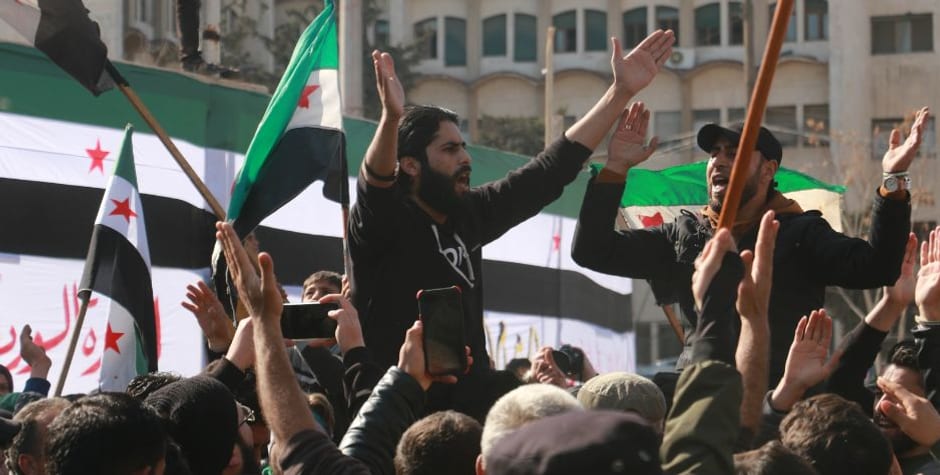
Since June 2026, demonstrators have called for those responsible for crimes committed under the Assad regime to be brought to justice. Following its mission to Syria from 1 to 7 July 2026, the United Nations Commission of Inquiry nevertheless warned against the risks of selective transitional justice. While welcoming the first prosecutions of former regime officials, it also called for impartial investigations into the massacres of Alawite civilians on Syria's coast and the violence committed against Druze communities in Suwayda. Without an independent and impartial justice system, Syria risks replacing yesterday's impunity with a new cycle of revenge.
A Political Transition That Remains Insufficiently Inclusive
These institutional shortcomings are equally apparent in the organisation of the new political system. In October 2025, around 7,000 members of electoral colleges appointed by the new authorities elected 140 members of parliament, representing two-thirds of Syria's first post-Assad legislature. The remaining 70 seats were filled through direct appointments by interim President Ahmed al-Sharaa. The full composition of Parliament was not announced until 1 July 2026—eight months behind schedule—and it held its inaugural session on 12 July.
Largely controlled by Ahmed al-Sharaa, this Parliament reflects neither Syria's political diversity nor its ethnic and religious pluralism. The indirect electoral process excluded several parts of the country, including the Autonomous Administration of North and East Syria (AANES) and much of Suwayda Governorate. Kurdish political leaders and Assyrian organisations have denounced their exclusion from the appointment process, which effectively deprives them of meaningful representation in the new legislature.
The new authorities have also paid particular attention to their image among Christian communities, whose situation continues to be closely monitored by Western governments. In this context, Hind Kabawat, a Christian, was appointed Minister of Social Affairs and Labour in March 2025. Jihad Makdissi, a Christian from Damascus and former diplomat who defected from the Assad regime in 2012, became adviser for U.S. affairs in June 2026. Nevertheless, the key centres of political, military and security power remain dominated by close associates of Ahmed al-Sharaa originating from Idlib Province—a phenomenon increasingly described as the "Idlibization" of Syria's governing elite.
The Future of Christians in Syria at Stake
Against this backdrop, only an estimated 300,000 to 500,000 Christians remain in Syria, compared with nearly two million before the outbreak of the civil war in 2011. Churches remain open and religious services continue to be celebrated. Nevertheless, the suicide bombing of the Greek Orthodox Mar Elias Church in Damascus on 22 June 2025, which killed 25 people and injured 63 others, revived deep concerns about the security of Christian communities. A few months later, following the attack on the Christian town of Sqaylabiyah on 27 March 2026, Syria's churches cancelled Palm Sunday processions, Scout parades and other public Holy Week and Easter celebrations.
Present in Syria since the earliest days of Christianity, Christians seek no privileged status, but simply equal participation in national life. They nevertheless face growing social pressure: Islamist preaching in Christian neighbourhoods, the gradual Islamization of certain public policies and school curricula, restrictions on alcohol, and rhetoric portraying Christians as fouloul—supporters of the former regime. Many also observe an increasing salafization of Syrian society, modelled on policies previously implemented in Idlib Province.
Beyond discrimination itself, the very survival of Christianity in Syria is now at stake. Christian schools are becoming increasingly vulnerable, families in exile continue to lose their property, and terrorist attacks, violence, kidnappings and widespread impunity have fostered a profound sense of abandonment. Emigration continues unabated, weakening both the churches themselves and Syria's historic religious pluralism. Protecting freedom of worship alone is therefore no longer sufficient. Political, legal, security and economic conditions must be established that allow Christians to remain permanently in their homeland.
The true measure of Syria's transition will not be the reopening of embassies or the signing of reconstruction contracts. In its submission to the United Nations for Syria's Universal Periodic Review, the European Centre for Law and Justice recalls that the new authorities must guarantee equal citizenship for all, ensure impartial justice, protect religious communities, and preserve the pluralism that has long been one of Syria's greatest strengths.





 France: The Church's Suffering & HopeBy Grégor Puppinck
 China: Pastor Cao Must Come HomeBy ECLJ
 Tunisia: Christians Facing Kais Saied’s Identity-Driven ShiftBy Constance Avenel
 The EU Condemns the Systematic Persecution of Christians in PakistanBy Thibault van den Bossche